

Re: Three myths about AI we keep seeing in books and movies
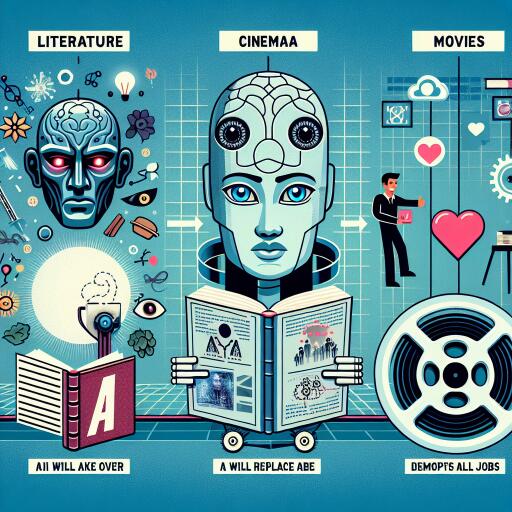
Books and movies have trained us to expect artificial intelligence to behave like a quirky sidekick, a soulless copycat, or an unstoppable villain. Entertaining? Absolutely. Useful for the real world we’re building with AI? Not so much. If you’re making strategic decisions about technology, security, or creative work, it’s time to separate cinematic myth from operational reality.
Myth 1: “AI can’t be creative”
The idea that AI is just “autocomplete on steroids” misses what modern systems demonstrably do. Consider AlphaGo: by playing millions of games against itself, it surfaced novel strategies in Go that surprised the world’s best human players—moves widely described as creative because they were effective, unorthodox, and previously unseen. In generative media, high‑quality AI output increasingly passes casual inspection; judges and audiences have been fooled by AI-produced imagery and prose in various contests. We’re very good at spotting the bad examples. The good ones are harder to call.
It helps to break creativity into components where machines are already strong—and one where we still don’t have a scientific handle:
- Recombination: Merging disparate ideas into something meaningfully new. AIs excel here because they can ingest vast corpora and synthesize across domains at scales we can’t.
- Projection: Extrapolating trends and building plausible futures. Given patterns, AIs can iterate scenarios rapidly and consistently.
- Stochastic exploration: Leveraging randomness to escape ruts and discover fresh angles. Generative models use sampling to surface diverse, surprising outputs.
- The ineffable: Call it the spiritual, mystical, or soul-driven spark. We don’t have a rigorous definition for it in humans, let alone a test for it in machines.
If you create for a living, the takeaway isn’t “AI can’t do my job.” It’s “my edge can’t just be efficiency or format.” Competing head‑on with automation is a losing proposition; differentiating on human voice, lived experience, taste, and ethics is not. In practice, that means:
- Provenance and trust: Use content credentials and provenance frameworks (for example, C2PA-style metadata) to signal what’s human-made and how AI was used.
- Editorial judgment: Curate, critique, and contextualize. The value is not just in generating, but in deciding what matters and why.
- Community and brand: Build relationships, not just deliverables. People follow people; they remember perspective, not prompts.
Myth 2: “AI will destroy humanity”
Pop culture loves an AI villain with a singular obsession: eliminate humans. Existential risk isn’t a punchline, and serious researchers do model catastrophic scenarios. But the most immediate, measurable risks look a lot more like familiar cybersecurity problems at new scale: automated phishing, deepfake-enabled fraud, malware co‑pilots, model exfiltration, data poisoning, unsafe bioinformation, and information operations that erode trust.
We don’t “overpower” powerful technologies by standing in front of them. We govern them. Nuclear safety doesn’t rely on bravado—it relies on treaties, monitoring, audits, and controls. AI will be no different. The practical defense-in-depth we’re building now includes:
- Oversight AIs: Specialized models that monitor other models, flag unsafe behavior, enforce policy, and provide real-time guardrails.
- Red teaming and evaluations: Systematic stress-tests for deception, jailbreaks, data leakage, cyber abuse, and emergent capability.
- Interpretability research: Mapping internal features and circuits to human-understandable concepts to spot risky behaviors early. Think less “mind reading” and more “instrumentation for complex systems.”
- Compute and access controls: Rate limiting, identity and key management, sandboxing, and isolation for inference and fine-tuning workloads.
- Provenance and authenticity: Watermarking, cryptographic content credentials, and detection networks to combat AI-driven fraud and disinformation.
- Governance and law: Incident reporting, safety standards, export controls, and international cooperation to curb misuse by criminal groups and hostile states.
As for resource competition—another sci‑fi staple—there’s little reason to assume zero-sum conflict. Energy and compute can expand beyond terrestrial constraints, and industry players are exploring space-adjacent architectures and edge deployments that tap abundant solar power and extreme cooling environments. The more realistic threat horizon is not a machine deciding to wipe us out; it’s people using AI to scale harm unless we build and enforce strong guardrails.
Myth 3: “We’ll recognize sentient AI when we see it”
In films, a few witty lines tip us off: the machine “wakes up,” announces itself, and the plot begins. Reality is murkier because we don’t have a crisp, testable definition of sentience even for ourselves. Today’s large language models can convincingly emulate conversation without having persistent selves. Behind the scenes, your chat may be handled by different, short‑lived processes across a cluster; instances spin up and down per request. Consciousness—if it ever applies—wouldn’t map neatly onto this ephemeral, distributed architecture.
Behavior alone can be misleading. A model trained on human dialogue can simulate introspection; that doesn’t settle the question. The scientific path forward likely blends behavioral tests, interpretability advances, and rigorous operational definitions. Until then, “I’ll know it when I see it” is a poor guide for policy. Designing rights, responsibilities, and controls around ambiguous sentience claims is a recipe for confusion—and a distraction from the here-and-now risks we can measure and mitigate.
What this means for builders, defenders, and creators
Getting past myths isn’t just an intellectual exercise—it’s operational hygiene.
- For security teams: Treat AI as both tool and target. Build model threat models, monitor for prompt injection and data leakage, protect training data, and assume adversaries have AI co‑pilots. Log, label, and version everything.
- For executives: Align AI initiatives with governance early. Establish acceptable use, human-in-the-loop checkpoints, model inventories, and incident response playbooks that include AI-specific failure modes.
- For creators: Use AI to extend your range, not replace your voice. Be transparent about your process, secure your assets, and lean into what only you can bring—taste, context, and connection.
- For the public sector: Fund safety research, standardize evaluations, and coordinate internationally on misuse. We already know how to build oversight regimes for powerful technologies; apply that muscle memory.
The real world rarely follows a blockbuster script. AI can be startlingly inventive without being mystical; it can be dangerous without being apocalyptic; and it can be persuasive without being conscious. If we invest in controls, insist on provenance, and keep our human advantages in play, we’ll make better products, safer systems, and—ironically—more interesting stories than anything Hollywood keeps recycling.