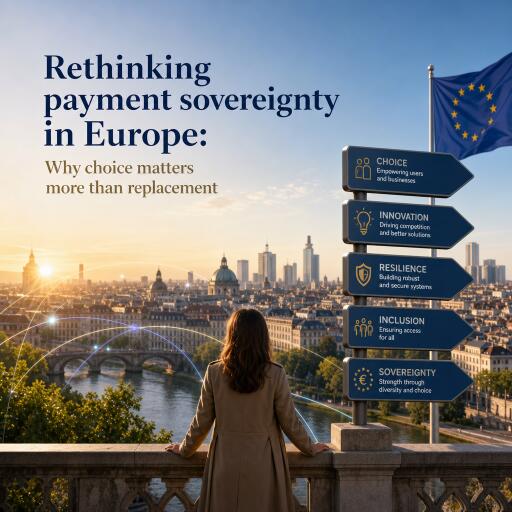

Rethinking payment sovereignty in Europe: Why choice matters more than replacement
In virtual economies and real life markets alike, money flows through an invisible spine. Every card tap, wallet scan, or phone tap sets off a cascade of networks, banks, and processors that move value and data in seconds.
This seamless experience has a side effect: a handful of global rails now carry the majority of digital payments across Europe. Their scale is the result of decades of investment, trust, and network effects. But it also raises a critical question: if Europe wants a payments landscape that is more resilient and offers real choices, how can alternatives realistically emerge in a market dominated by such traction?
At the core is the idea of payment sovereignty. The question isn’t whether the current system works—it does. It’s whether Europe is taking the right steps to ensure payments infrastructure evolves in step with economic goals and regulatory aims.
The machinery behind everyday payments is a web of fees and processes that move funds between banks and payment providers. The most visible piece is the interchange fee charged by the cardholder’s bank when a transaction is processed. Merchants pay this as part of their service costs, and even small percentages compound into meaningful totals over time.
Regulators began addressing the market’s structural nature in 2015 by capping these interchange fees for consumer cards. After Brexit, the UK retained similar caps. Yet impact varied: smaller issuers and acquirers, who depended on interchange margins, bore much of the pressure. The card networks responded by diversifying into scheme fees, tokenization, fraud services, data analytics, and cross-border processing, sometimes introducing new fee categories that widened the cost palette.
That shift matters because it illustrates a broader truth: targeting a single visible fee does not dismantle the underlying structure. The cap was meaningful, but it did not reduce Europe’s dependence on two dominant networks.
Is there a truly competitive alternative that can steer pricing, access, and innovation toward consumers and the wider economy? That is the fundamental question facing policymakers, fintechs, and banks alike.
Open banking has offered a glimpse of what a more diverse payments ecosystem could look like. Europe’s framework pushes banks to share data and lets fintechs plug into standardized interfaces. The promise: more players, more competition, and better, more tailored experiences. Yet the transition remains unfinished, with integration challenges, uneven uptake, and a need for stronger trust rails and consumer protections to reach scale.
As the conversation shifts from “how much does a card cost” to “how many rails exist and how well they work together,” Europe should think beyond wholesale replacement. The goal should be a mixed ecosystem that offers both legacy compatibility and compelling new options — a design intent that serves public aims: lower costs for merchants, faster settlement, stronger fraud controls, and broader access for small players and underserved regions.
That means practical steps: encourage interoperable, open standards that reduce connection costs for new entrants; support a spectrum of rails — some centralized for speed, some distributed for resilience and specialization; and create policy environments that reward reliability and user experience over sheer scale. Public-private collaboration, sandbox environments, and procurement models can test and accelerate resilient, user-centric designs.
Crucially, sovereignty does not require a single replacement. A layered approach, where legacy networks remain usable while new rails offer meaningful alternatives, would unlock true choice. That approach could stabilize payments during outages, expand instant settlements for on-demand work, and tailor cross-border services to regional needs.
In gaming terms, Europe’s payment landscape is a live patch ready for a new class: more players, more roles, and more ways for value to move. The aim is not to erase the old systems but to enrich the field so different strategies can thrive side by side, each driven to improve security, speed, and user experience.
The bottom line: the challenge is to design a framework that preserves capability while inviting diverse, high-quality payment paths. If Europe leans into this approach, it can safeguard sovereignty, spur innovation, and restore genuine choice for how people pay and get paid.