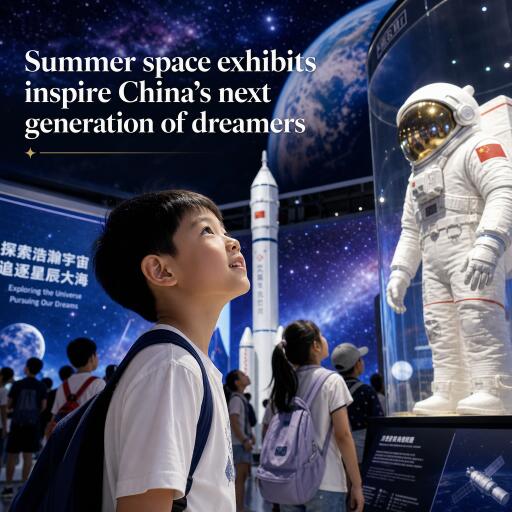

Summer space exhibits inspire China’s next generation of dreamers
Under the glow of a silvery “moonrise” and the hum of excited chatter, a seasonal exhibition at the China Science and Technology Museum is turning summer break into a launch window for young imaginations. The showcase blends real aerospace artifacts with an ambitious virtual reality trip that propels visitors to a concept lunar base in 2049—inviting them to walk, look, and learn like future explorers.
On a recent afternoon, an 11-year-old from Hebei slipped off his headset and lingered by the exit, still mentally adrift on the lunar surface. He described the scene not as a game, but as a place—one he hopes to visit for real someday. For many families, that’s the point: use immersion to move spaceflight from abstract headlines into lived experience.
This exhibition pairs headline-grabbing tech with tangible proof of progress. Among the showpieces are flight-adjacent hardware and materials: a backup of the national flag designed for lunar deployment during the 2020 Chang’e-5 mission, a sample of a high-performance alloy informally known as “Chang’e steel,” and a commercial rocket engine that underscores how the country’s space industry now spans public and private frontiers. These physical artifacts ground the virtual tour, reminding visitors that today’s simulations are tethered to real engineering milestones.
The VR component is the clear crowd magnet. Rather than offering arcade thrills, it positions visitors as researchers and team members en route to a moon outpost, emphasizing cooperation, procedure, and the patient cadence of science. The design is didactic without feeling didactic—an elegant trick—and draws from the best instincts of modern game design: onboarding that’s gentle, goals that are legible, feedback that’s immediate, and enough spectacle to leave a memory trace long after the headset comes off.
Parents, too, are visibly swept up in the moment. One father, watching his son take that first virtual step off a lander ramp, reflected on how far access to space knowledge has come. As a child he knew the names—Long March rockets, the nation’s early orbital successes—and remembers the pride of seeing Yang Liwei’s historic flight in 2003. But learning about space then meant scanning newspapers and catching fleeting TV segments. Now, he said, kids can “touch” the program, toggling between museum floors and simulated moonscapes in a single afternoon.
This shift mirrors a broader evolution in science education. The old model—read, memorize, test—has given way to experiences that prioritize feeling and agency. Immersive tools like VR and AR don’t just tell students what happened; they put them in a position to ask what might happen next. In that mode, the brain treats the lesson like a lived event, which is why so many children come away describing the sensation of distance, silence, and scale as if they had truly been there.
From a design perspective, the exhibition’s 2049 setting plays a clever narrative role. By projecting a plausible near-future, the simulation keeps its feet in reality while widening the horizon of possibility. It’s aspirational, not fantastical—a critical distinction for educational VR, where the line between inspiration and make-believe determines how seriously young visitors take the experience. The hardware showcase then closes the loop, translating imagined futures into present-tense components and materials.
For museums, this hybrid formula is fast becoming a best practice. Static displays provide authenticity; immersive layers deliver empathy and presence. Together they form a feedback cycle familiar to anyone who loves simulation games: learn a concept, try it, reflect, then return with better questions. That loop is addictive in the best sense, and it’s why families are seeking out science venues as a meaningful alternative to typical summer entertainment.
None of this replaces textbooks or the discipline of math and physics. But as on-ramps go, it’s hard to beat a guided “walk” on the moon followed by a face-to-face look at the hardware that made a real lunar sample-return mission possible. The experience reframes study as preparation rather than obligation, a subtle psychological shift that can set a student’s trajectory for years.
As the day wound down, kids compared notes about the base layout, the look of the regolith, and the eerie calm of a world without weather. Parents swapped photos and plans to come back with friends. Between the vitrines and the headsets, the message landed: the space age isn’t some distant broadcast. It’s a place you can step into—and, with enough curiosity and effort, help build.
That’s the summer promise of exhibits like this. They don’t just celebrate milestones; they recruit dreamers. And if the long line for the next VR session is any indication, the next generation is already queuing for the journey.