
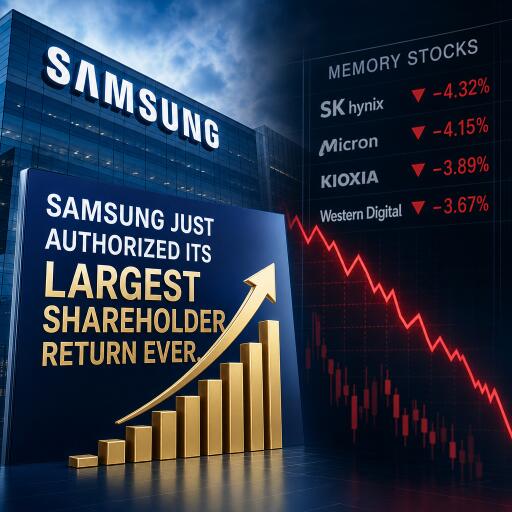

Samsung Just Authorized Its Largest Shareholder Return Ever. Every Major Memory Stock Fell Monday.
Samsung Electronics’ board unveiled a plan for 2026 that targets a total return to shareholders in the 90 trillion to 110 trillion won range (roughly $65 billion to $80 billion). If realized, this would top the company’s previous record around 20 trillion won set in 2020 and would stand as the largest such payout ever issued by a Korean corporation.
The justification for a plan of this magnitude rests on the memory division’s current strength. In the latest quarterly report, operating profit surged dramatically year over year, driven by sustained demand for AI-oriented memory products and related chips.
Market reactions were swift once the details became public. Samsung’s stock tumbled about 8.7% on Monday, while the benchmark Kospi index declined by more than 3% as investors digested the plan and its implications.
Memory-sector peers also moved lower in sympathy. SanDisk, Micron Technology, Seagate Technology, Western Digital, and SK Hynix all traded down after the news, highlighting how widespread sentiment across memory equities shifted in response to the announcement.
Interest in a payout that large did not translate into immediate enthusiasm, in part because expectations had ranged higher. Some industry observers had floated a ceiling near 150 trillion won, and the plan as announced comes with a staged structure rather than an upfront, fully specified program. It begins with roughly 30 trillion won in cash dividends slated for the third quarter and includes a pledge to return half of the free cash flow generated from 2024 through 2026.
Many investors wanted more details on buybacks and share cancellations right away. Those particulars are scheduled to be finalized at a January board meeting after the full-year 2026 results are in, leaving some market participants wary of committing to a timetable that hinges on future performance.
In a related development, SK Hynix disclosed a 40 trillion won buyback initiative the previous week, with the intention that repurchased shares would be cancelled. Its stock reaction was more muted than Samsung’s on Monday, underscoring how the market views the certainty of share cancellations as a stronger signal than a deferred cash plan.
Beyond company-specific factors, broader financial conditions also weighed on sentiment. A shift higher in long-term interest rates has been a drag on equities globally, with benchmark yields rising to levels not seen in years and contributing to a cautious mood in risk assets, including technology and memory names.
Looking ahead, the path from promise to tangible returns will depend on actual 2026 results and the precise mechanics the company adopts for buybacks and capitalization actions. Investors will be watching closely as the year closes and as management outlines the February-to-January timetable for implementing the program and delivering the stated commitments to shareholders.