
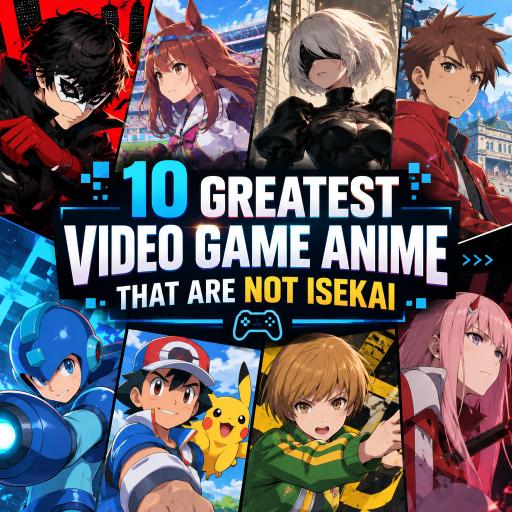

10 Greatest Video Game Anime That Are Not Isekai
Anime inspired by video games does not always need to transport its hero into another dimension. Some series portray gaming as a hobby, a professional sport or a social space, while others build RPG mechanics directly into their native fantasy settings. From virtual-reality adventures to level-based power systems, these ten shows capture the appeal of gaming without relying on the familiar isekai formula.
10. The Recovery of an MMO Junkie
After leaving an exhausting corporate career, Moriko Morioka withdraws from society and devotes her time to the MMORPG Fruits de Mer. Behind her male avatar, she forms a meaningful friendship that gradually crosses into her offline life.
The game provides more than colorful quests and battles: it gives Moriko a comfortable way to reconnect with people. Because everyone remains firmly rooted in modern Japan, the series is best understood as a romantic comedy about burnout, identity and online companionship.
9. Chio’s School Road
Chio Miyamo has played so many PC games that she begins treating her daily commute like a virtual mission. Blocked roads become platforming challenges, rooftops resemble stealth routes and minor social problems feel like dangerous encounters.
Nothing supernatural is happening. Chio is simply an imaginative gamer whose questionable strategies turn an ordinary walk to school into chaotic comedy. Its exaggerated gaming references make the series especially relatable to players who have ever viewed reality through the logic of their favorite title.
8. Shangri-La Frontier
Rakuro Hizutome specializes in completing notoriously broken games. When he finally enters the polished VR phenomenon Shangri-La Frontier, his unusual experience helps him discover hidden encounters and unconventional solutions.
Rakuro is never imprisoned inside the software and can remove his headset whenever he wants. The anime instead celebrates experimentation, difficult bosses, multiplayer communities and the thrill of mastering complicated systems. His victories feel satisfying because they come from practice and curiosity rather than effortless power.
7. The King’s Avatar
Former esports champion Ye Xiu must begin again after being pushed out of his professional team. Returning to the online game Glory, he uses years of knowledge to create a new character, recruit allies and prove that his competitive career is far from finished.
The series approaches esports as a demanding profession shaped by tactics, teamwork and commercial pressure. Ye Xiu succeeds through technical understanding and experience, making this a compelling comeback story rather than an alternate-world adventure.
6. Accel World
Haruyuki Arita is an isolated student who finds confidence in digital spaces. His life changes when he gains access to Brain Burst, an augmented-reality fighting program that accelerates the user’s perception of time.
Although its duels are spectacular, Brain Burst remains connected to the characters’ everyday surroundings and personal anxieties. Defeat can cost players access to the program and erase their memories of it, giving each match consequences beyond rankings. The virtual competition becomes a reflection of insecurity, friendship and bullying.
5. Deca-Dence
At first, Deca-Dence appears to follow the last human survivors fighting monsters from a mobile fortress. Its central revelation transforms that premise: the conflict is part of a vast entertainment operation managed like a commercial game.
Quests, scores, avatars and system maintenance conceal an exploitative structure in which genuine lives are treated as disposable content. That twist allows the anime to examine corporate control and manufactured entertainment while delivering energetic action and sharply contrasting visual styles.
4. Is It Wrong to Try to Pick Up Girls in a Dungeon?
Orario is a fantasy city where gods grant adventurers status sheets that track attributes, skills and levels. Beneath the city lies the Dungeon, a dangerous labyrinth filled with monsters, valuable drops and opportunities for advancement.
Bell Cranel starts as an inexperienced fighter and must earn his growth encounter by encounter. Despite its RPG framework, the show is not isekai: Bell was born in this world, and its mechanics are part of the setting’s natural order. His gradual development gives the series the satisfying rhythm of a long fantasy campaign.
3. The Villager of Level 999
In a society that judges people according to RPG-style classes, Villagers are assumed to be permanently weak. Koji Kagami overturns that belief by defeating monsters until he reaches the astonishing level of 999.
Koji is neither reincarnated nor summoned. He belongs to this fantasy world and has mastered its rules through his own efforts. His practical priorities and disregard for heroic traditions also let the story question a hierarchy that confuses assigned roles with actual ability.
2. Solo Leveling
Sung Jinwoo begins as a notoriously fragile hunter in a modern world threatened by magical gates. After surviving a deadly dungeon, he receives access to a mysterious interface that lets him complete quests, improve statistics and gain levels.
Unlike the people around him, Jinwoo can continually increase his strength. This creates an addictive progression loop reminiscent of an action RPG, complete with rewards, inventory management and escalating boss fights. The setting remains his own world, however, making his transformation a supernatural awakening rather than an isekai journey.
1. BOFURI: I Don’t Want to Get Hurt, So I’ll Max Out My Defense
New player Kaede Honjo enters a virtual-reality MMO as Maple and pours every available point into defense because she wants to avoid pain. Her innocent decisions unexpectedly produce an absurdly powerful build, forcing the game’s developers to repeatedly reconsider its balance.
BOFURI embraces the playful side of online gaming. Maple can safely log out, avatar deaths carry no real-world danger and her adventures are shared with friends. Instead of manufacturing grim stakes, the anime finds joy in strange character builds, guild events, exploration and the delightful chaos players can create inside a game.