
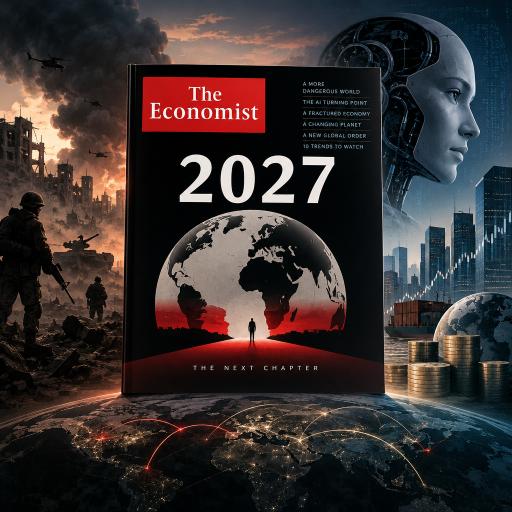

The Economist’s 2027 Cover Explained, What Its Images of War, AI and the Economy Mean, According to the Editor’s 10 Key Trends
The Economist’s 2027 cover presents a stark collage of missiles, tanks, robots, medicine, financial charts, rockets and a brain built from electronic circuits. Its red, black and white design looks almost like a science-fiction poster, but the message is less a prediction than a map of the risks and transformations that could define the year ahead.
The artwork is connected to The World Ahead 2027, the publication’s annual outlook on global politics, technology, economics, climate and culture. Rather than confirming that a specific disaster will occur, the cover groups together ten major issues that deserve attention.
1. Trump and the Next U.S. Political Cycle
Donald Trump remains central to the political outlook for 2027. His use of executive power, ongoing legal disputes and influence over the Republican Party could shape both domestic policy and international relations.
The larger question is what happens after the current political phase. As the next U.S. election cycle begins to take form, decisions made during 2027 may influence the candidates, alliances and disputes that follow.
2. War, Iran and the Global Cost of Conflict
The military hardware on the cover points to continuing international tensions, particularly in the Middle East. Any prolonged conflict involving Iran could affect energy supplies, diplomatic relationships and global trade.
The consequences would not stop at the fuel pump. Disruption to fertilizer production or transport could raise agricultural costs and eventually affect food prices in countries far from the battlefield.
3. A Hotter Climate
Burning landscapes and damaged vegetation suggest another major concern: climate change. A strong El Niño pattern could contribute to record temperatures, droughts, wildfires and more frequent extreme weather.
The cover also links climate policy with energy security. Renewable power is not only a response to global warming; it can also reduce dependence on fuel markets vulnerable to wars and political shocks.
4. Artificial Intelligence and Financial Fragility
The circuit-board brain is one of the clearest references to artificial intelligence. Investment in AI infrastructure continues to grow, but companies may be relying on increasingly complex financing and debt to maintain that expansion.
If expectations become detached from earnings, markets could face a sharp correction. AI also presents non-financial risks, including more sophisticated cyberattacks and new conflicts over access to chips, data and computing power.
Other debates remain unsettled, including AI’s effect on employment and the energy and water consumed by data centers. The cover reflects these uncertainties rather than offering a definitive answer.
5. Europe and Populism
European politics could enter a decisive period in 2027, with France at the center of attention. A major shift in French leadership would have consequences for the country’s relationship with Germany and for the direction of the European Union.
Questions surrounding immigration, economic policy, defense and European integration could intensify as populist movements challenge established parties.
6. Debt, Inflation and Bond Markets
Coins, charts and market symbols represent mounting pressure on the financial system. Governments are carrying high debt loads while spending on defense, energy and infrastructure. At the same time, the AI boom requires enormous private investment.
Higher energy costs could revive inflation, prompting investors to demand better returns for holding government bonds. That would increase borrowing costs for states, businesses and households, potentially slowing investment and consumer spending.
7. China, Taiwan and the Future of Warfare
Military tension between China and Taiwan is another important theme. A target date for military readiness should not automatically be interpreted as a scheduled invasion, but it does highlight the importance of military planning, elections and regional alliances.
Drones and relatively inexpensive autonomous systems are changing the battlefield by allowing smaller forces to challenge more powerful opponents. Taiwan’s role in semiconductor manufacturing also means that any crisis could have worldwide economic consequences.
8. Weight-Loss Drugs and Changing Consumer Habits
Medicine on the cover points partly to the rapid growth of weight-loss treatments such as Ozempic and similar drugs. Their effects could extend well beyond healthcare.
As some users lose weight, spending may shift toward clothing, cosmetics, fitness and other lifestyle categories. Pharmaceutical companies are also investing in treatments focused on healthier aging and longer lives, potentially reshaping both consumer markets and healthcare systems.
9. Rockets, Satellites and Business in Space
Rockets symbolize the growing commercial competition beyond Earth. Reusable launch systems could make satellite deployment cheaper and more frequent, while companies in the United States and China compete to demonstrate reliable booster recovery.
Those advances may support private space stations, expanded satellite networks and even experimental data centers in orbit. The technology remains expensive and difficult, but space is increasingly being treated as a business environment rather than an exclusively government-led frontier.
10. Hollywood, Franchises and the Gaming Connection
The entertainment industry is also entering a crucial period. Major properties such as Star Wars, Marvel and James Bond continue to attract audiences, but studios face growing competition from independent creators, streaming platforms, online video and interactive entertainment.
The anniversary of the original Star Wars film offers an unexpected connection to modern technology. Its story features a powerful military system vulnerable to small, inexpensive craft, autonomous machines and information weaknesses—ideas that now echo debates about drones, AI and cybersecurity.
For gamers and virtual reality audiences, the same trend is visible in the growing overlap between cinema, games and immersive experiences. Familiar franchises are no longer limited to films; they increasingly live across interactive worlds, social platforms and virtual spaces.
Is the Cover Predicting World War III?
No. The weapons and explosions are visual shorthand for geopolitical risk, not proof that a global war is scheduled. The cover combines possible scenarios, ongoing trends and unresolved challenges into one dramatic image.
The same caution applies to predictions of an AI-driven market crash, a new energy crisis or a major confrontation in Asia. These are issues to monitor, not guaranteed outcomes.
What the 2027 Cover Really Represents
At its core, the cover is a snapshot of a world where military conflict, climate pressure, artificial intelligence, financial instability, medicine, space technology and entertainment are increasingly connected.
Its message is not that one event will define 2027. Instead, the year may be shaped by how governments, companies and consumers respond when these forces collide.