Taichung Green Museumbrary opens with A Call of All Beings
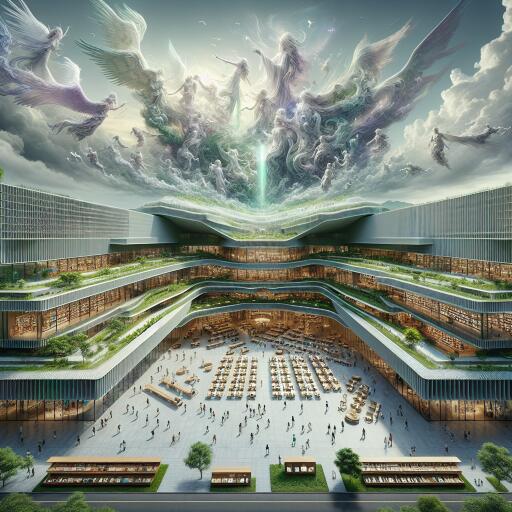
Taichung’s ambitious Green Museumbrary opens December 13, 2025, fusing a metropolitan art museum and a central library into a single cultural platform inside Central Park. Designed by SANAA, the Japanese studio led by Kazuyo Sejima and Ryue Nishizawa, the 5.8-hectare complex unfolds as eight low, interlinked volumes veiled in expanded aluminum mesh. The result feels less like a traditional institution and more like a seamless, explorable map—porous, airy, and primed for spatial storytelling.
A museum you navigate, not just visit
Raised on the former Shuinan military airport, the building encourages movement and discovery. The mesh cladding blurs edges and sightlines, coaxing visitors to roam between pavilions the way players drift across zones in an open-world hub. Light bleeds and visibility shift like dynamic fog-of-war: spaces reveal themselves gradually, inviting upward glances and lateral detours. It’s a striking piece of architectural level design that sets the tone for the programs within.
A Call of All Beings: many voices, shared worlds
The inaugural exhibition, A Call of All Beings: See you tomorrow, same time, same place, reframes how humans relate to the more-than-human world. Co-curated by the museum’s team alongside Ling-Chih Chow (Taiwan), Alaina Claire Feldman (USA), and Anca Mihuleţ-Kim (Romania/South Korea), the show braids Daoist thought, indigenous cosmologies, embodied knowledge, and non-Western perspectives to push beyond single-story narratives about nature, culture, and interspecies life.
Local masters lay groundwork with tactile, materially rich works that make earth and weather legible. Chen Ting-Shih’s cane fiber relief channels the electricity of a first thunderclap. Yeh Huo-Cheng’s thick surfaces evoke the mineral density of Mount Huoyan. Wang Ching-Shuang’s lacquer pieces shimmer with mother-of-pearl and maki-e. In a bracing inversion, Chen Hsing-Wan mounts hardened textiles onto cowhide, flipping our sense of permanence and vitality between fabric and skin.
Commissions that worldbuild
New commissions expand the show’s scope through multisensory design and narrative play. Chen Yin-Ju’s Evocative of Mountains and Seas revives creatures from a two-millennia-old Chinese bestiary using sound, scent, and pared-back text—less linear tale, more ambient lore, like a living codex you walk through. Au Sow Yee’s The Broadcast Project II fractures colonial-era histories of Malaya into interlaced fictions of coconut palms and contested documents, a glitchy historical channel surf. Hong-Kai Wang’s collaborative publication Our Words Don’t Suit Prophecies Anymore asks how we can attend to beings that don’t speak in human tongues, redirecting attention toward silence, vibration, and listening as practice.
International signals and an essential VR encounter
Global voices complicate old binaries of human versus nature. Joan Jonas suspends bamboo-paper kites overhead, teasing apparition-like species that demand we look up rather than forward. Karolina Breguła follows coastal communities grappling with rising seas, where adaptation becomes daily choreography. Myrlande Constant’s densely beaded drapos braid Vodou cosmology, history, and lived reality, proposing a world where humans and deities share civic space.
For VR and immersive media fans, Loukia Alavanou’s On the Way to Colonus is a must. The installation re-stages Greek tragedy inside an Athenian Roma settlement, folding peripheral geographies into the center of the narrative. It’s a potent reminder that immersion isn’t just technology—it’s a politics of where you place the viewer, whose viewpoint you inhabit, and which worlds get rendered with dignity.
Bodies, barriers, and the building as stage
Performance-oriented works key directly into the architecture’s flow. Seung Hyun Moon’s On Thin and Transparent Things uses the artist’s own movement—shaped by cerebral palsy—to probe thresholds and obstructions, asking how consciousness navigates a world of uneven affordances. TAI Body Theatre channels Truku legends in which giants’ bodies seed island landscapes, transforming the Museumbrary into a terrain formed from myth: a playable space of steps, pauses, and leaps.
Historic anchors, contemporary echoes
Art-historical touchstones deepen the exhibition’s temporal reach. Late sculptures by Joseph Beuys recast therapeutic materials as vessels for mending a fractured world. Ana Mendieta’s final earth-body works press human outline back into soil and rock. Chris Marker’s Bestiaire lingers on the mirrored gaze between observer and animal, while early manuscripts for The Little Prince sketch a fragile ethic of care and imagination that resonates powerfully amid today’s ecological anxieties.
Commissions that speak with the building
Launching alongside the exhibition, the biennial TcAM Art Commission introduces two major interventions. In the 27-meter atrium, Haegue Yang’s Liquid Votive — Tree Shade Triad rises like a vertical grove, drawing on cross-cultural rites of tree veneration. Michael Lin’s Processed scales up Taiwanese textile motifs into spatial patterns that wrap surfaces and re-tempo circulation. Framed as two-year cycles, these projects function a bit like seasonal updates: long-form content that keeps the architecture in live dialogue with artists and audiences.
A platform for shared futures
By intertwining library, museum, and public realm, the Green Museumbrary invites reading, viewing, and wandering to happen in the same breath. The building’s porous design encourages crossovers—scholarly research brushing up against performance, family visits flowing into VR encounters, archival study meeting multisensory installations. As an urban-scale sandbox for learning and imagination, this opening chapter positions Taichung’s new landmark as a gathering place where many kinds of knowledge—and many kinds of beings—coexist.