
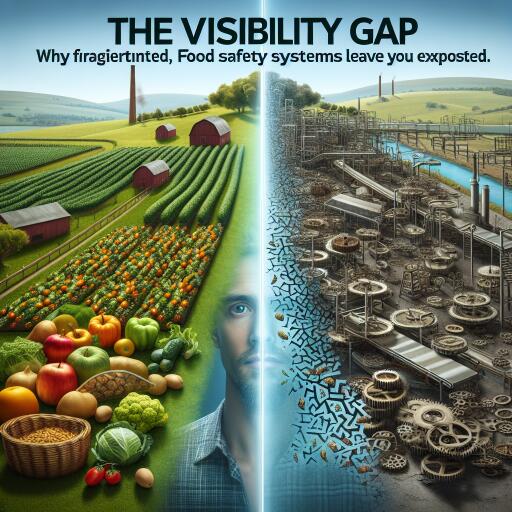
The Visibility Gap: Why Fragmented Food Safety Systems Leave You Exposed – FoodSafetyTech
In today’s connected world, privacy and safety are not separate lanes but part of the same highway. The way data is gathered, stored, and shared across devices and services creates a visibility gap: a blind spot where risks can slip through because no single authority has a complete view. That same gap can show up in the food system, where fragmented oversight across producers, processors, regulators, and distributors makes it harder to guarantee safety from farm to fork.
At the core of online privacy are small data packets that help websites “remember” who you are, your preferences, and how you interact. These are commonly known as cookies, but they sit alongside a family of technologies that track devices, behaviors, and signals. Together, these tools build a broad picture of user activity, which editors and advertisers use to tailor content and experiences. In parallel, the food ecosystem relies on distributed data—ingredient provenance, handling records, and storage conditions—being shared among several actors. When this information is spread across disparate systems with divergent standards, the result is a patchwork of visibility that can obscure risks and delay crucial interventions.
Most browsers are configured to accept cookies and similar trackers by default, which accelerates user experiences by retaining login status, preferences, and site features. Yet, when you reset a browser, disable data storage, or toggle settings to ask before storing data, these tracking mechanisms may not be placed. The practical effect is an opt-out from pervasive data collection, and the digital environment adjusts accordingly. That choice—whether to let data flow or to curb it—has real implications for transparency and safety across digital platforms and beyond.
Beyond your own device, third-party services play a significant role. Advertisers and analytics providers may request access to data to verify delivery, measure reach, or retarget audiences as they move across sites. If you want to minimize that activity, you can adjust privacy settings, enable stricter controls, or activate built‑in privacy safeguards. Signals that you prefer less cross-site tracking or fewer personalized ads influence how widely information travels and how deeply it’s analyzed.
The degree of control over what is installed, when it is installed, and how data is used varies by browser, device, and user preference. Turning off certain cookies or trackers can reduce personalization and may affect some site features, such as saved settings or streamlined logins. The trade-off is balancing openness and convenience with a clear, auditable path for who has access to data, how it’s used, and how quickly issues can be detected and addressed. When data collection becomes diffuse across multiple services, it becomes harder to spot anomalies that could indicate a safety concern.
A broader ecosystem of privacy practices exists as well. Each organization that collects data operates under its own policy, shaping how information is used and shared. If you want to reduce cross-site tracking, you can limit cookies at the browser level or opt out of interest-based advertising through the available controls. There are tools designed to help you manage your privacy preferences across devices and apps, though they require some attention and ongoing management to stay aligned with your comfort level.
Ultimately, robust safety and privacy hinge on coherent standards and accountable governance. When platforms align on data handling and regulators enforce transparent, consistent rules, the visibility gap shrinks. Consumers gain clarity, stronger protections, and a more trustworthy experience online. The same principle applies to food safety: when oversight is fragmented, blind spots appear; when governance is unified and transparent, risk decreases and trust grows from the farm to you.