
New W&M integrated science building will allow for ‘more opportunity’
WILLIAMSBURG — William & Mary opened the doors to its Integrated Science Center 4 (ISC 4) as the spring semester began, giving students and researchers a high-capacity hub for computing, data science and applied science—and marking a major milestone for the university’s first new school in half a century, the School of Computing, Data Sciences & Physics.
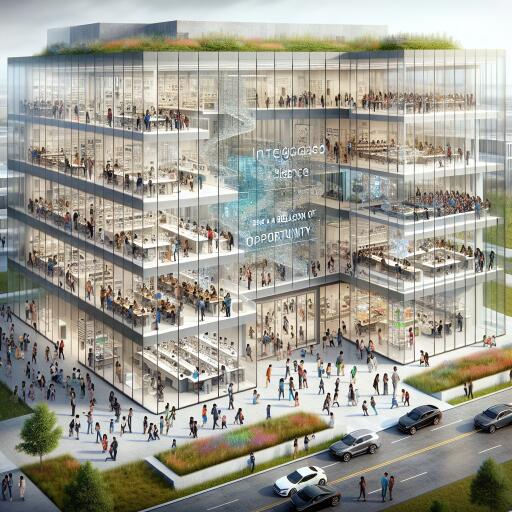
Rising on the former site of Millington Hall near Swem Library, the four-story ISC 4 adds 124,000 square feet of new facilities and connects via 10,000 square feet of renovated space to the existing ISC complex. It now houses the computer science and data science departments and portions of applied science, consolidating programs that sit at the center of national demand for expertise in software development, analytics, artificial intelligence, cybersecurity, computational science and bioengineering.
“The opening of the new building will allow for more opportunity in collaboration and interdisciplinary research and learning,” said Eric Bradley, chair of W&M’s applied science program, who has worked on the project since 2016, when it was still a “dream.” The expanded footprint and shared labs, he added, will help students and faculty produce “faster and higher quality” work.
Inside ISC 4: Labs, learning spaces and a high-impact makerspace
ISC 4 is designed to accelerate hands-on learning and research at scale. The facility includes:
- 35 instructional and research laboratories
- William & Mary’s first interactive classroom
- A 152-seat lecture hall
- Study areas, offices, collaborative zones and multipurpose rooms
- An 8,000-square-foot makerspace with rooms for welding, laser cutting, metalwork, woodworking, 3D printing and more
“When they entered the building, you could see the excitement on the students’ faces,” said Randy Ready, director of communications and marketing for the School of Computing, Data Sciences & Physics. The energy was matched by faculty who emphasized how the new environment will translate into earlier, deeper research experiences for undergraduates.
“It’s important for students to become engaged with science early on in their careers,” said Margaret Saha, chancellor professor of applied science. “It is really cool to be in this building. We are going to do amazing things.”
For faculty whose work depends on specialized wet labs, the opening is transformative. “I can’t do anything without this space,” said Geoffrey Zahn, a microbial ecologist and assistant professor in the applied science program, who plans to launch new fungi research immediately. “I am really ready to get started.”
Why it matters: AI, data and cybersecurity demand is surging
The new building responds directly to enrollment growth across computing and the physical sciences—growth that mirrors the global race for talent in AI, cyber defense, advanced analytics and data-intensive research.
- Computer science majors at W&M have more than doubled over the past decade, up 117%.
- Physics enrollment has climbed 36% in the same period.
- Since the launch of the data science bachelor’s degree five years ago, enrollment has increased 167%.
- The data science minor is now the most popular at the university, and a new minor in artificial intelligence debuted this past fall.
These trends have deep cybersecurity implications. As AI models proliferate and software eats more of the economy, institutions need pipelines of graduates fluent in secure coding practices, adversarial machine learning, privacy-preserving analytics and the protection of cyber-physical systems. ISC 4’s integrated layout—bringing computer scientists, data scientists, physicists and applied scientists under one roof—creates a setting where teams can tackle threats that don’t respect disciplinary boundaries, from securing IoT and robotics to building resilient, trustworthy AI.
A collaborative blueprint for faster discovery
ISC 4’s emphasis on proximity and flexibility is designed to shorten the time from idea to impact. Configurable labs enable quick pivots between instruction and experimentation; the makerspace fosters rapid prototyping of hardware-software systems; and open collaboration areas help students move seamlessly from classroom theory to real-world builds and experiments. That architecture supports projects across domains—computationally driven biology, materials research, data engineering, and cyber—while lowering the barrier for undergraduates to join active research.
Bradley underscored the point: the building’s design is about velocity and quality. By co-locating talent and tooling, W&M aims to elevate both the pace of learning and the rigor of outputs—whether that’s publishing new findings, delivering software and data products, or training students to lead in security-critical industries.
From campus momentum to workforce readiness
The launch of ISC 4 is also a workforce story. Employers across sectors—finance, healthcare, energy, defense, and the public sector—are hungry for graduates who can reason about data, build and secure complex systems, and collaborate across specialties. With enrollment momentum and new programs such as the AI minor, W&M is signaling that students won’t have to choose between depth and breadth: they can learn to code, analyze and defend within the same ecosystem.
The building’s adjacency to the broader ISC complex further compounds that value, tying new labs and classrooms into existing research infrastructure and faculty networks. For students, that means more chances to engage in cutting-edge work earlier in their academic journeys. For faculty, it’s a platform to launch interdisciplinary initiatives that are increasingly necessary to address modern scientific and security challenges.
The bottom line
ISC 4 is more than an address change; it’s a strategic bet that collaborative, computation-forward science will define the next decade of innovation and security. Judging by the first week’s reaction—students filing into interactive classrooms, faculty booting up new labs, makers spinning up prototypes—that bet is already paying dividends. And as the School of Computing, Data Sciences & Physics grows into its expanded home, expect the ripple effects to be felt well beyond campus, from AI and data science breakthroughs to the cybersecurity talent pipeline the country urgently needs.