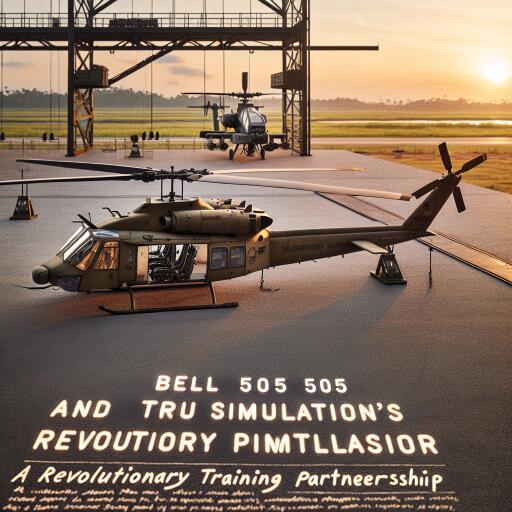
Bell 505 and TRU Simulation’s Veris Simulator: A Revolutionary Training Partnership – Asian Military Review
Helicopter training is undergoing a quiet revolution. Pairing the Bell 505 with TRU Simulation’s Veris VR flight training device brings modern military flight schools a scalable, budget-friendly pathway to mastering fundamentals and rehearsing emergencies with striking realism—without compromising safety or performance.
Why the Bell 505 fits the training sweet spot
At the core of this approach is the Bell 505, engineered with simplicity and predictability in mind—two traits that matter most when building pilot confidence. Its Safran Arrius 2R powerplant, managed by a dual-channel FADEC, automates complex engine tasks so instructors can stay focused on technique and decision-making. The aircraft’s forgiving rotor system and stable handling characteristics give students room to learn, especially during demanding maneuvers like autorotations.
Inside, an open and highly visible cockpit layout boosts situational awareness and supports robust crew communication from the first lesson. The platform’s adaptable architecture also makes it easy to tailor training to different syllabi and mission sets. It’s little surprise the 505 has already found its way into the fleets of multiple defense customers, steadily building a track record as a dependable entry-level trainer.
Immersion and precision with Veris VR
On the ground, TRU Simulation’s Veris Virtual Reality Flight Simulator—qualified as an FAA Level 7 Flight Training Device—mirrors the 505 experience with high-fidelity cues and tactile realism. A fully electric six-degrees-of-freedom motion base translates aircraft dynamics into believable seat-of-the-pants feedback, while TRU’s REALFeel control loading system delivers the nuanced forces pilots expect on the cyclic, collective, and pedals.
A premium VR/MR headset enhances immersion, surrounding trainees with richly rendered environments and weather effects. Crucially, the Veris device is dual-use: instructors can remove the headset for avionics or procedural sessions using traditional visual displays, then restore VR to practice complex tasks that benefit from depth perception and spatial awareness. That flexibility keeps training efficient and targeted at every stage, from systems familiarization to advanced handling.
The power of an integrated pipeline
Combining the Bell 505 and Veris VR simulator creates a training continuum where students can rehearse and refine skills in the simulator, then validate them in the aircraft with minimal friction. Emergency procedures, adverse weather, and edge-of-envelope scenarios can be repeated safely and consistently in VR before moving to live flights, minimizing risk and maximizing readiness.
Because the simulator can replicate rare or hazardous events on demand, flight hours in the aircraft are preserved for reinforcing technique, sharpening judgment, and confirming proficiency. The result is a more cost-effective program that maintains high standards while delivering more learning per hour—on the ground and in the air.
Key advantages for modern military training
- Accelerated skill progression: Students build muscle memory in the simulator and transition to the aircraft more smoothly.
- Risk-managed emergency practice: High-stress scenarios can be trained repeatedly with zero exposure to real-world hazards.
- Lower total training cost: Reduced reliance on live flight for early repetitions and procedural drills.
- Consistent, high-fidelity scenarios: Standardized training across cohorts ensures uniform outcomes and easier evaluation.
- Adaptive learning: Dual-use simulation supports headset-on immersion or headset-off procedural focus as needed.
- Instructor efficiency: More time is spent coaching decision-making and fundamentals rather than managing complex engine tasks.
From basics to emergencies: a sample progression
Early in the syllabus, trainees can master startup flows, avionics configuration, and hover work in the Veris device, toggling between VR and conventional displays to emphasize the right skills at the right time. As confidence grows, instructors introduce failures—tail rotor malfunctions, engine anomalies, and hydraulic faults—under precise, repeatable conditions. Students then carry those lessons into the Bell 505, where the aircraft’s stable handling and FADEC-managed engine reduce workload and keep the focus on judgment, coordination, and accuracy.
For autorotations, for instance, the VR environment allows repeated practice of power-loss recognition, rotor energy management, and flare timing in varied terrain and weather. By the time trainees perform the maneuver in the 505, they’ve already internalized sight pictures, control inputs, and callouts—leading to safer, more reliable outcomes.
Scalable, future-ready training
As defense organizations seek to balance readiness and affordability, this 505–Veris pairing stands out. It scales to different fleet sizes, adapts to evolving syllabi, and supports data-driven oversight of student performance. Most importantly, it aligns the strengths of real-world flying with immersive simulation, enabling pilots to learn faster, safer, and smarter.
The result is a tighter, more resilient training pipeline—one that equips new helicopter pilots with the confidence and competence they need from day one, and gives instructors a powerful toolkit to sustain excellence across every phase of training.