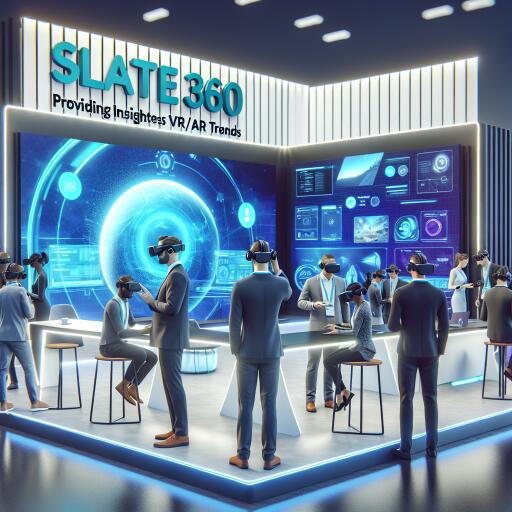

Slate360 Provides Insights on the Latest Trends in Virtual Reality / Augmented Reality and Why They Work at Tradeshows
Virtual reality and augmented reality have moved from novelty to necessity on the tradeshow floor. What began as a handful of headsets and demo pods has evolved into a strategic centerpiece for exhibitors, especially in medical devices, pharmaceuticals, and life sciences. Slate360 observes that immersive tech isn’t just drawing crowds—it’s reshaping how attendees learn, evaluate, and remember complex innovations.
Why immersive tech wins at tradeshows
- Rapid comprehension: A five-minute simulation can explain a complex mechanism or workflow better than a 20-page brochure. VR/AR collapses learning time by letting attendees experience the use case firsthand.
- Risk-free exploration: Simulated environments allow high-stakes procedures or delicate device interactions without real-world risk, making difficult concepts approachable.
- Memorability and recall: Embodied interaction builds deeper memory, turning a booth visit into a story attendees retell long after the event.
- Signal amid noise: Immersive stations stand out visually and sonically, naturally funneling foot traffic and creating a spectator effect that amplifies interest.
- Actionable data: Eye tracking, dwell time, and scenario completion metrics convert engagement into measurable insights, informing follow-up and product iteration.
The trends shaping VR/AR at events right now
1) Standalone, all-day headsets
Battery-efficient, cable-free hardware has reduced setup friction. Exhibitors can run multiple stations without PC tethers, enabling higher throughput and more flexible booth design.
2) Mixed reality over full isolation
Pass-through MR keeps attendees grounded in the real world while layering visuals onto physical products, models, or surgical mannequins. This reduces motion discomfort and shortens the learning curve.
3) Spatial anchors and digital twins
AR experiences increasingly snap to real objects—catheters, pumps, implants—so overlays align precisely with the physical item. VR replicas (digital twins) demonstrate internal mechanics and workflows impossible to show on the floor.
4) Haptics and tactile cues
Subtle feedback (vibration, resistance, force cues) elevates training realism. Even low-profile controllers can simulate texture changes or pressure thresholds relevant to clinical tasks.
5) Multiuser collaboration
Co-present experiences let an expert guide multiple participants, local or remote, in real time. This mirrors real-world teamwork and scales education beyond the booth.
6) Built-in analytics and intent signals
Attendee journeys are instrumented: which modules they choose, where they dwell, what they struggle with. These micro-signals help sales teams tailor follow-ups and help marketers refine content.
7) AI-driven guidance
Conversational agents in-headset answer product questions, route users to relevant modules, and adapt difficulty based on behavior. The result: shorter queues, better personalization, and less staff strain.
8) Hygiene and operations at scale
Swappable face gaskets, UV sanitization, and simplified onboarding flows keep lines moving without compromising comfort or cleanliness—now standard expectations post-2020.
What makes an effective tradeshow build
- Design for five-minute loops: Clear start, aha moment, and call-to-action. Optional deeper modules for power users.
- Comfort first: Mixed reality over full VR for newcomers; gentle motion, teleport locomotion, seated options; clear safety briefings.
- Accessibility by default: Subtitles, audio descriptions, color-safe palettes, and controller-free options where possible.
- Narrative clarity: Clinical problems first, solution second, proof points last. Let the story carry the tech—not vice versa.
- Content modularity: Swap data, regions, or indications without rebuilding the whole app. Useful for multi-show roadmaps.
- Compliance and privacy: Bake regulatory considerations and consent into the flow, with offline modes for restricted environments.
How exhibitors measure impact
- Engagement quality: Dwell time, module completion, and decision checkpoints beat raw headset count.
- Knowledge transfer: Quick post-experience quizzes or scenario outcomes show whether concepts landed.
- Lead qualification: Tie behaviors to CRM; prioritize attendees who explore advanced modules or request follow-ups in-headset.
- Pipeline connection: Map immersive touchpoints to trials, demos, and conversions post-event.
- Cost per engaged minute: A simple yardstick to compare immersive spend with other booth elements.
A common life sciences use case
Attendees don MR headsets to see an implant’s placement pathway mapped onto a life-size model, with real-time annotations on anatomy, contraindications, and instrument sequencing. A follow-up VR module simulates the procedure with escalating complexity, tracking accuracy and adherence to protocol. In minutes, a clinician experiences what typically takes hours to understand on paper—while the marketing team captures which features resonated most.
Why it works psychologically
- Agency: People learn best by doing; interactivity turns passive browsing into active problem-solving.
- Context: Spatial overlays situate information where it matters, making complex details intuitive.
- Emotion: High-fidelity visuals and feedback create memorable peaks—key to recall and word-of-mouth.
What’s next
Expect more photoreal MR, slimmer optics, and interoperable content that jumps across devices. Cloud-assisted rendering and smarter on-device AI will power denser simulations without ballooning setup. For exhibitors, the advantage shifts from “who has headsets” to “who tells the clearest story, with the cleanest data, at the fastest throughput.”
Slate360’s perspective
From Slate360’s vantage point, the winners are combining theatrical showmanship with instructional design and rigorous analytics. Immersive demos aren’t just spectacle; they’re the new first mile of product education. Get the flow, comfort, and measurement right, and VR/AR becomes a repeatable tradeshow engine—not a one-off gimmick.