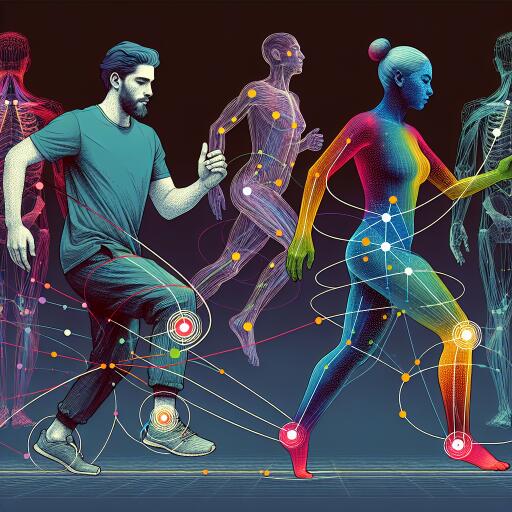

GAITEX: Human motion dataset of impaired gait and rehabilitation exercises using inertial and optical sensors – Scientific Data
Wearable inertial measurement units (IMUs) are reshaping how clinicians and researchers assess human movement, bringing lab-grade insights to clinics and even to everyday settings. But training robust classification models for physiotherapy and gait analysis still hits a familiar wall: curated, diverse, and well-annotated datasets are hard to build and expensive to scale. GAITEX steps into that gap with a multimodal collection designed to accelerate research across rehabilitation and gait assessment.
The team has released an early, unedited version of the manuscript describing GAITEX to make the findings available ahead of final publication. As a pre-publication release, it may contain errors and will undergo further editorial refinements.
What GAITEX offers
GAITEX compiles a comprehensive set of physiotherapeutic and gait-related exercises, capturing both ideal executions and clinically relevant variants that mirror real-world deviations. The dataset was recorded from 19 healthy participants and synchronizes two gold-standard modalities—wearable IMUs and optical marker-based motion capture (MoCap)—to support precise comparisons and benchmarking.
- Multimodal recording: nine IMUs worn across the body, paired with a 68-marker optical MoCap setup tracking full-body kinematics.
- Direct cross-modal comparison: four reflective markers aligned with each IMU enable head-to-head orientation comparisons between IMU-derived and MoCap-derived signals.
- Processed orientations: IMU orientations are provided and aligned to widely used segment coordinate systems, easing downstream analysis and model training.
- Biomechanical modeling: subject-specific OpenSim models and inverse kinematics outputs give researchers a pathway from raw signals to joint-level kinematics.
- Visualization tools: utilities to inspect and validate IMU-derived orientations, supporting rapid quality checks and method development.
- Rich annotations: movement quality ratings and timestamped segmentations label each sequence, enabling supervised learning and fine-grained analysis.
Why it matters
Building reliable models for exercise evaluation and gait assessment demands scale and diversity—covering correct movements and the nuanced ways people deviate from clinical protocols. By pairing synchronized IMU and MoCap streams, GAITEX supports validation across modalities and helps researchers understand where algorithms succeed or fail. This dual view is especially important when translating methods from controlled labs to real-world environments, where IMUs provide portability but are harder to ground-truth.
Beyond raw data, standardized coordinate systems, subject-specific biomechanical models, and inverse kinematics outputs reduce the heavy lifting needed to get from sensors to meaningful features. That in turn shortens development cycles and encourages reproducible pipelines across teams.
Designed for modern ML workflows
GAITEX is structured to serve both movement science and machine learning communities. With exhaustive labels and synchronized modalities, it naturally lends itself to a variety of tasks:
- Exercise evaluation: classify correct technique versus clinically relevant deviations.
- Gait classification: distinguish gait patterns and support research into impaired movement.
- Temporal segmentation: identify phases or events within exercises and walking sequences.
- Biomechanical estimation: derive joint kinematics or related parameters from IMU streams.
To promote reproducibility, the release includes code for postprocessing and alignment, running inverse kinematics, and technical validation. These resources help standardize benchmarks and let researchers compare methods under consistent conditions.
Who should use GAITEX
- ML researchers building models for rehab, remote monitoring, or sports tech who need synchronized IMU/MoCap ground truth.
- Biomechanists seeking open datasets with subject-specific OpenSim models and inverse kinematics outputs.
- Clinicians and rehabilitation scientists evaluating exercise adherence and movement quality outside the lab.
- Device makers and digital health teams validating wearable sensing pipelines.
Early access, transparent methods
Because the manuscript is unedited, details may change before final publication in Scientific Data. Still, the core contribution is clear: a high-fidelity, fully annotated, and methodologically transparent dataset aimed at advancing objective, scalable assessment of gait and rehabilitation exercises.
The bottom line
GAITEX delivers what the field has been missing: a synchronized, multimodal, and richly annotated dataset that bridges wearable IMUs and optical motion capture. With aligned orientations, subject-specific models, inverse kinematics outputs, and open code, it lays a strong foundation for building and validating the next generation of algorithms for movement assessment—spanning exercise evaluation, gait classification, temporal segmentation, and biomechanical estimation.