
2,000-year-old machine found in China tomb could be binary computer
The core idea of computing is simple: input goes in, processing happens, output comes out. By that lens, an ancient Chinese textile machine known as the ti hua ji—“figured loom”—may deserve a surprising title: the world’s earliest programmable computer. That’s the case being made by the China Association for Science and Technology (CAST), which argues the Western Han–era device encoded instructions in a binary-like system more than 2,000 years ago.
A programmable loom from 150 BC
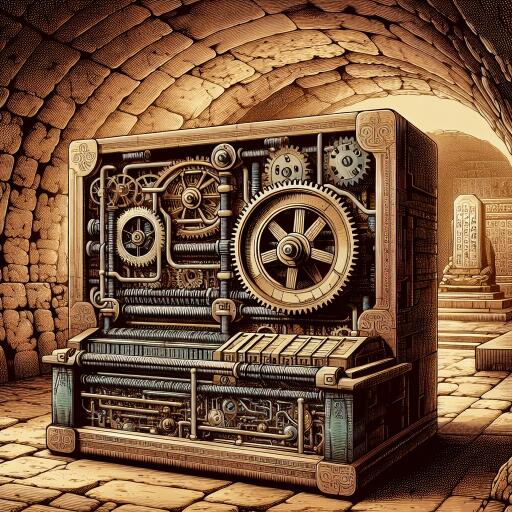
Unearthed in 2012 during construction of Chengdu Metro Line 3 at the Laoguan Mountain site, a Western Han tomb dated to around 150 BC yielded four remarkably preserved loom models. Textile specialists identified them as the oldest complete figured looms found anywhere. Their significance quickly elevated the find to one of China’s Top 10 Archaeological Discoveries of 2013, and subsequent research enabled a full reconstruction and technical analysis of how the mechanism worked.
CAST, China’s largest official scientific body, spotlighted the discovery in a Dec 27 video, framing the Chengdu loom as “computer hardware” operated by a physical “software” system: pattern cards or templates that commanded exactly which warp threads to raise or lower, line by line, to produce a design. In that logic, a raised warp could be read as 1, a lowered warp as 0—turning woven motifs into sequences of bits.
How the ancient “program” worked
All weaving interlaces warp (longitudinal) and weft (latitudinal) threads. Before figured looms, artisans had to manually lift specific warp sets for each pass of the shuttle, a precision job that limited complexity and scale. The Chengdu machine mechanized that control with a “pattern book”—a structured sequence using threads or bamboo sticks that functioned like an instruction tape.
Key details cited by researchers:
- 10,470 warp threads controlled by 86 brown “programming” patches
- More than 9.6 million potential warp–weft intersections governed by those controls
- Operation across up to 100 devices once set up, enabling consistent, repeatable output
As the loom cycled through the pattern sequence, each node acted like a command, lifting the exact threads required to expose a color sequence in the weft and render the intended figure with striking precision. Notably, the models show the loom could be programmed via at least two mechanisms—sliding frames and connecting rods—each enabling different patterning strategies.
Binary thinking before bits
The suggestion that a raised warp equals 1 and a lowered warp equals 0 isn’t just metaphor. CAST and several Chinese scholars argue the loom embodies three pillars of computing: programmability (an external instruction set), automation (mechanical execution without constant human decision-making), and information encoding (a two-state system mapping to a visual result). In that view, the loom’s “software” is the pattern book; the “hardware” is the frame, hooks, rods, and lifters; and the “output” is the finished textile.
To be clear, this is proto-computing: a domain-specific, mechanical device rather than a general-purpose calculator. Still, the resemblance to later breakthroughs is striking—and, CAST argues, historically important.
From Chengdu to the world
Chinese figured weaving techniques spread west along the Silk Road, reportedly reaching the Persian world by the 6th century. By the 12th century, Italian workshops in cities like Lucca and Venice were producing silk with Chinese-style looms. In 1805, French inventor Joseph Marie Jacquard introduced a loom controlled by punched cards and needles—the now-famous Jacquard loom—which Karl Marx called the most complex machine before the steam engine. Its punched-card logic later inspired early computing methods in the 19th century and beyond.
That lineage matters for more than textiles. It shows how ideas about encoding, control, and automation traveled and evolved across cultures, culminating in fully electronic computing in the 20th century.
Rewriting the origin story
For generations, standard narratives placed computing’s origins primarily in Europe. CAST’s endorsement of the Chengdu loom as proto-computer hardware contributes to a broader reevaluation that highlights non-Western foundations of key technologies. As China reasserts technological leadership in areas like 5G, AI, and robotics, there’s renewed attention to historical innovations that anticipate modern concepts.
Wang Yusheng, former director of the China Science and Technology Museum, has called the figure loom “a crystallization of ancient programming thought and mechanical wisdom,” crediting it with making Chinese silk a global luxury while shaping the logic that underlies information technology. Some scholars even trace conceptual links from Chinese binary-like systems—such as the I Ching’s yin–yang line encoding—to later formalizations of binary arithmetic.
Modern echoes: from looms to ENIAC
In 1946, the University of Pennsylvania unveiled ENIAC, widely regarded as the first general-purpose electronic computer. Among the team was Zhu Chuanju, who contributed to ENIAC’s logical design. His work, like that of his colleagues, relied on binary operations and programmable control—principles that, in a long historical view, resonate with the figured loom’s logic.
None of this diminishes the distinct leap represented by electronic computing; rather, it situates ENIAC and its successors within a deeper continuum of human problem-solving: representing information with discrete states, externalizing instructions, and automating execution.
What we still don’t know
There’s vigorous debate over what qualifies as a “computer,” and whether a specialized mechanical loom should share that label. The archaeological record is also incomplete: while the Chengdu models are the oldest complete figured looms known, earlier steps in the technology’s evolution remain hazy. Even so, the evidence from Laoguan Mountain makes a compelling case that programmability and binary-like encoding were not invented in a vacuum—they were woven, quite literally, into human culture long before electrons carried the load.
As researchers refine reconstructions and test the loom’s capabilities, one thing is clear: the history of computing is broader, older, and more global than the standard script suggests—and a silk pattern from 150 BC might be one of its earliest, most elegant “printouts.”