
Open Source Tools for Physics Data Analysis
In modern science, data analysis is not a side quest—it’s central to how we learn from experiments and validate theories. From first-year lab courses to advanced research projects, students and researchers in physics, mathematics, chemistry, biology, and engineering collect data, clean it, visualize it, and extract meaning. While commercial software can be approachable, open-source tools paired with programming skills unlock flexibility, transparency, and the full computational power needed for serious inquiry.
Why Open Source Matters in the Lab
Open-source ecosystems enable reproducible workflows, community-vetted algorithms, and cost-free access—critical advantages for education and collaborative research. Graphical tools can help newcomers grasp fundamentals, but they often become limiting. Programming literacy removes the ceiling: you can automate analyses, customize models, and scale from a handful of measurements to millions of events.
Learning to Think Like a Computational Scientist
A solid foundation typically starts with C++ and Python. C++ is favored for performance-critical tasks and low-level control—vital in high-energy physics or simulation-heavy workloads. Python emphasizes readability and rapid prototyping, backed by a vast ecosystem of scientific libraries. Exposure to both helps students match the tool to the task and understand trade-offs between speed, clarity, and portability.
- C++: Strong typing, high performance, fine-grained memory control, and deep integration with legacy scientific codebases.
- Python: Expressive syntax, rich libraries, and interactive notebooks ideal for exploration and visualization.
- Other open-source options (e.g., Julia) may be introduced for numerical computing, but C++ and Python remain the backbone in most physics curricula.
ROOT: A Workhorse for Experimental Physics
ROOT—born at CERN—remains a cornerstone of data analysis in particle and nuclear physics. It combines I/O for large datasets, histogramming, curve fitting, statistical modeling, and powerful visualization into a coherent framework. You can work in C++ or via PyROOT bindings in Python, allowing teams to blend performance with productivity.
- Data handling: Efficient storage and retrieval of complex event data.
- Analysis: Histograms, multi-dimensional fits, and uncertainty propagation.
- Visualization: Publication-ready plots tailored to physics workflows.
For labs that produce sizable datasets—think scintillation counters, spectrometers, or beamline experiments—ROOT can streamline the entire pipeline from raw events to final plots.
The Python Scientific Stack
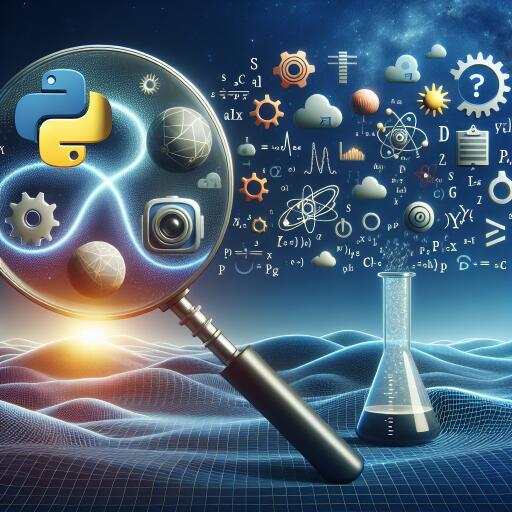
Python’s “batteries included” approach makes it an ideal platform for general scientific analysis and teaching. The core stack typically includes:
- NumPy: Fast array operations, linear algebra, FFTs.
- SciPy: Numerical methods—optimization, integration, interpolation, signal processing.
- pandas: Clean tabular data handling and time-series operations.
- Matplotlib and Seaborn: Customizable plotting for exploratory analysis and reports.
- scikit-learn: Machine learning for classification, regression, clustering, and model validation.
- Jupyter Notebooks: Interactive documents mixing code, results, and narrative for reproducible research.
Together, these tools cover most undergraduate and many graduate-level needs—from fitting a radioactive decay curve to analyzing diffraction patterns or calibrating sensors.
From Classroom to Experiment: A Typical Workflow
- Acquisition: Collect measurements from lab instruments or simulations; store as CSV, ROOT files, or HDF5.
- Cleaning: Remove outliers, handle missing values, correct timestamps, and standardize units.
- Exploration: Plot raw and derived quantities; compute summary statistics; sanity-check assumptions.
- Modeling: Fit physical models (exponential decay, harmonic motion, Gaussian beams) and quantify uncertainties.
- Validation: Cross-validate results, compare with theoretical predictions, and evaluate systematic errors.
- Communication: Create clear figures, tables, and narrative—ideally in a notebook or script for full reproducibility.
Why Programming Belongs in Every Science Curriculum
Embedding computing into lab courses teaches more than syntax. Students learn to design reproducible pipelines, manage versions of their code and data, and think critically about statistics and uncertainty. These skills transfer across disciplines and prepare graduates for data-heavy roles in academia and industry.
Getting Started: Practical Recommendations
- Pick a stack and stick with it: For many labs, Python plus Jupyter is the fastest route to results; add ROOT where needed for performance and domain-specific features.
- Start simple: Begin with loading, plotting, and basic curve fitting before moving to advanced models or machine learning.
- Automate early: Wrap repetitive steps in functions or scripts to avoid manual errors and save time.
- Document as you go: Use notebooks or literate programming to capture rationale alongside results.
- Validate: Apply uncertainty analysis, residual checks, and sensitivity tests to avoid overconfident conclusions.
Putting It All Together
A modern, open-source toolchain—grounded in C++ and Python, anchored by ROOT for data-heavy physics, and powered by the Python scientific libraries—offers a complete, extensible solution for data analysis in education and research. It supports the full journey: from raw measurements to interpretable, reproducible results. With these tools, students don’t just press buttons; they build understanding, craft models, and learn to interrogate data like scientists.