
TTT-Discover Stanford, Nvidia Develop AI That Trains While Being Used
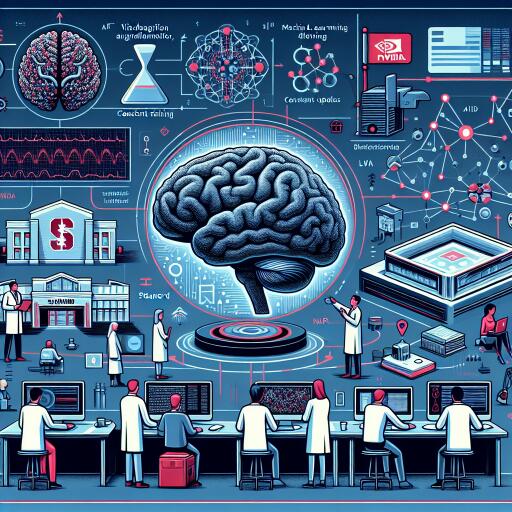
Proven results: TTT-Discover set new world records across four domains—systems engineering, algorithm design, biology, and mathematics—by letting AI keep learning during inference. Developed by researchers from Stanford, Nvidia, and Together AI, the technique optimizes GPU kernels to run up to twice as fast as expert-written code and outperforms top human baselines on hard algorithmic challenges.
From Frozen Models to Live Discovery
Traditional enterprise AI relies on frozen models: once training ends, parameters don’t change. That works for pattern recognition but breaks down for true discovery tasks—like inventing new algorithms—because such problems are inherently out-of-distribution.
TTT-Discover (Test-Time Training to Discover) flips that assumption. It continues training during inference, updating weights for the specific problem at hand. As co-author and Stanford PhD student Mert Yuksekgonul put it, thinking models will struggle with deep breakthroughs—“like proving P != NP”—without the ability to learn during the attempt, much as Andrew Wiles refined his approach to prove Fermat’s Last Theorem through years of iteration.
How TTT-Discover Works
Each “discovery run” treats inference as an optimization loop. The model proposes candidates, evaluates them against a reliable scalar signal (e.g., runtime, error, cost, molecular properties), and updates its weights based on feedback. A typical run includes ~50 training steps and thousands of rollouts, costing roughly $500 per problem. It performs best when rewards are continuous (speed, error rate) rather than binary pass/fail.
Two core innovations drive results:
- An entropic objective that exponentially emphasizes high-reward outcomes instead of optimizing for average expected reward, improving the odds of landing breakthrough solutions.
- PUCT, a tree-search strategy inspired by AlphaZero, to efficiently explore and exploit promising solution paths.
The team orchestrated experiments using the Tinker API by Thinking Machines. Crucially, TTT-Discover works with open-weights models and modest infrastructure—no proprietary frontier model is required—making it far more accessible than billion-dollar pretraining runs.
Record-Setting Results Across Four Domains
In systems engineering, TTT-Discover optimized GPU kernels for matrix multiplication, including the TriMul kernel used in AlphaFold, achieving up to 2x speedups over expert-written baselines. In algorithm design, it solved difficult heuristic problems on the AtCoder competitive programming platform and surpassed top human experts and prior AI systems. The approach also delivered state-of-the-art outcomes in biology and mathematics, underscoring its range.
Analyst Raymond Uzwyshyn, Ph.D., called the results decisive: “The most compelling proof of TTT-Discover’s power is in its results. It has set new world records on problems that have stumped human experts and previous AI systems for years.”
Importantly, once an artifact is discovered—say, a faster kernel—the producing network can be discarded. The model is a discovery instrument; only the solution matters.
Deployment: Practical, Private, and Cost-Aware
For enterprises, the operational model is familiar. If you already run reinforcement learning, you likely have what you need: GPUs, rollout workers, optimizers, and checkpointing. The discovery loop can run inside a secure VPC or on-prem H100 clusters, keeping proprietary data in house.
Because per-problem costs are in the hundreds of dollars, the economics pencil out for “low-frequency, high-impact” decisions. Examples include supply chain routing, drug design, and materials discovery—scenarios where a single discovery can be worth far more than the compute bill. Even in infrastructure, a 1% gain in GPU kernel efficiency can translate to six-figure annual savings at scale.
Researchers reported top results using the open-weights model gpt-oss-120b, reinforcing that TTT-Discover’s edge comes from test-time learning dynamics rather than exclusive access to closed frontier models.
What It Can’t Do (Yet)
TTT-Discover needs verifiable scalar feedback. If you can’t measure progress—cost, error, speed, molecular properties—it can’t optimize. That rules out qualitative or subjective tasks without robust automated verifiers. Designing such verifiers, and making them resistant to gaming, remains an open challenge.
Before adopting, organizations should check two boxes:
- Clear, measurable outcomes to optimize against.
- Expected value of an improved solution substantially exceeds the compute cost of discovery.
The Bigger Shift: Adaptive Inference
Static models, no matter how large, will often miss solutions that require leaps beyond their training distribution. TTT-Discover reframes inference as a learning opportunity—an iterative search guided by measurable signals. That shift could reshape competitive dynamics: teams that integrate test-time learning may find consistent gains on high-value optimization tasks, while those locked into frozen models risk stagnation on novel challenges.
The Stanford–Nvidia–Together AI collaboration suggests a broader lesson: progress may come not only from bigger models, but from rethinking how we use them. By blending training and inference into a continuous process, TTT-Discover opens a path to AI systems that don’t just recognize patterns—they discover new ones.