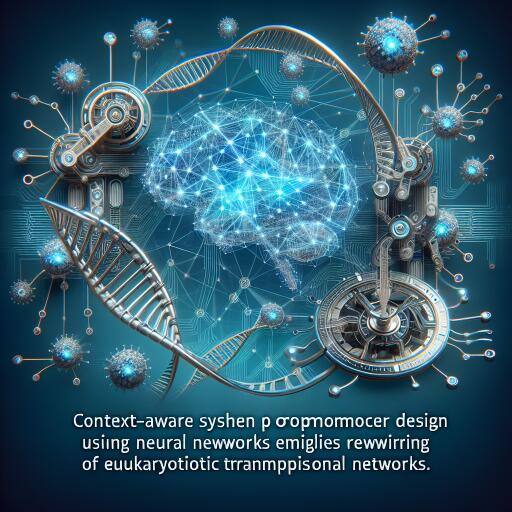

Context-aware synthetic promoter design using neural networks enables rewiring of eukaryotic transcriptional networks – npj Systems Biology and Applications
Promoter engineering has long promised precise control over gene activity, but getting from concept to functional DNA sequence usually involves weeks of trial-and-error in the lab. A new study showcases a machine learning framework that tackles this bottleneck head-on, using artificial neural networks (ANNs) to design synthetic promoters in yeast that work the first time—no prior tuning required. The approach doesn’t just predict whether a promoter element will function; it recommends where and how to insert transcription factor binding sites (TFBSs) to achieve reliable regulation, effectively “rewiring” transcriptional logic in a eukaryotic cell.
Why this is a big deal
Most computational tools in synthetic biology focus on predicting the activity of existing regulatory elements or scanning sequences for binding motifs. What has been missing is a practical method to assemble new regulatory logic within real promoter contexts. This work fills that gap with a context-aware design framework that guides TFBS placement and specifies how much promoter sequence should be rewritten to ensure compatibility—two decisions that typically demand extensive experimental screening.
The core idea
The researchers developed an ANN that evaluates native promoters in Saccharomyces cerevisiae and determines the optimal locations for inserting TFBSs. Crucially, the model also estimates the degree of local promoter modification required to make those insertions effective. By coupling placement with contextual editing, the system moves beyond motif matching and into practical promoter engineering.
A large-scale screen in yeast
To test scalability, the team applied the framework to 6,011 native yeast promoters, assessing each for compatibility with the TetR transcription factor binding site. The output was a ranked list of high-confidence promoter–TFBS pairs, prioritizing candidates most likely to deliver strong, predictable control.
Strong performance out of the box
Experimental validation confirmed what the model predicted: engineered promoters designed by the ANN achieved repression rates up to 98.4%, without any prior empirical tuning or promoter characterization. That kind of plug-and-play performance is rare in promoter design, where subtle sequence context often makes or breaks function.
Rewiring transcriptional logic
Beyond repression with TetR, the team demonstrated network rewiring by inserting a Mig1 TFBS to impose glucose-dependent regulation on an essential gene. This shows the method can not only control individual promoters, but also reshape regulatory dependencies—an important step for building synthetic circuits and dynamic responses in eukaryotes.
What makes it different
- Context-aware design: Instead of treating TFBSs as portable “stickers,” the model factors in promoter context to suggest where a site will actually work.
- Guided rewriting: It estimates how much promoter sequence should be modified to integrate a new binding site effectively, reducing guesswork.
- Scale and prioritization: By screening thousands of promoters and providing a ranked list, it focuses experimental effort where success is most likely.
Implications for synthetic biology
Reliable promoter design is foundational for building gene circuits, metabolic pathways, and responsive therapies. A predictive tool that cuts down on iteration can accelerate the design–build–test cycle, reduce costs, and expand the complexity of genetic programs researchers can attempt. While this study is in yeast, the strategy—explicitly modeling context and edit extent—points to a generalizable playbook for eukaryotic systems where chromatin structure and sequence environment heavily influence transcription.
What to watch next
- Portability: Applying the framework to other eukaryotic organisms with more complex chromatin landscapes.
- Multifactor logic: Designing promoters that combine multiple TFBSs for layered AND/OR/NAND logic in a single regulatory element.
- Dynamic behaviors: Integrating time- and condition-dependent responses to build adaptive cellular programs.
- Safety and stability: Assessing long-term performance, mutational robustness, and off-target effects in diverse growth conditions.
Bottom line
This study delivers a practical, scalable method for designing synthetic promoters that respect the nuances of eukaryotic context. By predicting both where to place TFBSs and how much to rewrite, the ANN framework streamlines promoter engineering, achieves near-complete repression in tests, and demonstrates real network rewiring via glucose-dependent control. It’s a compelling step toward predictive, programmable control of transcription in living cells.