
New Model Uses Team Interactions to Predict Next Steps in Collaborative Work
A team-informed algorithm forecasts where collaborators will click next, boosting navigation accuracy and pointing the way to smarter tools for software engineering and beyond.
Finding the right file, function, or document at the right moment can make or break complex, time-pressured work. A new predictive model developed by researchers at North Carolina State University taps not only an individual’s behavior but also the actions and conversations of their teammates to guide users to what they need next—faster.
From animal behavior to team software tools
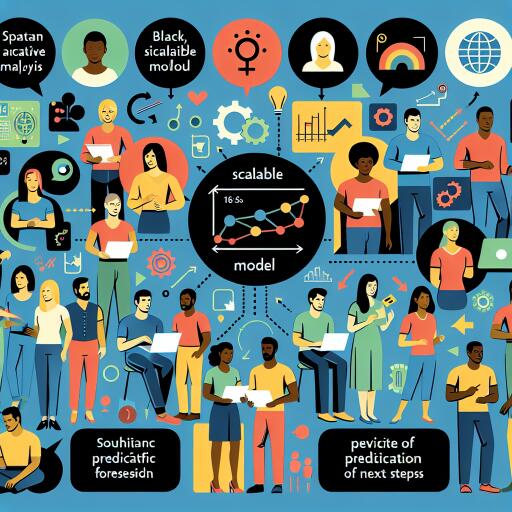
The model is inspired by “social foraging,” a phenomenon well known in animal behavior where groups share cues to locate resources more efficiently. While recommendation systems typically learn from a single user’s clicks and queries, the research team argues that collaborative work produces rich, underused signals—what teammates open, where they navigate, and what they discuss—that can sharpen next-step predictions.
Meet PFIS-T: a socially grounded next-step predictor
The system, called Programmer Flow by Information Scent for teams (PFIS-T), integrates two categories of input:
- Individual traces: a user’s own navigation history and behavioral cues.
- Team signals: teammates’ activity within the system plus explicit communication cues drawn from their interactions.
PFIS-T was designed with software engineering maintenance in mind—debugging, code reuse, and feature development—contexts where developers constantly decide which file or function to open next. But the approach is generalizable to other collaborative domains such as scientific research, intelligence analysis, or crisis response, where shared context often shapes the path to answers.
How the study was run
To evaluate PFIS-T, the researchers conducted a lab study with 30 software engineers working in 10 three-person teams on code-maintenance tasks. They compared three things:
- What teams actually did as they navigated the codebase.
- PFIS-T’s predictions of where each teammate would go next.
- Predictions from a previous state-of-the-art model that relied solely on the individual user’s history.
The headline result: PFIS-T correctly predicted 81.5% of team navigations, improving accuracy by up to 16.7% over the individual-only baseline. The advantage widened when teammates communicated frequently, suggesting that collaboration itself amplifies useful signals.
Why team cues matter
In real-world engineering, developers frequently follow one another’s trails—opening the modules a colleague just referenced, revisiting a function a teammate flagged, or jumping to files discussed in chat. PFIS-T captures these dynamics by blending “information scent” (the cues that suggest where relevant information lies) from a user’s own context with the evolving context of the team. The result is a socially aware predictor that mirrors how humans actually traverse complex information spaces.
What this could change
PFIS-T is well positioned to complement AI-powered next-step or code navigation tools in integrated development environments, documentation portals, and knowledge bases. By injecting a socially grounded signal—what the team is doing and saying right now—it can help tools:
- Rank search results and code symbols that are contextually relevant to the whole team.
- Surface likely next files, functions, or tickets based on collective activity.
- Reduce context-switching friction during pair programming or incident response.
Beyond software engineering, any high-stakes collaborative workflow—lab research, operations centers, emergency management—could benefit from next-step predictions that reflect group behavior, not just solo histories.
Where to see the work
The paper, “Where Will They Click Next? A Social Foraging Model for Collaborating Teams,” will be presented on April 17 at the ACM CHI Conference on Human Factors in Computing Systems in Barcelona, Spain. The corresponding author is Shahnewaz Leon, a Ph.D. student at NC State, with co-author Sandeep Kuttal, associate professor of computer science at NC State.
Funding
This research was supported by the Air Force Office of Scientific Research (FA9550-21-1-0108) and the National Science Foundation (2313890).