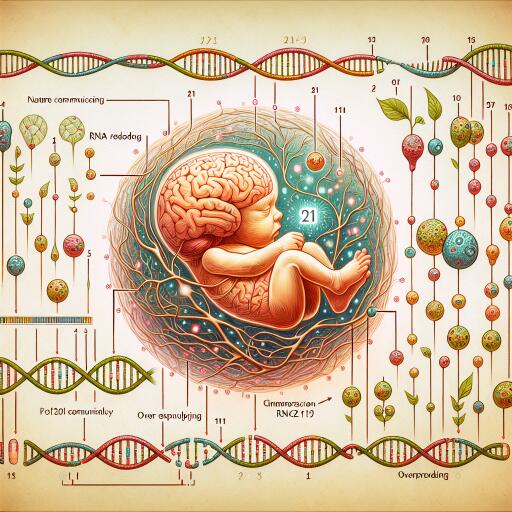

Trisomy 21 Drives ADARB1 Overexpression and Premature RNA Recoding in the Developing Fetal Brain – Nature Communications
In one of the most comprehensive looks at fetal brain biology in Down syndrome to date, researchers show that Trisomy 21 (T21) boosts expression of the RNA-editing enzyme ADARB1 and triggers premature A-to-I RNA editing—especially at protein-recoding sites crucial for synaptic development. The work reframes RNA editing dysregulation as a core, conserved mechanism of T21 neuropathology and pinpoints concrete molecular events that may alter neuronal maturation long before birth.
What’s new
- ADARB1 (ADAR2) is consistently overexpressed in T21 fetal brain and across multiple independent datasets.
- Global A-to-I RNA editing is elevated and skews toward premature, excessive recoding at synaptic genes.
- Editing changes are neuron-enriched, developmentally regulated, and occur without differences in neuronal cell proportions.
- Chromosome 21 dosage effects are robust but selective, with a subset of chr21 genes consistently overexpressed.
- Non-chr21 transcriptional shifts suggest a timing mismatch: prenatal programs are dampened while postnatal pathways are prematurely activated.
How the study worked
The team profiled bulk RNA from fetal prefrontal cortex (PFC) and hippocampus (13–22 weeks post-conception) in 20 T21 and 27 matched controls, then meta-analyzed findings with nine additional RNA-seq datasets spanning iPSCs, neural progenitors, neurons, and fibroblasts. Rigorous normalization, covariate adjustment (including neuronal content, RNA quality, gestational age, and technical factors), and region-specific models ensured robust comparisons. They also mapped high-confidence A-to-I editing sites and integrated reference cell type editing maps and developmental trajectories.
Key transcriptomic results
- Hundreds of differentially expressed genes (DEGs) were detected per region (PFC: 572; hippocampus: 519), with only 155 shared—underscoring region specificity.
- Upregulated chr21 genes were strongly enriched in T21, yet dosage effects were not universal; many chr21 genes remained unchanged.
- Genes up in T21 were typically those already highly expressed in controls, hinting at selective dosage sensitivity.
- Beyond chr21, T21 brains showed suppression of mitochondrial translation, RNA binding, and protein synthesis pathways, alongside premature activation of sodium channel activity and extracellular matrix programs.
- Developmental timing analysis revealed a striking asymmetry: T21-downregulated genes are usually prenatal-biased, while T21-upregulated genes skew postnatal—suggesting desynchronized maturation.
Network-level disruption
Co-expression module architecture looked broadly intact, but gene set preservation tests uncovered group-specific cracks in coordination. In PFC, sets tied to astrocyte activation and ion transport were less preserved in T21. The hippocampus showed wider disruption across four domains: neurodevelopment and synaptic plasticity, chromatin/epigenetics, mitochondrial metabolism, and immune signaling—pointing to systems-level instability beyond average gene abundance changes.
ADARB1 in the driver’s seat of RNA editing
Among chr21 genes, ADARB1 (which encodes the neuronally enriched editing enzyme ADAR2) stood out. It was significantly overexpressed in both PFC and hippocampus, whereas ADAR1 and ADAR3 (ADARB2) were not. A global Alu Editing Index confirmed elevated editing in T21, and statistical modeling identified ADARB1 as the strongest predictor of this increase—implicating dosage-sensitive ADARB1 as the primary engine of heightened editing in fetal brain.
Transcriptome-wide mapping recovered ~19k editing sites in PFC and ~18.6k in hippocampus; most sat in 3′UTRs and introns. Differential analysis flagged 39 sites (PFC) and 151 (hippocampus) as dysregulated—overwhelmingly over-edited in T21, with strong enrichment in 3′UTRs and notable exonic enrichment in PFC. Editing in 3′UTRs inversely tracked with gene expression, consistent with destabilization via altered structure or miRNA engagement.
Premature protein recoding at synaptic genes
Seven classic recoding sites—where editing changes amino acids—were consistently over-edited in T21. Highlights include:
- GRIK2 (Q621R, Y571C) in both regions
- GRIA2 (R764G) and GRIA3 (R775G), critical for AMPA receptor function
- GABRA3 (I342M), CYFIP2 (K294E), and COG3 (I635V)
Editing levels at these loci tightly correlated with ADARB1 expression. Cell-type integration showed these sites are neuron-enriched and much higher in fresh versus postmortem tissue—arguing for dynamic, functional regulation rather than artifact.
Editing ahead of schedule
Using normative developmental trajectories, the authors found these recoding sites typically ramp up and peak postnatally. Yet T21 fetal brains already sit above the age-matched baseline, with consistently positive z-scores across key sites—evidence of premature post-transcriptional maturation that could reshape proteomic remodeling and circuit refinement in utero.
Across datasets—and beyond the brain
Meta-analysis across 10 RNA-seq studies confirmed selective yet pervasive chr21 overexpression, identifying 543 upregulated and 437 downregulated genes in T21 at stringent thresholds—including APP, DYRK1A, IFNAR1/2, and ADARB1. A harmonized editing meta-analysis recovered 68 high-confidence and 69 additional over-edited sites, ~51% in 3′UTRs. Computational modeling indicated edited 3′UTRs reduce miRNA binding affinity, supporting a conserved mechanism of post-transcriptional deregulation.
GRIA3 R775G emerged as the most consistently over-edited site across fetal brain and multiple in vitro models, with an average ~8% increase—potentially shifting excitatory–inhibitory balance during critical periods.
In matched whole blood, ADARB1 was also elevated by dosage, but global editing wasn’t uniformly higher. Instead, increased editing tracked with immune activation and ADAR1 expression, underscoring tissue-specific control: ADARB1 drives CNS editing changes, while immune-linked ADAR1 shapes peripheral editing.
Why it matters
These data link a concrete gene-dosage effect—ADARB1 overexpression—to widespread, premature RNA recoding at synaptic and neuronal genes during a pivotal window of human brain development. The findings outline a unified mechanism for T21-related neurodevelopmental change that bridges transcriptional timing shifts, disrupted co-regulation, and neuron-specific editing of functionally constrained sites. They also provide a roadmap for future therapeutic exploration—whether by modulating ADARB1 activity, targeting specific recoding events, or stabilizing post-transcriptional control in early development.