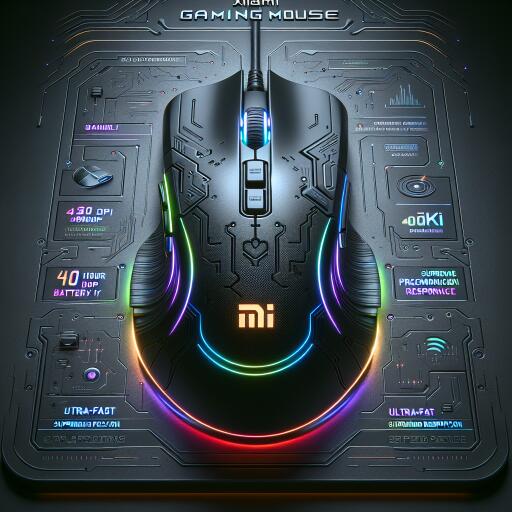

Xiaomi Gaming Mouse 2 Arrives With 160-Hour Battery, 40K DPI Sensor, and 8000Hz Response
Xiaomi’s latest pointer aims straight at the competitive scene. The Gaming Mouse 2 debuts in China with a lightweight build, blistering-fast polling, and a battery that promises marathon sessions. It lands at a retail price of $58, with an introductory offer of $51, positioning it as an aggressive value play against established esports staples.
Featherweight frame, esports-focused fit
At just 58 grams, the Gaming Mouse 2 is purpose-built for fast-twitch shooters and long scrim blocks. Xiaomi says the shape was refined using grip data from competitive players, supporting claw, fingertip, and palm styles. A symmetrical outer shell houses two side buttons on the left, making it a primarily right-handed design.
Inside, an umbrella-style internal skeleton trims mass without compromising rigidity. The structure targets a true 1:1 front-to-rear weight balance, which helps the mouse feel neutral during micro-adjustments and rapid flicks.
Next-gen optics and ultra-fine control
Under the hood is a custom PixArt PAW3955XM sensor rated for up to 40,000 DPI, 750 IPS tracking, and 60G acceleration. An esports mode boosts the static scan rate past 20,000 FPS to cut latency and tighten consistency in high-speed scenarios.
The mouse ships factory-calibrated with a DPI error margin below one percent, and you can make one-step DPI changes on the fly. Motion Sync keeps sensor output aligned with the PC’s polling cycle to smooth out pointer behavior, while five levels of lift-off distance let you dial in how the sensor disengages. There’s also a 1-degree angle snapping option for those who prefer slight line-straightening, and the sensor can track on glass surfaces thicker than 4 mm—handy for modern desks.
8000Hz in both wired and 2.4GHz modes
A Telink TL3228 dual-core controller powers the mouse’s headline-grabbing 8000Hz polling rate, whether you’re tethered via USB-C or running over 2.4GHz. For wireless reliability, the mouse transmits duplicate packets over two channels every 125 microseconds, aiming to reduce dropouts and jitter during clutch moments.
Click feel and durability
The primary buttons use TTC optical switches for crisp, low-latency activation and immunity to traditional switch bounce. The scroll wheel relies on a TTC gold encoder rated for two million cycles, which should keep scroll steps consistent over the long haul.
Triple-mode connectivity and long-haul battery
The Gaming Mouse 2 connects three ways: a braided USB-C cable for wired play, 2.4GHz wireless for competitive use, and Bluetooth 6.1 for easy device hopping. Inside sits a 530mAh battery. In 2.4GHz mode, Xiaomi rates it for up to 160 hours when polling is set to 1000Hz—ideal for players who don’t need 8K polling every session and prefer fewer charge cycles.
Onboard memory and streamlined tuning
Customization covers the essentials: DPI steps, polling rate, and sensor parameters. You can adjust settings through a web-based interface or local software, then store profiles directly in the mouse’s onboard memory so your setup travels with you.
Early take
On paper, Xiaomi’s Gaming Mouse 2 blends bleeding-edge specs—8K polling over both wired and 2.4GHz, a 40K DPI PixArt sensor, and Motion Sync—with a competition-friendly 58g frame. Add the long battery life and flexible connectivity and it reads like a serious contender for players chasing speed, portability, and precision without blowing the budget.
- Weight: 58 g
- Sensor: PixArt PAW3955XM, up to 40,000 DPI, 750 IPS, 60G
- Polling rate: Up to 8000Hz (wired and 2.4GHz)
- Wireless design: Dual-channel duplicate packet transmission every 125 μs
- Switches: TTC optical (L/R), TTC gold wheel encoder (rated 2M cycles)
- Grip support: Claw, fingertip, palm; right-handed with left-side buttons
- Features: Motion Sync, one-step DPI, 5-stage LOD, 1° angle snapping, glass tracking (>4 mm)
- Connectivity: USB-C (braided), 2.4GHz, Bluetooth 6.1
- Battery: 530mAh, up to 160 hours in 2.4GHz at 1000Hz
- Price: $58 retail, $51 introductory (China)
If the real-world performance matches the spec sheet, this could be one of the most accessible paths into 8K polling and high-end tracking this year.