
25 people learned to fly with virtual wings. Here’s how the brain changed
What happens to your sense of self when you strap on a headset, sprout a pair of feathered wings, and take off? A new virtual reality experiment suggests the brain doesn’t just play along—it adapts. After a week of learning to “fly” with simulated wings, volunteers began to process wings more like their own limbs, hinting at how profoundly our body maps can be reshaped by immersive tech.
From daydream to lab protocol
A team of researchers in Beijing built a VR training program inspired by the physics of bird flight and asked a simple question: could everyday people learn to fly with virtual wings, and would their brains treat those wings as part of the body? The answer, based on a cohort of 25 participants, appears to be yes—at least to a striking degree.
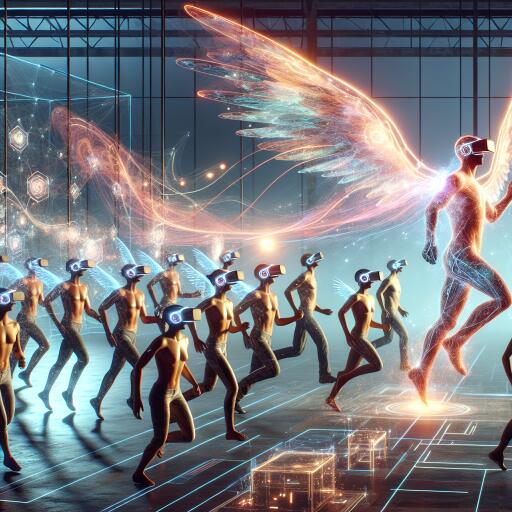
Each participant donned a headset and motion trackers, then faced a virtual mirror. In place of their usual avatar, they saw a birdlike self sporting large, rust-toned wings anchored to the shoulders. Wrist rotation, elbow extension, and broad arm sweeps drove the wings’ flaps and tilts, translating human motion into avian mechanics.
Flight school, VR style
Training unfolded over a week, moving from simple movement mapping to airborne control. The tasks escalated like a good tutorial level in a game: first, match basic flapping rhythms; then fend off drifting “airballs” by timing strokes; hold altitude over dramatic cliffs; and finally, thread a course through floating rings. Some participants took to it almost immediately. Others needed several sessions before the motions clicked. But across the group, performance improved clearly and consistently.
Crucially, the controls were designed to be believable—close enough to how wings actually work that users had to learn lift, drag, and orientation intuitively rather than button-mash their way through. That realism seems to have mattered for what happened next.
The brain starts to treat wings like “us”
Before and after training, the team measured brain responses to images of various body parts and different kinds of wings. After the week of flight school, regions in the visual cortex that typically light up for hands, arms, and other body parts showed an enhanced response to wings. Even more telling: the activation pattern to wings began to resemble the pattern these areas show for upper limbs.
In plain terms, practice with convincing, controllable wings nudged the brain toward including wings in its internal model of the body. The researchers describe this as a shift in body representation—an extension of the “body schema” that normally keeps track of where our parts are and how they move.
Why this matters for VR, gaming, and beyond
VR designers have long known that embodiment—the feeling that a virtual body is yours—amplifies immersion. This study goes a step further: not only can users feel as if they own nonhuman appendages, their brains can start to process those appendages in a body-like way after relatively brief, structured training. That has several implications:
- More intuitive control schemes: Mapping novel inputs (tails, wings, tentacles) onto human motion may become second nature with the right training arcs, reducing cognitive load in complex simulations and games.
- Assistive tech and prosthetics: If the brain can adopt something as alien as wings, there’s hope for smoother integration of advanced prosthetics, exoskeletons, or extra robotic limbs—especially when feedback is rich and training is guided.
- New genres of play: Designers can craft mechanics around truly nonhuman bodies, confident that players can learn them fast enough to be fun, not frustrating.
- Education through experience: Firsthand “feel” may teach concepts—like lift and control surfaces—far more effectively than abstract explanation.
Plasticity on display
Neuroscientists have documented body-ownership illusions for decades, from the classic rubber hand to full-body swaps. But wings push the envelope: they’re not just an extended arm; they’re a fundamentally different structure. Seeing visual body areas tune themselves toward wings after a short course underscores how malleable these systems are when given coherent, controllable multisensory input.
Participants didn’t just report feeling more “winged”; their performance in flight tasks and their neural responses moved in tandem. That pairing—behavioral learning plus brain-level change—suggests the brain isn’t merely pretending. It’s updating predictive models about how “my body” should behave in a gravity-bound world, even when that body is fantastical.
How they built the illusion
Several design choices likely boosted embodiment:
- Mirror feedback: Seeing the wings attached to a self-reflection strengthens ownership far more than third-person views.
- Biomechanics-informed mapping: Rotations and flaps followed plausible aerodynamics, rewarding physically coherent movement.
- Progressive challenge: Graduated tasks provided a clear learning curve with immediate, meaningful feedback.
Limits and what’s next
It’s early days. Twenty-five people constitute a modest sample, and the training lasted only a week. Open questions include how long the brain changes persist, whether more intense haptics or wind feedback would deepen embodiment, and how generalizable the effect is to other nonhuman forms (fins, extra arms, tails). There’s also the matter of transfer: does VR flight practice alter how people think about real-world physics or balance, and for how long?
Still, the results align with a broader trend: when virtual environments provide tight sensorimotor loops—your actions yield believable, timely consequences—the brain is eager to adapt. As our time in VR and mixed reality grows, understanding how these adaptations shape perception, attention, and self-image will be critical, both for crafting better experiences and for safeguarding users’ well-being.
The takeaway
Give people wings in VR and teach them to use them well, and their brains begin to treat those wings like part of the body. That’s a remarkable testament to human plasticity—and an exciting signal to anyone building the next generation of immersive games, tools, and assistive technologies. The more convincingly we can inhabit impossible bodies, the more our nervous systems seem willing to meet us halfway.