
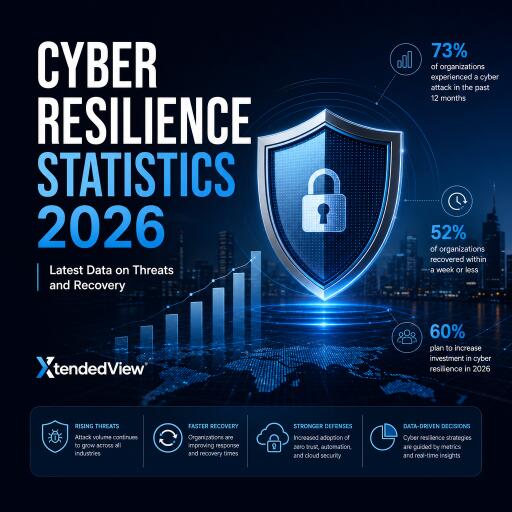

Cyber Resilience Statistics 2026: Latest Data on Threats and Recovery * XtendedView
Staying online, productive, and trustworthy in the face of relentless cyber pressure is now a core business competency. Cyber resilience goes beyond classic “keep them out” security to emphasize continuity, rapid response, and fast recovery when—not if—incidents occur. As AI reshapes attack surfaces, supply chains interlock across clouds, and regulators scrutinize risk, the difference between a brief disruption and a full-scale business crisis increasingly hinges on resilience maturity.
At-a-glance: 2026 highlights
- 72% of organizations saw risk increase year over year.
- Average breach cost: $4.44M in 2025 (down from $4.88M in 2024).
- Breach identification/containment dropped to 241 days—the best in nine years.
- 94% say AI is the dominant disruptor of cyber risk in 2026.
- 87% flag AI-system vulnerabilities as a fast-rising threat.
- 65% of large companies rank third-party/supply chain exposure as the top resilience challenge.
- Smaller firms are roughly 2x more likely to report inadequate resilience.
- Only 14% believe they have enough cybersecurity talent right now.
- Over 40% endured successful social engineering attacks in the past year.
AI, ransomware, and the shifting threat map
- Top forces redefining resilience: AI adoption, geopolitical fragmentation, and capability gaps.
- Ransomware hit new highs in 2025: 124 active groups and 7,458 disclosed attacks.
- A newly formed crew drove about 10% of global incidents within its first year.
- Public-sector resilience lags: 23% report insufficient capabilities.
- AI governance is immature—63% lack formal policies; 97% of AI-related incidents lacked proper access controls.
Regional confidence snapshot
- North America: 65% confident (highest)
- Oceania: 50%
- Latin America: 42%
- Africa: 38%
- Middle East: 36%
- Asia: 20%
- Europe: 15% (lowest)
Resilience vs. security: why the difference matters
- Security focuses on prevention; resilience adds response, recovery, and continuity.
- 23% of public-sector entities report weak resilience despite having controls.
- AI-enabled defenses lower breach costs and speed containment; 2025 lifecycle hit 241 days.
- Supply chain dependencies (54% of large orgs) demand more than traditional controls.
- Incidents with poor AI governance (97%) underscore the need for policy, not just tooling.
The business cost of disruption
- Global average breach cost: $4.44M (2025); U.S. average: ~$10.22M.
- Hybrid/multi-environment breaches: ~$5.05M; healthcare tops sectors at ~$7.42M.
- Average per-record cost: ~$160; India averaged ~₹220M per breach.
- Staffing shortages commonly inflate recovery costs and downtime.
Attack volume, disclosure gaps, and extortion
- 42% faced phishing/social engineering in 2024; over 40% reported successful attempts.
- Researchers counted 7,458 disclosed ransomware attacks in 2025; an estimated 86% of incidents go unreported.
- One major market logged 1,536 ransomware cases; another saw 265M web attacks in 2025.
- Double extortion dominates; over 70% of ransomware now exfiltrates data pre-encryption.
- Manufacturing remains the most frequent ransomware target.
- Organizations with tested incident response and segmented backups recover far faster—often without paying.
Cloud, SaaS, and supply chain exposure
- 90%+ run multi/hybrid cloud; hybrid breaches average ~$5.05M.
- 82% rank cloud security as a top resilience priority; misconfiguration remains a leading cause.
- 94% rely on SaaS; 78% use cloud-native backup/recovery; multi-cloud boosts redundancy but raises complexity for 67%.
- Centralized visibility yields 50% faster threat detection; cloud resilience spend rose 35% (2025–2026).
- 65% cite supply chain risk as the No. 1 resilience challenge in 2026 (up from 54% in 2025).
- Over 40% of breaches involve third parties; 62% require risk assessments pre-onboarding.
- Software supply chain attacks are up 300%+ since 2021; only 37% continuously monitor vendors.
- Formal third-party risk programs deliver up to 45% faster recovery after partner-linked incidents.
Time to detect, contain, and recover
- Average breach lifecycle (2025): 241 days (181 to detect, 60 to contain).
- Security AI shortens detection/containment by ~98 days; automation cuts containment times ~40% in large enterprises.
- Breaches taking >200 days cost ~$5.46M; faster cases save ~$1.39M.
- Dedicated incident response teams save ~$2.2M per breach.
- Regular exercises trim detection by ~28 days; AI-assisted monitoring: MTTD 161 days vs 284 manually in cloud/hybrid.
Readiness, maturity, and the talent squeeze
- Readiness reality: 64% meet only baseline requirements; 19% exceed; 17% are insufficient.
- Maturity by size: large enterprises 71%; government 62%; mid-market 54%; small business 38% (33-point gap large vs small).
- Only 14% say they have adequate cyber talent; 65% report moderate-to-critical skill shortages.
- Staffing gaps can raise breach costs up to 20% and extend response times by ~30%.
- 70% of small firms report shortages vs 45% of large enterprises; nearly 60% struggle to hire for cloud, AI governance, and threat intel.
- About 55% lean on automation and managed services to bridge the workforce gap; global shortfall totals ~3.4M roles.
Business continuity: practice makes faster
- 52% maintain documented disaster recovery plans; only 38% run cyber crisis simulations more than once a year.
- Enterprises that integrate security with continuity recover faster than siloed teams.
- Downtime can cost ~$5,600 per minute; one hour can exceed $300K in large enterprises.
- 93% say downtime directly hits revenue and trust; ransomware often triggers multi-day outages.
- Customer-facing and OT systems experience the highest operational impact during incidents.
Conclusion
The data is clear: threats are accelerating, AI is rewriting risk, and ecosystem dependencies are now central to resilience. Organizations that invest in response playbooks, automation, recovery testing, cloud and vendor governance, and skilled teams consistently cut breach costs and bounce back faster. The gap between prevention-focused programs and resilience-led strategies is widening—those who build for continuity and rapid recovery today will weather tomorrow’s attacks with fewer losses and less downtime.