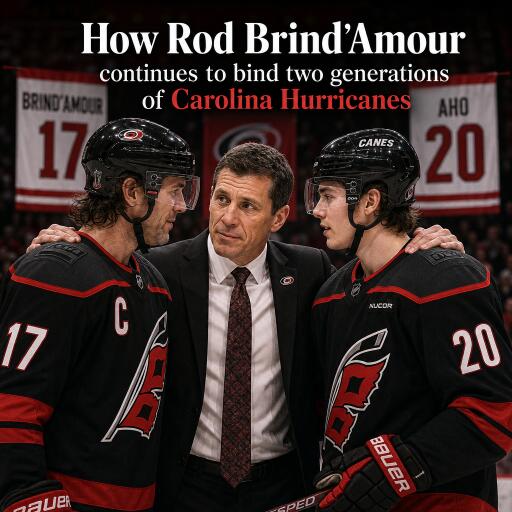

How Rod Brind’Amour continues to bind two generations of Carolina Hurricanes
Two decades after hoisting the Stanley Cup in a moment that defined an era in Raleigh, Rod Brind’Amour is steering another Hurricanes group to the brink of the sport’s summit. His teams look like he once played: relentless, fast, and forever on top of the puck. The blueprint hasn’t changed—only the vantage point behind the bench.
Now in his eighth season as head coach, Brind’Amour has guided Carolina to the Final with the same unflinching standards that powered his playing career. He admits the thrill feels different from his days in the faceoff circle; he’s trying to savor the ride while bracing for the hardest steps left. The opponent is battle-tested and recently crowned, a reminder that the last climb is always the steepest.
A philosophy forged as a player
Brind’Amour’s approach is simple to describe and infuriating to play against: smothering puck pressure, five-man responsibility, and a full-ice commitment every shift. Those who’ve shared a bench with him say his teams mirror his habits—nothing fancy, nothing unclear, just clear roles executed at full throttle. Former teammates and coaches have long marveled at how he strips the game to essentials. Players know exactly what’s expected. There’s no gray area.
From trade to title—and beyond
Carolina’s connection to Brind’Amour began with a franchise-shaping trade in January 2000. He immediately gave the club backbone, helped push it to the 2002 Final, and captained the 2006 champions. Over more than 1,600 NHL games, he set the standard for two-way responsibility, earning two Selke Trophies and a reputation for winning pucks in places others dreaded.
When he retired in 2010, he shifted seamlessly into development, then assistant coaching, before taking the helm in 2018. What followed has been a defining era of consistency: fundamentally sound hockey, detail by detail, day by day. He learned from the smart benches he played under, then layered on his own presence—intense, direct, and unmistakably authentic.
Standards set in steel
His message hasn’t softened with time. Make the right play. Be in the right spot. Make every shift count. If it doesn’t fit the standard, it doesn’t last long. He often talks about “doing it right,” and the buy-in is non-negotiable. The result is a team that rarely strays from its identity, one that trusts its habits to carry it through the tightest games.
Those who watched the 2006 run remember how he set the tone—first in the battle, last to ease up. That same edge guides his coaching. He paces behind the bench, jaw working a stick of gum like it owes him money, living every puck touch. The line between passion and poise is thin; he walks it with intention.
The coach who can still outlift you
At 55, he still looks built for a third-period defensive-zone draw. The work never dips—early mornings in the weight room, sweat before sunrise, then onto video and practice. Staffers talk about how he leads with example: he won’t demand anything of players he wouldn’t do himself. That was true in his prime and it’s true now, which explains why his voice still hits with credibility in an NHL room.
Echoes of 2006 in the present
There’s a familiar structure to this version of the Hurricanes. The captain is again a veteran center, defense-first by nature and universally respected—an extension of the coach’s pulse in the room. Up front, the offense feels collective more than star-driven, a sum greater than its parts. In net, Carolina has navigated seasons with multiple contributors, riding whoever is right for the moment. Through it all, the constant is the standard.
Observers around the league point to Carolina’s year-over-year reliability as a testament to the job behind the bench. Teach exactly what you want. Hold everyone to it. Repeat. Brind’Amour chased perfection as a player—sometimes to a fault—and he channels that same pursuit as a coach without grinding players down. Compliments rarely land; the answer is usually a version of “just doing my job.” That humility trickles through the roster.
Open doors, open dialogue
Brind’Amour’s relatability comes from having lived every role. He’s been a Cup-winning captain, a fourth-liner, and a healthy scratch. He’s played hurt and played heavy minutes. That breadth lets him meet players where they are. Veterans and young skaters alike talk about the open-door conversations and honest video sessions. As players mature, he invites more dialogue—he’ll always have a rebuttal, but he wants the back-and-forth. That balance keeps buy-in strong when the stakes rise.
Family roots that never left
The culture he curates still feels like a family gathering. After home games, it’s common to see kids wandering the room, ping pong paddles tapping away as the adrenaline settles. His own children grew up in that setting; now a new batch of little ones carries the tradition. The message is constant: everyone matters, from the kitchen to the front office to the last forward over the boards. Care about each other and play for each other.
One more memory to make
The 2006 champions remain inseparable, bonded forever by silver etchings and shared scars. Brind’Amour often challenges his teams to build their own lasting reels. Every year is a new journey, he says, and the past—glorious or otherwise—doesn’t score a single goal tomorrow. Only the work ahead matters. The “ultimate prize” is still the same gleam it was when he lifted it as a player. The difference now is he’s trying to hand it to his players first.
The Final awaits. The opponent is formidable. The path is narrow. And there is perhaps no coach better built to keep a group steady on that edge than the one who turned two generations of Hurricanes into his reflection.