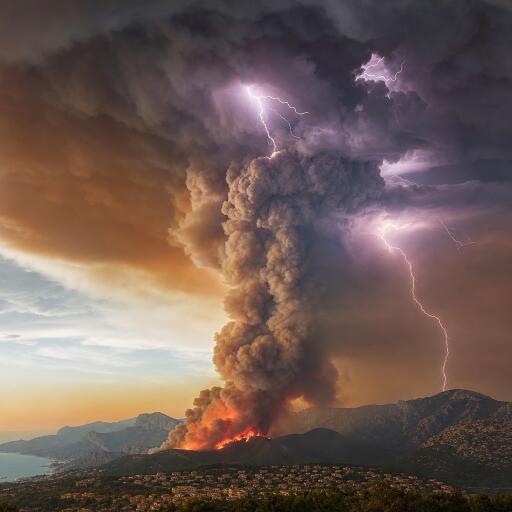

Dramatic moment smoke column amid France wildfires becomes thunderstorm
A colossal wildfire in southwest France intensified to such a degree that the rising smoky column evolved into a thunderstorm, spawning lightning and triggering new fires across the region.
New footage from the Saumos area in the Gironde department captured a voracious plume of smoke stretching for miles and blotting out the sky as the blaze expanded.
Starting on July 22, the roughly 162-square-mile blaze has consumed large swathes of countryside and threatened nearby towns. Officials said hundreds of homes were abandoned and tens of thousands were forced to flee, with numbers reaching roughly 240 homes and around 220,000 people displaced so far.
What sets this fire apart is its ability to sustain itself, feeding a pyroCumulonimbus — a pyrocumulonimbus cloud spawned by extreme heat, smoke, and moisture. Such clouds are rare in Europe and are more commonly seen in other continents under severe fire conditions. Fire service authorities noted the pyroCb forming within days of the blaze breaking out, lifting heat and smoke into an immense, electrified cloud that behaved as a self-contained weather system above the flames.
Experts explain that the process begins when a blaze heats the air at ground level to extraordinary temperatures, creating a pocket of hot, dry air that rises, pulling in hot ash and water vapor. As the plume climbs and cools, droplets condense around ash particles; above the altitude where it freezes, ice crystals carry electrical charges that can unleash lightning. The resulting cloud can complicate firefighting by generating its own winds and, in some cases, even driving fire-whirls — fiery spirals resembling rotating columns of flame and heat.
PyroCumulonimbus events are uncommon in Europe. Portugal recorded one during its 2017 season, and now France has joined the list as wildfires surge across the region.
Looking ahead, authorities warned that the heatwave gripping the area — with temperatures nearing 40 degrees Celsius — could fuel further outbreaks and escalate the challenge for crews on the ground. The ongoing crisis has displaced hundreds of thousands and stretched regional emergency services to the limit as they try to contain multiple fronts.
Officials described the situation as exceptionally severe, underscoring the strain on resources and the complexity of forecasting when such self-generated storms appear above active fires. The episode is a stark reminder of how climate-driven megafires can create their own weather systems, altering risk patterns and complicating response efforts.