
SASC proposes reorganization of Pentagon’s IT, cyber leadership
Senate lawmakers want to consolidate the Pentagon’s IT and cyber authorities under a single top official, aiming to eliminate longstanding seams between defensive network management and operational cyber forces.
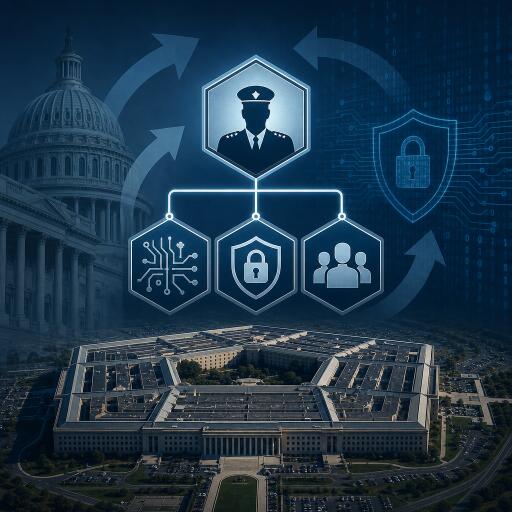
The Senate Armed Services Committee (SASC) is proposing a new post—Undersecretary of Defense for Cyber, Information, and Networks—folding the Defense Department’s chief information officer (CIO) and principal cyber advisor (PCA) into one dual-hatted leader. The move appears in the committee’s draft of the fiscal 2027 National Defense Authorization Act (NDAA), according to a bill summary shared with reporters.
Under the plan, the new undersecretary would act both as the Pentagon’s CIO—overseeing the enterprise IT portfolio, digital modernization, and defensive cybersecurity—and as the PCA, who is charged with advising on offensive cyber operations and ensuring the readiness of the department’s cyber forces in coordination with U.S. Cyber Command.
For years, lawmakers and defense officials have wrestled with the blurry boundary between the CIO’s “protect and defend” mission and Cyber Command’s operational activities. Senate staffers briefing reporters said the reorganization is designed to reduce friction by unifying oversight where those missions intersect. As one staffer put it, the maturation of cyber operations exposed gaps between enterprise network defense and operational cyber forces that a single accountable leader could help close.
One umbrella for IT, cyber operations, and AI
Beyond aligning the CIO and PCA roles, the new undersecretary would also have oversight of the Chief Digital and Artificial Intelligence Office (CDAO), according to committee staff. The intent: speed the integration of AI and data capabilities into cyber defense and operations without creating yet another silo.
Importantly, staffers emphasized that CDAO would remain a distinct organization—“nested” under the undersecretary’s purview—rather than being dissolved or merged outright. That structure aims to preserve CDAO’s mission focus while tying its priorities more tightly to enterprise IT modernization and cyber operations.
Why the consolidation now?
The Pentagon’s CIO is the department’s senior IT advisor and steward of sprawling enterprise infrastructure—from cloud and identity to cybersecurity and zero-trust implementation. The PCA, by contrast, centers on force readiness for cyberspace operations, overseeing how the services organize, train, and equip cyber forces for missions often conducted by U.S. Cyber Command.
As cyber threats have grown more sophisticated, the distinction between “defensive network management” and “operational cyber” has blurred. Defensive improvements to the enterprise can directly enable or constrain operational tempo, while cyber operations can have implications for the security and resilience of DOD networks. Committee staff described the new undersecretary as an attempt to create clear accountability across these interlocking missions.
House echoes: reduce duplication and fragmentation
The House Armed Services Committee (HASC) is pressing in a similar direction. In its version of the FY27 NDAA—approved June 5—lawmakers directed the Pentagon to review and, as needed, reorganize its cybersecurity, IT, network defense, and defensive cyber operations to improve alignment and cut duplication. While the House bill stops short of creating a new undersecretary, the underlying diagnosis is shared: current structures risk fragmented accountability and overlapping efforts.
What could change if the proposal becomes law
- Simplified lines of authority: A single leader would adjudicate tradeoffs where enterprise IT, defensive cyber, and operational needs converge, reducing bureaucratic cross-talk.
- Clearer boundary with U.S. Cyber Command: By consolidating CIO and PCA roles, the Pentagon could better define where enterprise defense ends and operational activities begin—potentially smoothing coordination with Cyber Command.
- Faster AI integration: With CDAO under the same umbrella, data and AI capabilities could be baked into both enterprise defenses and cyber operations more coherently.
- Reduced duplication: Overlapping initiatives across CIO, PCA, and defensive cyber elements could be rationalized under one strategic plan.
Key details still to watch
- Implementation blueprint: How authorities, budgets, and staff realign under the new undersecretary will determine whether consolidation delivers speed and clarity—or just adds another layer.
- Service roles and responsibilities: The services organize, train, and equip cyber forces. Any shift in oversight must preserve service accountability while tightening enterprise-operations integration.
- CDAO’s autonomy: Nesting CDAO could accelerate impact, but guardrails will be needed to maintain its innovation tempo and cross-department reach.
- Coordination with Cyber Command: The new undersecretary will need robust mechanisms for joint planning and real-time synchronization with operational commanders.
The road ahead
The undersecretary proposal hinges on final NDAA negotiations and passage. If enacted, the Pentagon would face a significant—but potentially streamlining—reorganization, with ripple effects across IT acquisition, cybersecurity architectures, and cyber force readiness. The House’s directive to review and potentially reorganize suggests bipartisan momentum for tackling fragmentation, even if the chambers differ on structure.
For defenders, operators, and acquisition teams, the message is consistent: reduce seams, clarify accountability, and align technology with mission effects. Whether through a new undersecretary or targeted reforms, the FY27 cycle appears poised to reshape how the Pentagon manages its digital backbone and the cyber forces that rely on it.
Bottom line
By unifying the CIO and principal cyber advisor under a new undersecretary—and placing CDAO within its orbit—the Senate aims to bring enterprise IT, defensive cybersecurity, and operational cyber readiness under a single strategic roof. If lawmakers can translate that vision into a workable structure, the Pentagon could gain the clarity and speed it needs for a domain where milliseconds and misalignments both matter.