
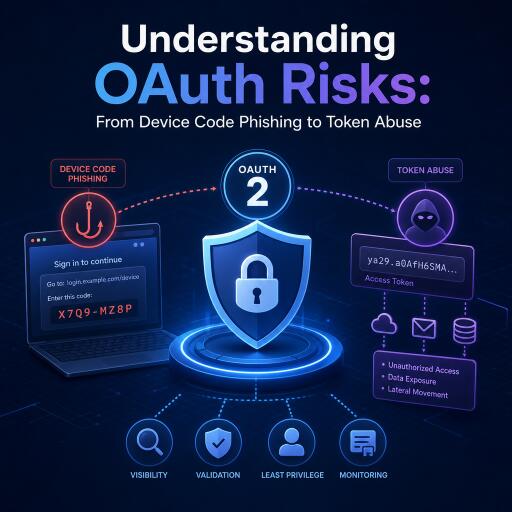

Understanding OAuth Risks: From Device Code Phishing to Token Abuse
OAuth sits at the core of how modern apps sign you in and access your data without sharing passwords. It’s elegant, fast, and everywhere—from productivity suites to cloud consoles. But that same convenience is now being bent by attackers who don’t need your credentials at all. By riding legitimate authorization flows and session tokens, they can slip past phishing filters and even multi-factor authentication, then persist quietly in the background.
The new identity attack meta
Classic phishing chases passwords. The current wave targets tokens, consent, and redirect logic—the plumbing of OAuth itself. Three tactics dominate:
- Device code phishing: convincing users to enter a one-time code on a real login page, handing over tokens to an attacker.
- Token abuse: manipulating legitimate authorization to harvest access and refresh tokens for long-lived access.
- Redirection abuse: chaining valid OAuth redirects to land victims on attacker-controlled infrastructure without obvious tells.
Device code phishing: trusted page, wrong intent
The device code flow was built for limited-input devices like TVs and IoT endpoints. A user opens a sign-in page on a second device and types a short code—simple and secure in the right context. Attackers twist that simplicity with convincing lures (invoices, quotes, project invites) that push a target to enter a code on an authentic sign-in page. The page is real. The MFA prompt is real. The authorization succeeds—just not for the right party.
Once completed, valid access (and often refresh) tokens are created for the attacker’s session. Because everything happens on legitimate pages, users rarely suspect foul play. Campaigns have evolved from broad, generic spam to highly tailored messages that mirror everyday workflows, vastly improving hit rates.
Token abuse: the quiet takeover
After consent is granted, OAuth issues an access token and sometimes a refresh token. Attackers don’t need your password if they can orchestrate that grant. By crafting or piggybacking on a seemingly normal sign-in or app authorization, they receive tokens that let them:
- Read mail, files, calendars, or cloud assets within the token’s scope.
- Blend into normal traffic because requests appear as an approved app.
- Persist by minting new access tokens from a captured refresh token.
The result is a stealthy foothold that doesn’t trigger new login prompts and may bypass controls focused only on credentials.
Redirection abuse: weaponizing legitimate flows
OAuth uses redirects to shuttle users and authorization codes between identity providers and applications. When those redirects are overly permissive or poorly governed, attackers can graft their own endpoints into the chain. Victims see a familiar sign-in screen, complete authentication, and are seamlessly redirected—ultimately landing on attacker-controlled pages or payload delivery sites. Because each step uses expected mechanisms, link scanners and browser protections can be sidestepped.
Why defenders miss it
- Legitimate UX: Users see official sign-in pages and MFA prompts, so nothing “looks” phishy.
- Token-first tradecraft: Security tuned for password anomalies or login failures won’t catch authorized token use.
- Persistence by design: Refresh tokens extend access without additional prompts.
- Benign cover: Activity resembles a permitted app interacting with resources.
Blast radius beyond sign-in
Once tokens are in play, the impact reaches far past the login screen. Email, documents, messaging, storage, and cloud management interfaces can all be touched, depending on scopes granted. Business processes can be disrupted, data exfiltrated, and audits muddied by activity that appears “legitimate” in the logs.
Defense, distilled
Blocking every risky path isn’t realistic, but you can shrink the attack surface and add sharp detection points.
- Restrict device code flow:
- Disable or limit it unless there’s a clear, documented use case.
- Pilot in report-only mode to understand impact before enforcement.
- Keep exception lists tiny, controlled, and regularly reviewed.
- Treat device code sign-ins as high-signal events; watch for unusual IPs, geos, and follow-on token use.
- Harden consent and app governance:
- Require review for higher-privilege scopes; block risky third-party consents by default.
- Continuously inventory enterprise apps, publishers, and granted permissions.
- Remove unused apps and excessive scopes; prefer least-privilege access.
- Choose stronger OAuth patterns:
- Prefer authorization code with PKCE for public/native clients.
- Avoid legacy or implicit flows; eliminate wildcard redirects.
- Bind tokens to client and context where possible (proof-of-possession, token binding).
- Shorten token lifetimes; rotate secrets frequently.
- Monitor for token-centric anomalies:
- Correlate sign-ins with subsequent API calls and resource access.
- Alert on impossible travel, unfamiliar device-app pairs, and sudden scope changes.
- Track refresh token reuse across atypical locations or infrastructures.
- Lock down redirects:
- Maintain strict, exact redirect URI allowlists; no wildcards.
- Review changes to redirect settings and app registration metadata.
- Validate state and nonce values to prevent tampering.
- Make users part of the control loop:
- Teach that an official sign-in page doesn’t guarantee a safe flow.
- Never enter verification codes from unsolicited prompts or messages.
- Decline and report unexpected consent requests or app approvals.
The bottom line
OAuth isn’t broken; it’s being misused in ways that sidestep defenses fixated on passwords. Treat tokens, consents, and redirects as first-class security assets. When you reduce exposed flows, tighten app governance, and watch for token-era signals, you turn today’s stealthiest identity attacks into loud, actionable events.