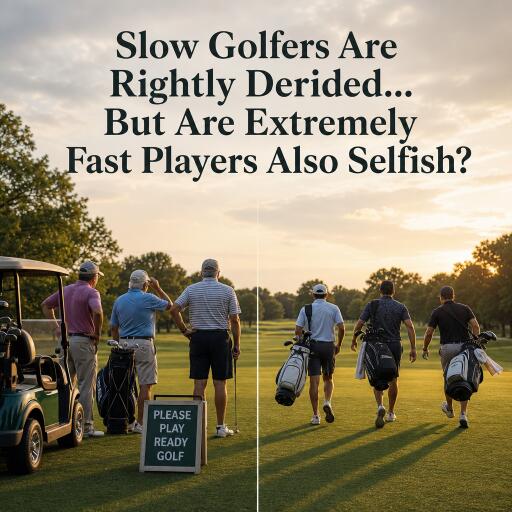

Slow Golfers Are Rightly Derided… But Are Extremely Fast Players Also Selfish?
Everyone knows the agony of waiting behind a glacial fourball. But there’s a flip side we rarely discuss: the player who treats 18 holes like a time trial. When the throttle stays wide open, does “playing briskly” turn into something else—impatience, pressure, even selfishness?
Slow play isn’t one problem—it’s several
“Slow” doesn’t wear a single handicap. It might be the newcomer who reloads on every tee and combs the rough for five minutes a hole. It might also be the low-marker who rehearses a 60-second routine for every swing and lines up tap-ins like championship putts. Different routes, same traffic jam.
Solutions exist—ready golf, fewer long searches, enforced time limits—but getting an entire field to adopt them consistently is another matter. Culture, not just rules, dictates pace.
Now meet the speedster
There’s another archetype: the hyper-fast player. They’re usually competent, rarely care about a card, almost never hit a provisional, and treat “gimme” as the default. Their mission is to get around in a blur and be back at the car before the coffee’s cold. Waiting behind a group? One pause is tolerable; two is a personal affront.
On an empty course, this style can be harmless—even admirable. But on a moderately busy day, a one-person sprint can create a different kind of friction: not minutes added, but tension introduced. Partners hurry, routines unravel, and the joy of a social round evaporates under a silent stopwatch.
When fast turns hostile
Here’s a scene many will recognize. A midweek game with friends, deliberately chosen off-peak for a relaxed stroll. By the third green, a two-ball has crept up behind and begins the silent pantomime—hands on hips, arms waving, the infamous “teapot” pose. You were always going to wave them through on the next par-3, but the dagger looks arrive first, followed by a scolding about pace of play as if the tee box were a headmaster’s office.
They go through, the conversation that follows is weirdly chummy, and yet the vibe has already soured. No one wants the course to grind to a halt. But weaponizing speed—gesturing, pressuring, policing—rarely helps. It swaps minutes saved for goodwill lost.
Speed has a time and a place
Plenty of golfers cherish a fast winter loop: sub-four hours, keep moving, stay warm. Lose a ball just off the fairway? Tough break—drop one and move on. Can’t score on the hole? Pick up. In that context, “pace” is part of the fun.
But during weekend competitions, or on crowded Saturdays, the tempo slows. That isn’t failure; it’s reality. If every fairway ahead is occupied, barging through one group doesn’t change the queue. Smart fast players read the room: when offered to play through, they take it; when it’s jammed ahead, they settle in without theatrics. Solo golfers often improvise—hit a practice ball, groove a shot, make the wait productive without pressuring others.
What both camps owe each other
- Offer and accept the pass sensibly: If you’re clearly holding up play and the way ahead is open, wave faster groups through. If the course is stacked, recognize there’s nowhere to go.
- Lose the pantomime: No teapots, no sarcastic clapping, no passive-aggressive body language. A polite ask beats a public shaming every time.
- Be realistic about searches: A brief look is fine; a treasure hunt isn’t. Use provisional balls when appropriate.
- Trim the fluff: Endless rehearsal swings and elaborate green-reading routines add up. Keep essentials, ditch the rest.
- Respect different rounds: Casual twilight knock? Speed away. Medal day or a course at capacity? Expect and accept slower rhythms.
- Communicate like adults: “We’ll let you through on the next tee” or “Mind if we slip by?” said calmly, solves 95% of conflicts.
Fast isn’t a free pass
Playing quickly is good etiquette; making others feel rushed is not. The same way slow play can strangle enjoyment, extreme speed can squeeze it, too—by turning a shared game into someone else’s sprint. The best golfers adapt: they tighten up when the course is clear, relax when it’s busy, and treat everyone on the tee sheet like part of the same day out rather than obstacles to dodge.
We should absolutely discourage the behaviors that stall a course. But let’s also retire the roadside theatrics. Courtesy, not a ticking clock, is what keeps golf moving. If you want to be a pace hero, do it the classy way: be ready, be tidy, be kind—and save the teapot for the clubhouse kettle.