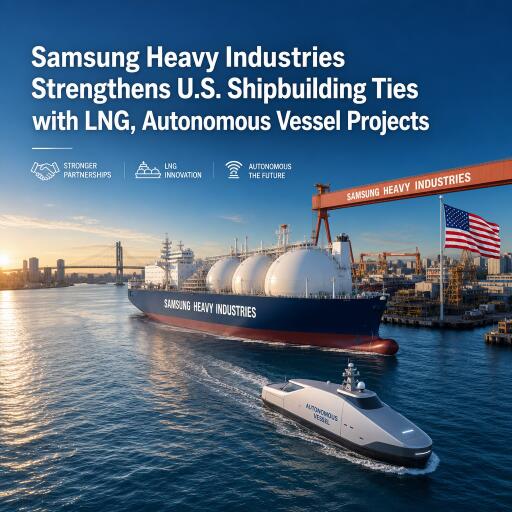

Samsung Heavy Industries Strengthens U.S. Shipbuilding Ties with LNG, Autonomous Vessel Projects
Samsung Heavy Industries (SHI) is deepening its collaboration with U.S. shipbuilders, startups, and academic institutions, unveiling a broad slate of initiatives spanning LNG bunkering, autonomous surface vessels, and immersive workforce training. The moves were announced alongside the launch of the Korea–U.S. Shipbuilding Cooperation Center (KUSPC) in Washington, D.C., a new platform designed to facilitate joint research and policy coordination between the two countries’ maritime sectors.
New hub for trans-Pacific shipbuilding collaboration
The newly inaugurated KUSPC aims to streamline cooperation between government and industry while accelerating joint R&D. At the opening ceremony, SHI signed multiple agreements that collectively bolster its presence in the U.S. market and expand shared development pipelines across next-gen shipbuilding technologies.
LNG bunkering milestone clears a key hurdle
Among the headline developments, SHI secured Approval in Principle (AiP) for a 12,000-cubic-meter LNG bunkering vessel concept created with Conrad Shipyard and classed with the American Bureau of Shipping. The AiP marks a significant step toward deployment of cleaner-fuel logistics infrastructure in North America. SHI and Conrad established their LNG bunkering cooperation late last year, and the new recognition signals that the design has cleared preliminary technical and safety assessments.
Autonomous and unmanned vessels take center stage
SHI also inked a strategic cooperation pact with Saronic Technologies, a U.S. startup focused on unmanned surface vessels (USVs). The partnership targets collaborative research on autonomous navigation stacks and AI-driven digital solutions that support mission planning, situational awareness, and fleet operations for USVs. The two companies plan to explore robotics-enabled manufacturing and process automation to scale production.
Workforce pipelines meet immersive training
With skilled labor in high demand across global yards, SHI is expanding its U.S. workforce strategy through an agreement with Vigor Marine Group, a major MRO provider. The companies intend to establish a joint training hub that focuses on developing welding and coating talent critical to ship construction and repair. SHI will bring virtual reality (VR) and augmented reality (AR) training modules into the program, allowing trainees to practice complex procedures in realistic, risk-free simulations before transitioning to the shop floor.
For those tracking the convergence of industrial training and immersive tech, this is a notable signal. VR/AR-driven instruction can standardize best practices, shorten time-to-competency, and reduce waste—benefits long seen in aerospace and automotive. Applying similar toolsets to shipbuilding aligns with a broader shift toward digital-first upskilling in heavy industry.
AI-powered fabrication and academic alliances
On the manufacturing side, SHI reached an agreement with U.S. welding equipment maker Miller to co-develop an AI-based system for producing stainless steel spools—components central to piping networks aboard ships. The goal is to enhance quality control and throughput by embedding intelligence into fabrication workflows.
Complementing the industrial partnerships, SHI signed research agreements with the University of Texas at Dallas, San Diego State University, and California Polytechnic State University. The collaborations will focus on virtual training ecosystems tailored to shipyard environments, integrating simulation, assessment, and skills tracking. Expect a mix of VR scenarios for welding and coating, digital twins of workstations, and analytics that help instructors pinpoint where learners need targeted coaching.
Why this matters
- Cleaner fuels: LNG bunkering capabilities accelerate the maritime sector’s near-term decarbonization pathway while enabling dual-fuel fleets.
- Autonomy at sea: USV research underscores how AI and robotics are moving from pilot projects to production-ready platforms for defense, logistics, and environmental monitoring.
- Immersive upskilling: VR/AR training for shipyards mirrors broader enterprise trends, promising safer learning, higher retention, and more consistent workmanship.
- Supply chain resilience: U.S.-based partnerships expand local capacity for advanced fabrication and MRO, diversifying global shipbuilding value chains.
Outlook
SHI’s leadership characterized the initiatives as the start of a new phase in Korea–U.S. maritime cooperation, with ambitions to catalyze a broader industry resurgence through technology-led projects. With regulatory recognition for LNG bunkering, a push into autonomous vessel systems, and a clear bet on VR/AR training pipelines, the company is positioning itself at the intersection of cleaner propulsion, smart ships, and digitally skilled labor.
As these programs progress—from prototype to production, and from pilot classrooms to live yards—the tangible measures of success will include safety metrics, training throughput, vessel availability, and emissions reductions. If delivered at scale, the combined impact could help modernize U.S. maritime infrastructure while setting a template for cross-border innovation in heavy industry.