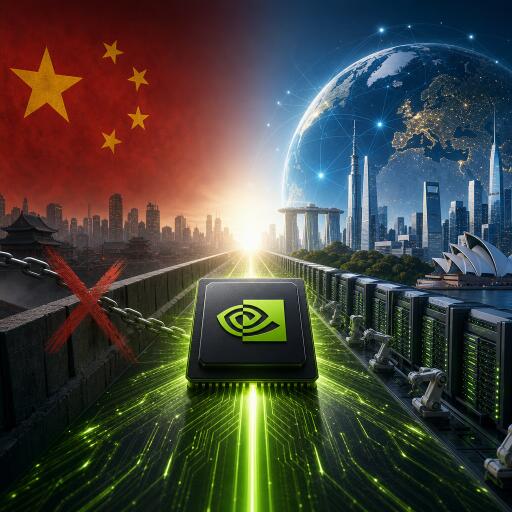

Nvidia Just Proved It Doesn’t Need China Anymore
Nvidia has spent the past year fighting two big questions from investors: Is the AI boom starting to slow, and does the company need China to keep growing at this pace? After its latest quarterly report, the company offered an unusually direct answer to both.
The short version: Nvidia says demand is still running ahead of supply, growth next year could be far stronger than Wall Street expected, and none of that outlook depends on China.
That is a remarkable shift in the story around the AI giant. For months, skeptics argued that export restrictions and rising competition would eventually force Nvidia back to earth. Instead, management just laid out a case that the real constraint is not demand for AI chips at all. It is the physical supply chain needed to build and deploy them.
Nvidia shocked Wall Street with an early growth forecast
Companies rarely offer detailed guidance this far in advance, especially at Nvidia’s size. But during its fiscal 2027 second-quarter call, management said fiscal 2028 revenue could grow about 70% year over year.
That number matters because analysts were expecting something much lower, closer to 44% growth. Based on Wall Street’s existing models, Nvidia’s fiscal 2028 revenue would have landed around $574 billion. Using Nvidia’s own growth outlook, the figure moves far closer to $675 billion, and potentially near $700 billion if current momentum holds.
That leaves a massive gap between what the market had been pricing in and what Nvidia now believes it can deliver. We are not talking about a niche chipmaker growing off a small base anymore. Nvidia is already operating at a scale measured in hundreds of billions of dollars, yet management is signaling it can still add another enormous layer of revenue on top.
This is why the latest guidance matters beyond the headline number. It suggests the AI infrastructure cycle is not entering its final act. If anything, Nvidia is arguing it is still early enough that supply bottlenecks are dictating growth more than customer appetite is.
The real AI bottlenecks are no longer GPUs alone
Chief Financial Officer Colette Kress described next year’s outlook as “supply constrained.” CEO Jensen Huang went even further, indicating demand for Nvidia’s processors is growing faster than the company can fulfill.
That changes the debate. The issue is no longer whether customers want to buy Nvidia chips. The issue is whether the broader ecosystem can support the pace of deployment. High-bandwidth memory, advanced packaging, power systems, and even physical land for new AI data centers are now critical chokepoints.
In other words, the next phase of the AI race is not just about designing the best accelerator. It is about assembling the entire industrial stack around it.
That is good news for Nvidia because it reinforces the company’s place at the center of the buildout. Even as rivals push harder into the market, Nvidia remains the default platform around which much of the AI economy is still being constructed.
China is no longer central to the Nvidia thesis
The most striking part of Nvidia’s update may have been what it said about China. During the quarter, Hopper shipments to China represented less than 1% of data center revenue. Those sales also hurt gross margins. More importantly, Nvidia said there is no China data center compute revenue included in its forward outlook because of continued geopolitical uncertainty.
That is the key takeaway. Nvidia is projecting massive sales growth and triple-digit quarterly revenue scale without counting on China at all.
For investors, this undercuts a major bearish argument. The idea was that Nvidia needed to reclaim China in order to sustain its AI dominance. Management is now effectively saying the opposite: China would be helpful, but it is not necessary.
There is another important layer here. Nvidia’s demand is no longer being driven only by hyperscalers. Management said non-hyperscale customers now account for roughly half of its data center business. That includes AI labs, cloud upstarts, enterprises, and sovereign buyers building national AI infrastructure.
That diversity matters. A company with broad demand across so many customer types is far less vulnerable to weakness in any one geography. Losing ground in China may still be disappointing strategically, but it no longer looks like a threat to the core growth story.
Competition is rising, but Nvidia still looks firmly in control
Advanced Micro Devices, Broadcom, and custom silicon efforts from major cloud companies are all real competitive forces. But Nvidia’s guidance suggests it is still winning enough of the market to keep expanding at an extraordinary rate.
If anything, the company’s numbers imply that the AI server market remains large enough for competition to increase without seriously denting Nvidia’s momentum. The market is growing so quickly that Nvidia can continue taking huge revenue leaps even in a more crowded field.
That is an enviable position. Many tech companies need international expansion or category dominance just to defend growth. Nvidia does not appear to. It can lose China, face stronger rivals, and still post numbers that exceed what analysts had penciled in.
Is Nvidia stock still worth buying?
Valuation is always the final question with Nvidia. The stock has had a historic run, and that naturally makes investors nervous about overpaying. Yet by traditional measures, the shares no longer look excessively expensive.
Nvidia trades at roughly 23 times forward earnings, a far more modest multiple than many investors might expect for a company growing this quickly. Its PEG ratio, which compares valuation to expected earnings growth, sits around 0.6. In many cases, a PEG below 1 suggests a stock may be undervalued relative to its growth potential.
That does not guarantee upside, of course. Nvidia still faces execution risk, supply-chain constraints, regulation, and the ever-present possibility that AI spending cools faster than expected. But based on management’s latest outlook, the market may still be underestimating the company’s earnings power.
The bottom line
Nvidia’s latest message was not just another strong quarter. It was a statement about where the AI industry stands today. Demand remains intense, supply remains the limiting factor, and China is no longer essential to the company’s forward model.
That is why this report matters. It reframes Nvidia from a company dependent on every major market to one that can still grow at staggering speed even while excluding one of the world’s largest economies from its outlook.
For a market that has spent months looking for cracks in the AI story, Nvidia just delivered the clearest signal yet that the buildout is still very much alive — and that its empire can keep expanding without China.