
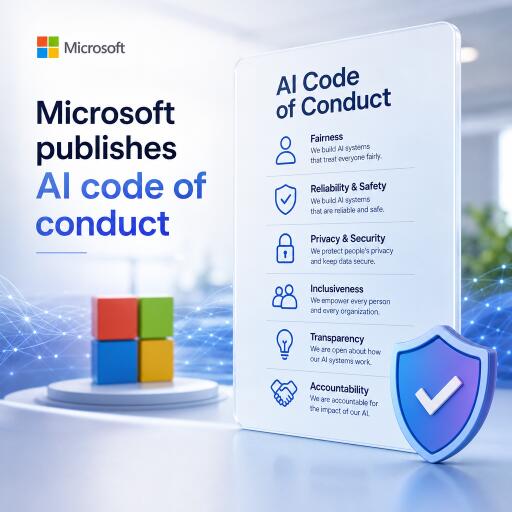
Microsoft publishes AI code of conduct
Microsoft’s AI division has rolled out a formal code of conduct that outlines how its artificial intelligence systems should behave and respond to human input. The document centers on a philosophy the company calls “Humanist AI”—designs built to stay under human oversight rather than act autonomously.
The core message emphasizes that people matter more than machines, placing human judgment and safety at the forefront of AI development and deployment.
The release comes amid rising concerns about AI safety and governance. Microsoft frames the timing as timely in light of recent large-scale security incidents where AI-enabled tooling played a role, underscoring the need for robust guardrails and transparent processes as capabilities expand.
The code does not single out other firms or past incidents; instead, it stresses practical safeguards such as requiring human review for certain actions, restricting autonomous decision-making, and keeping clear records of how models behave in real-world use. It also calls for thorough pre-release evaluations and continuous monitoring after deployment.
In this initiative, Microsoft’s own internal AI family—referred to as MAI—takes center stage as the initial testbed for the guidelines. The move is framed as offering an alternative approach to the external AI platforms the company has relied on in the past, aiming to embed governance more deeply into product design.
Industry observers have urged caution and a measured tempo for advancing AI capabilities, arguing that safety and accountability should guide progress. Microsoft’s code of conduct appears to codify that philosophy, turning ethical considerations into concrete development and deployment requirements.
Beyond broad principles, the document outlines practical protections: strict boundaries on data access, explicit user-privacy safeguards, and formal procedures for auditing and revoking capabilities if behavior deviates from expectations. The emphasis on human-in-the-loop oversight, detailed documentation, and ongoing governance underscores a shift toward accountability as a standard part of the product lifecycle.
As AI technologies evolve, this approach may influence how the broader industry balances rapid innovation with trust and responsibility. By weaving governance into the core architecture of its offerings, Microsoft signals a move toward reproducible safety metrics and clearer accountability for both developers and operators.