‘A true game changer’: Wichita school cuts ribbon on advanced tech lab
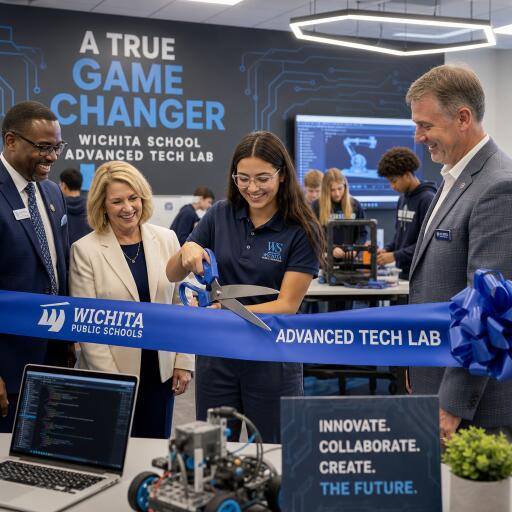
Wichita’s Brooks Center for STEM and Arts Magnet Middle School has unveiled a cutting-edge space designed to put immersive technology directly into students’ hands. At a ribbon-cutting this week, the school introduced its new Verizon Innovative Learning Lab—an experience-driven classroom where augmented and virtual reality, 3D printing, and artificial intelligence will be woven into everyday learning.
Administrators say the lab isn’t just about flashy hardware; it’s about reshaping how students explore science, art, and problem-solving. Principal Josh Wilbert described the space as a significant leap forward for the school’s curriculum, giving learners the tools to design, test, and iterate like real-world creators. He noted that while much of the technology is fresh for educators as well, students are already fearlessly experimenting—an energy he believes will carry them through high school and beyond.
Inside the lab: Immersion meets invention
The new lab opens the door to hands-on, future-facing projects. With AR and VR headsets, students can step into virtual environments—whether to visualize complex geometry, tour historical sites, or simulate lab experiments. 3D printers turn ideas into physical prototypes, amplifying engineering and art classes alike. Meanwhile, AI tools introduce data literacy, pattern recognition, and creative coding, helping students understand how intelligent systems power everything from chat assistants to robotics.
Wilbert emphasized that the lab will serve as a launchpad for cross-curricular projects: think science students printing custom parts for experiments, art students building interactive installations with mixed reality, or social studies classes constructing virtual exhibits. The goal is to elevate curiosity into tangible outcomes—skills that translate directly to advanced coursework and modern careers.
Powered by partnerships
The initiative is the result of a collaboration among Verizon, the nonprofit Heart of America, and Arizona State University. The lab’s curriculum framework was developed at ASU, aligning emerging technologies with grade-level standards and project-based learning. That backbone ensures the tech isn’t just a novelty; it’s intentionally embedded in lessons that build competencies over time.
Training the teachers, elevating the classroom
To jump-start the program, two teachers traveled to ASU for intensive training on the best ways to integrate the equipment into instruction. Back in Wichita, additional professional development—supported by district partners—helped expand the expertise across the staff. That shared learning model means teachers can iterate together, adapt projects for different subjects, and keep pace with rapid tech changes.
For Wilbert, the most exciting outcome so far is the student response: the buzz of discovery as learners test tools, make mistakes, and quickly try again. He described the momentum in the room as difficult to quantify but unmistakable—an energy that transforms a classroom into a studio, lab, and workshop all at once.
Why it matters
Across education, immersive tools are redefining what “hands-on” looks like. VR can bring distant places and microscopic processes within reach, while 3D printing turns abstract concepts into functional models. AI introduces students to the logic that underpins modern software and decision-making systems. Together, these technologies don’t replace traditional learning; they deepen it—pushing students to analyze, create, and communicate in new ways.
At Brooks, that means middle schoolers aren’t just reading about innovation—they’re practicing it. The lab invites them to prototype solutions, collaborate in digital and physical spaces, and build a portfolio of work that grows in complexity. It’s a foundation designed to boost confidence and readiness for the next steps in education and, ultimately, a tech-driven job market.
As the lab’s first projects roll out, the school expects to see more interdisciplinary units, student showcases, and community engagement. The promise is simple but powerful: give students the right tools and guidance, and they’ll surprise you with what they can make.