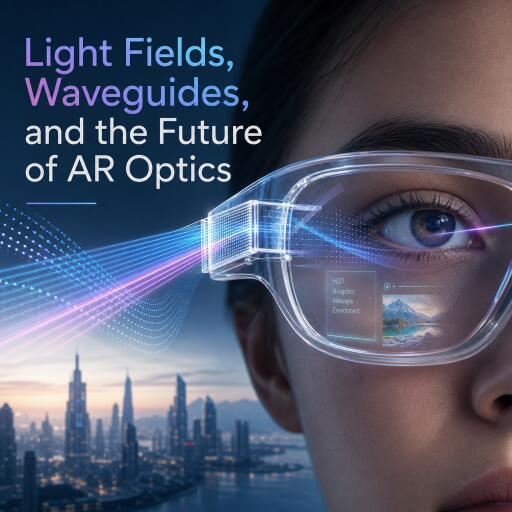
Light Fields, Waveguides, and the Future of AR Optics
Augmented reality asks a single transparent pane to do two jobs at once: let the real world pass through cleanly while projecting vivid, legible graphics into a moving human pupil. Waveguide combiners became the go-to answer because they trap light in a thin slab through total internal reflection, then leak it out toward the eye with precise control. By keeping the optics planar and close to the footprint of a spectacle lens, waveguides displaced bulkier approaches like birdbath optics and freeform mirrors. The remaining hurdles are well known: efficiency under sunlight, faithful color, and—most stubbornly—convincing depth.
Why Light Fields Matter Now
Most AR glasses pin their imagery to a single focal distance. Your eyes may converge on a virtual object, but your lenses keep focusing on that fixed plane, a mismatch called the vergence–accommodation conflict. Over time, that disconnect can strain vision and dampen immersion.
Light-field techniques attack the problem at its root by reconstructing not just intensity, but the directionality of rays. Options range from full wavefront control, such as computational holography and integral imaging, to partial solutions like multifocal stacks or tunable-focus optics. The catch? Prototypes that truly preserve depth often shrink other essentials. Integral imaging modules have shown modest fields of view and tight eyeboxes, while some holographic demonstrators nail wavefront accuracy over only a few degrees. The challenge for the next wave of products is to fold depth-correct imagery into a combiner that still looks and wears like everyday eyewear.
Inside the Waveguide
Waveguide combiners come in two broad flavors. Geometric types use prisms or mirrors for in- and out-coupling and rely on cascaded partially reflective mirrors to expand the exit pupil. Because they manipulate light by reflection and refraction, they add minimal chromatic error—but every embedded mirror can demand many coating layers, making manufacturing exacting and expensive.
Diffractive guides, the mainstay of today’s commercial devices, replace mirrors with surface-relief or volume holographic gratings. Properly engineered, multi-level phase profiles can push most of the light into a desired order, and polarization-selective gratings help manage stray modes. The trade-off is dispersion: diffraction angle depends on wavelength, so red, green, and blue don’t always line up across the field. A common workaround is stacking three guides (one per primary), which boosts color fidelity but adds thickness, weight, alignment sensitivity, and the risk of ghosting while nibbling away at modulation transfer.
The Etendue Squeeze
Etendue—the product of beam size and angular spread—sets a hard budget for any near-eye system. In a waveguide, field of view and eyebox are joined at the hip: expanding one tends to compress the other unless you pay with complexity or efficiency. Exit pupil expansion arrays spread light across a larger viewing window by bouncing it repeatedly, but wider fields and larger eyeboxes generally mean larger couplers and lower throughput.
Real-world numbers make the point. One compact double-layer diffractive guide with 50 out-coupling elements (arranged in five rows by ten columns) within a 2 mm substrate reported roughly 37% transmission and near 89% output uniformity across the field. That puts pressure upstream: in bright conditions, when only a third of the projector’s light survives, the light engine must be small, efficient, and deliver a narrow, well-controlled beam (low f-number). In practice, the combiner and projector are a single co-designed system, not independent modules you can optimize in isolation.
Metasurfaces Rewrite the Coupler
Enter metasurfaces: dense forests of subwavelength nanostructures that shape phase, amplitude, and polarization on a pixel-by-pixel basis. Recent work has shown silicon nitride structures around 160 nm tall, built on a high-index base (~1.9), can steer different diffraction orders to red, green, and blue respectively. By assigning the fourth, fifth, and sixth orders to the primaries, a single plate can funnel all three colors into a common viewing direction and open up a field of view near 45 degrees without resorting to triple stacks.
The most intriguing convergence happens when metasurface waveguides meet computational holography. Pairing a phase-only spatial light modulator directly with a metasurface in-coupler removes the need for a bulky projection lens and lets a transparent glass slab produce full-color, 3D holographic content. Symmetric couplers with sub-400 nm periods have demonstrated see-through efficiencies around 78% across the visible band—encouraging for everyday wear.
There are caveats. Early results show fields on the order of 11–12 degrees and eyeboxes around 4 mm, which is tight for casual, head-turning use. Uniformity can be excellent in green and blue, while red lags due to larger diffraction angles. And because the phase masks are often optimized by camera-in-the-loop neural networks, compute becomes part of the optical budget. That means power, latency, and thermal design are now optical concerns, too.
What’s Next
Materials and manufacturing will decide the winners as much as clever ray diagrams. Higher-index glass (above ~1.8) can widen the field and enable a single achromatic coupler to serve all primaries. Metagratings compatible with nanoimprint replication hint at scalable, single-layer combiners that hit consumer price points without bloating the temple arms.
The trajectory is coalescing: depth-correct light-field imagery, real-time computational wavefront control, and achromatic metasurface coupling—all inside a slim waveguide that disappears in a pair of glasses. The designs that stick will balance three levers at once: efficiency bright enough for noon daylight, color that stays aligned across the field, and an eyebox generous enough for natural eye motion. Nail those, and AR stops feeling like a demo and starts living on your face all day.