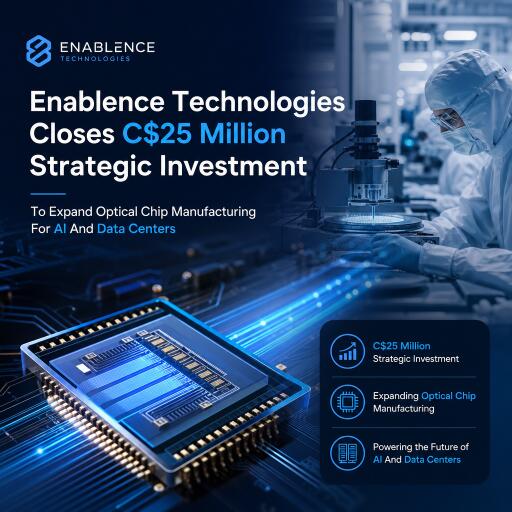
Enablence Technologies Closes C$25 Million Strategic Investment To Expand Optical Chip Manufacturing For AI And Data Centers
Enablence Technologies has secured a C$25 million strategic investment that will fuel a major scale-up of its optical chip production, aligning the Ottawa-based company with surging demand from artificial intelligence infrastructure, hyperscale data centers, and high-speed telecom networks. For the gaming and virtual reality ecosystem, where bandwidth, latency, and power efficiency increasingly dictate experience quality, this move lands at a pivotal moment.
Fresh Capital, Clear Target: More Chips, Faster
The funding comes via a private placement led by Collingwood Investments. Collingwood acquired approximately 3.226 million common shares of Enablence at C$7.75 per share, generating gross proceeds of around C$25 million. Enablence plans to channel the capital into expanding capacity at its fabrication operations in Silicon Valley and Vietnam, while also bolstering working capital to support rising sales and general corporate needs.
Beyond meeting immediate demand, the infusion is a bet on the accelerating transition to high-bandwidth optical connectivity—an essential backbone for AI training clusters, cloud gaming platforms, and real-time XR applications that depend on rapid data movement and low-latency visualization.
Optical Brains Behind the Scenes
Enablence specializes in planar lightwave circuit (PLC) optical chips and subsystems—silicon-based components that route and manage light for data transmission. These chips underpin critical links in datacom and telecom networks and are increasingly sought after by data center operators confronting the bandwidth crunch brought on by AI workloads. The company’s technology stack also fits neatly into advanced vision systems, with potential use cases spanning automotive LiDAR, medical devices, and immersive VR/AR hardware.
For cloud-driven gaming and XR streaming, faster optical interconnects can translate into fewer latency spikes, higher fidelity at the edge, and more consistent frame delivery—factors that determine whether a virtual world feels immediate or laggy. As optical infrastructure scales, expect smoother remote rendering, improved multiplayer stability, and broader access to graphically rich experiences across devices.
Footprint From Ottawa to Fremont to Vietnam
Headquartered in Ottawa, Enablence designs and manufactures primarily silicon-based PLC chips tailored to the growing needs of data centers and other high-growth segments. The company also operates a proprietary non-captive fabrication facility in Fremont, California, which can produce chips designed by third-party customers in select cases. This hybrid approach—own products plus foundry services—positions Enablence to capture a wider range of opportunities as the industry invests in faster optical backbones.
With expanded capacity planned for Silicon Valley and Vietnam, Enablence is aiming to shorten lead times and scale output without compromising the precision demanded by optical components. That’s especially relevant as AI servers multiply and network operators retool links between compute nodes to handle ever denser traffic patterns.
Deal Mechanics: Rights and Advisors
As part of the financing, Enablence and Collingwood Investments entered into an investor rights agreement. The arrangement grants Collingwood pro rata pre-emptive rights on future equity issuances, along with certain top-up rights designed to help maintain ownership position over time.
On the advisory front, Paradigm Capital served as the exclusive financial adviser to Enablence and is set to receive a cash advisory fee equal to 5% of the gross proceeds. Bennett Jones acted as legal counsel on the transaction.
Why This Matters for Gaming and VR
- Lower latency pathways: Faster optical links in data centers can improve responsiveness for cloud-rendered games and XR content.
- Higher throughput: As AI-driven assets (upscaling, physics, NPC behavior) grow in complexity, robust bandwidth helps keep experiences fluid.
- Edge scaling: Optical upgrades enable more distributed compute, reducing the gap between users and rendering nodes.
- Hardware crossover: The same photonic building blocks aiding data centers have potential in next-gen headsets and sensor-rich devices.
What to Watch Next
Keep an eye on how quickly Enablence brings new capacity online and whether the customer mix skews even more toward hyperscale and AI deployments. For the XR space, look for signals that optical modules and subsystems are migrating from industrial settings into components that can shrink, cool, and cost-optimize for consumer hardware. If that happens, we could see headsets with improved passthrough clarity, better depth sensing, and more efficient on-device data handling—crucial for longer sessions and more convincing mixed reality.
For now, the takeaway is clear: capital is flowing to the arteries of the AI and cloud era. As optical connectivity strengthens, so too does the foundation for richer, more responsive gaming and virtual experiences.