
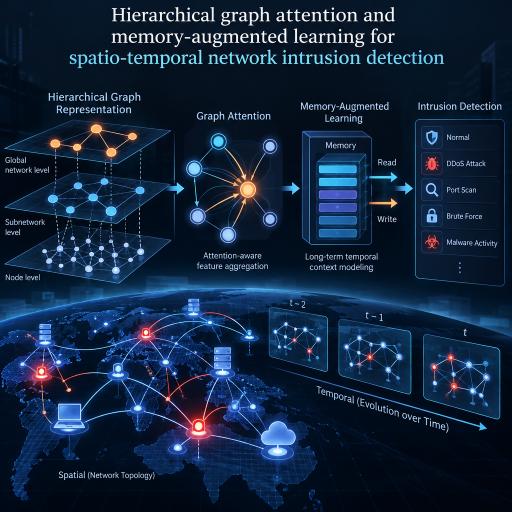

Hierarchical graph attention and memory-augmented learning for spatio-temporal network intrusion detection
Network intrusion detection increasingly relies on graph-based machine learning to uncover relationships that conventional traffic classifiers may overlook. Yet strong benchmark results can be heavily influenced by how network flows are grouped, ordered and divided between training and testing. STAR-IDS explores this problem through a combination of hierarchical graph attention, prototype-based memory and uncertainty estimation.
Turning traffic flows into temporal graphs
The system processes network activity in short windows containing ten consecutive flows. Each window becomes a graph in which IP addresses form nodes and traffic exchanges define connections. Preserving the chronological order of flow start times allows the model to examine both structural relationships and short-term changes in behavior.
STAR-IDS applies attention at two levels. The first stage identifies relevant interactions within each local traffic graph, while the second combines higher-level information to represent broader patterns. This hierarchy is designed to distinguish isolated anomalies from coordinated behavior spanning several connections.
Learning with a prototype memory bank
Alongside graph attention, the architecture uses a memory bank containing learned prototypes. These prototypes act as representative patterns for traffic classes, giving the classifier reference points when evaluating new activity. The mechanism is intended to improve recognition when malicious and legitimate flows share similar characteristics.
The model also uses Monte Carlo Dropout during inference to estimate predictive uncertainty. Instead of producing only a class label, it performs repeated predictions with slightly different internal configurations. Variation across those outputs indicates how confident the system should be in its decision.
Strict evaluation changes the picture
Testing covered two intrusion-detection datasets: NF-CSE-CIC-IDS2018-v3, which retains real IP-address nodes, and the IoT-focused NF-ToN-IoT-v2. Traffic was divided with block-based methods intended to prevent information from leaking between training and testing sets. The evaluation also included temporally blocked cross-validation and five paired random seeds.
STAR-IDS was compared under consistent training conditions with E-GraphSAGE, GAT, GCN, GraphSAGE and a multilayer perceptron that did not use graph structure. Ablation tests separately examined the contribution of individual components.
On NF-CSE-CIC-IDS2018-v3, STAR-IDS reached an average accuracy of 87.61%, with a variation of 1.22 percentage points, and recorded a macro-F1 score of 86.41%. However, after applying Holm correction for multiple statistical comparisons, its differences from the competing models and reduced variants were not significant.
The outcome was less favorable on NF-ToN-IoT-v2. The graph-free multilayer perceptron achieved 81.10% accuracy, while STAR-IDS reached 77.21%. This result shows that representing traffic as a graph does not automatically deliver a better detector, particularly when the available node relationships add limited predictive value.
Uncertainty offers practical value
The confidence mechanism proved useful for separating dependable predictions from likely mistakes. Its ability to distinguish incorrect and correct classifications produced an area under the curve of 0.89. Predictions marked as uncertain were between 16 and 25 percentage points less accurate than those accepted automatically.
In an operational security center, such estimates could support a selective review process. High-confidence classifications could move through automated workflows, while uncertain events could be escalated to analysts. This may be more valuable than a small improvement in aggregate accuracy because it indicates where human attention is most needed.
Evaluation design can outweigh architecture
Control experiments revealed unusually large sensitivity to data preparation. Randomly shuffling flows before creating windows, substituting synthetic node identifiers and switching to forward-in-time evaluation altered accuracy by as much as 68 percentage points.
These changes demonstrate that intrusion-detection benchmarks can reward shortcuts or dataset-specific patterns rather than genuine threat recognition. Temporal ordering, node identity and split strategy must therefore be treated as central parts of the experiment—not as minor implementation details.
STAR-IDS illustrates the potential of hierarchical attention and memory-augmented learning, but it also delivers a broader warning: sophisticated graph architectures should be judged through leakage-resistant, time-aware and statistically controlled evaluations. In some environments, their relational modeling may help; in others, a simpler graph-free model can remain the stronger choice.