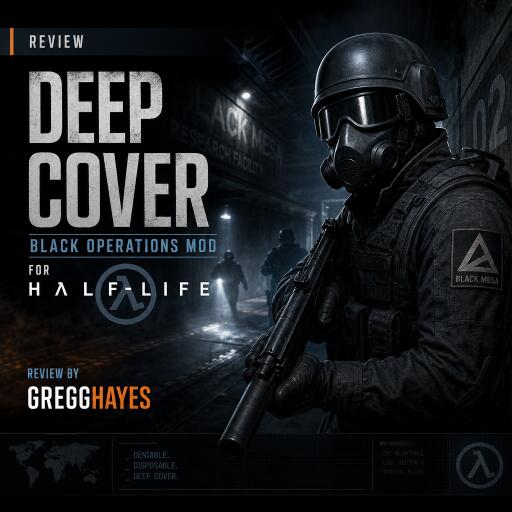

Review by GreggHayes – DEEP COVER: Black Operations mod for Half-Life
DEEP COVER: Black Operations drops you into a snow-lashed infiltration op in the Alaskan ranges, sneaking through a clandestine facility guarded by a private army known as Yellow Shield. It’s a single-player Half-Life mod that swings hard for the cinematic spy-thriller vibe with original weapons, enemies, music, and voice work—an ambitious passion project whose high points are memorable, even if its rough edges are hard to ignore.
A striking first impression
Visually, the mod shines. Industrial corridors, vertiginous catwalks, cavernous machine halls, and whiteout exteriors are staged with confident geometry and convincing dressing. The winter atmosphere is tangible: you can almost feel the sting of the wind at the edges of the compound. Navigation reads clearly, and the variety of shapes and sightlines keeps the environment dynamic without feeling busy.
That said, cohesion takes a few hits. Some props and textures appear to come from later-era pipelines or other franchises, resulting in high-poly models beside boxy brushwork. It’s jarring when a hyper-detailed container sits next to a classic-era crate; that clash chips away at immersion. Scale is another recurring oddity—cabinets towering overhead, handles at eye height, and rooms so oversized you feel like a kid in a grown-up’s world.
Smart puzzles with flair
The mod’s best trick is how it teaches you through play. One standout: an early rifle pickup that seems unremarkable—until you scope in and the solution to a lingering problem snaps into focus. It’s the kind of elegant, diegetic tutorial design you wish more shooters embraced.
Combat kits feel snappy and tactile, with bespoke animations and alternate fire modes adding texture. However, a few audio choices undermine the punch; for example, a sidearm that reads visually like a standard pistol sounds curiously suppressed, sapping feedback during firefights.
Pacing that trips over its own sprint
The opening chapters build quietly and confidently, letting the espionage tone breathe. Then the throttle slams. Once the mercs arrive in force, the mod doles out most of the arsenal in under a minute, undercutting progression. Encounters rarely get bespoke framing; aside from a couple of cut-ins to spotlight new enemy types and a late-game “mini-boss,” there’s limited staging to make fights feel distinct.
The finale doubles down with two helicopter battles nearly back-to-back. It’s a bold escalation, but the sequence loses steam—especially with an AI companion who has a habit of wandering into rocket fire. The last stretch becomes more frustrating than triumphant.
Story beats and presentation
Voice performances are a pleasant surprise: grounded, clear, and often charming enough to make you stop and listen. The score leans into cheeky spy capers, giving the operation a breezy, almost playful undertone that fits the premise.
Direction, though, wobbles. Third-person cutscenes frame the protagonist as if he’s part of the conversation, yet he never speaks or even grunts, leaving an odd disconnect. Facial animations don’t fully sell dialogue, and some scenes echo familiar inspirations a bit too closely. Your main ally lacks depth, serving more as an exposition tap than a character; by contrast, offhand NPCs—like a guard absorbed in a parody game during an elevator ride—bring more personality in seconds than some story beats do in minutes.
Audio ambiance: close but not bespoke
There’s a broad selection of effects, but many will ping your memory if you’ve played a lot of shooters, leading to that “I’ve heard this before” feeling. What’s missing is a sonic fingerprint—those tailored ambients and signature stingers that would cement the mod’s secret-agent identity. With a little more bespoke sound design, the setting could hum with tension.
Physics, props, and polish
Environmental interactivity doesn’t always match expectations. Objects that should shatter or reward you sometimes don’t; meanwhile, a critical quest item is once tucked into a nondescript crate that looks like pure set dressing. Those inconsistencies can make players second-guess the rules of the world—never ideal in a game that leans on scavenging and problem-solving.
You’ll also spot visual hiccups: clipping seams, null textures, the occasional floating prop, and a handful of invalid brush artifacts. None of these are dealbreakers on their own, but they nibble away at immersion, especially when the rest of the presentation reaches for cinematic spectacle.
Length, secrets, and replay
Expect about two to three hours for a first run, which feels right. The campaign ends before monotony sets in. Stashes and Easter eggs are tucked off the critical path, rewarding curiosity, and there’s even an alternate gag ending that lands with a wink. The extras help soften the linearity and give would-be speedrunners or completionists a reason to loop back.
Verdict
DEEP COVER: Black Operations is a bold, snowbound heist that nails mood, space, and gadget-forward problem solving. It stumbles where cohesion and pacing matter most—asset consistency, scale, encounter framing, and a finale that mistakes more for better. Even so, the new art, music, and voice work give it a distinct identity, and the high points stick with you.
As it stands, it’s easy to recommend to anyone hungry for fresh single-player Half-Life content: inventive, stylish, occasionally sloppy, but never dull. With tighter audio identity, smarter weapon ramp, more deliberate setpiece design, and a pass on interactivity and polish, it could ascend from “memorable” to “modern classic.”
Score: 8/10