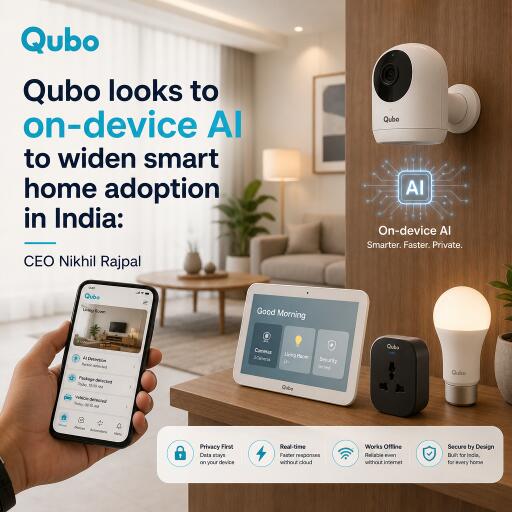
Qubo looks to on-device AI to widen smart home adoption in India: CEO Nikhil Rajpal
Indian smart-home brand Qubo is putting on-device artificial intelligence at the center of its strategy to make connected living affordable and practical for mainstream households. As the company broadens its lineup beyond security cameras into smart appliances, chief executive Nikhil Rajpal says the goal is simple: reduce reliance on the cloud, cut latency and data costs, and let devices act proactively without constant user input.
On-device smarts, cloud as an add-on
Qubo says it has built AI models that run directly on its cameras, including budget models around Rs 2,500, enabling features such as person recognition and threat detection without always needing a server connection. Many core capabilities are designed to operate locally for free, while an optional subscription—positioned under the AI Guard banner—adds advanced security features and cloud storage. The plans are priced at Rs 149, Rs 249, and Rs 399 per month, alongside a free base tier.
AI Guard’s feature set spans person and motion detection, instant notifications, automated alarms, and zone-based monitoring. For storage, customers can choose a microSD card or opt for subscription-based cloud storage, which the company says is hosted on domestic servers. The hybrid approach is meant to give users flexibility: real-time responses and basic intelligence on the device itself, with the cloud available for longer-term backup and premium analytics.
Designed for Indian homes and habits
Qubo emphasizes that its products are engineered for the realities of Indian households. Construction materials, room layouts, and family structures differ from Western markets, creating unique needs for security and automation. Common use cases include screening visitors at the door, checking on children and elderly family members, and keeping an eye on domestic staff.
Under the hood, the company points to a proprietary IoT stack that ties together its hardware, cloud services, mobile apps, and AI models. Parent company Hero Electronix frames the business as end-to-end—covering design, engineering, software, and manufacturing—to accelerate development and keep costs in check.
Price, penetration, and early traction
An entry-level smart camera capable of streaming to a phone starts at about Rs 2,500, according to Rajpal. He notes that Qubo moves a few thousand units daily on leading e-commerce marketplaces, signaling rising interest as prices fall and features improve.
Still, the company believes the market is at a very early stage. Smart-home penetration in India is estimated at under 2%, compared with roughly 30–50% in parts of the West and China. That gap, Rajpal argues, reflects untapped demand that could be unlocked by local AI processing, simpler setups, and devices that work together seamlessly.
From cameras to a full ecosystem
Qubo’s current catalog includes smart cameras, video doorbells, smart locks, and dashcams. The roadmap is expanding into environmental and cleaning appliances, with smart room heaters and robot vacuums planned this year and a water purifier under evaluation. The company previously entered the air-purifier category and is building towards an interconnected ecosystem that customers can adopt piece by piece rather than committing to a full-home overhaul at once.
In practice, this means devices that anticipate needs: an air purifier spinning up automatically as air quality dips, or a camera sounding an alarm when it identifies an intruder. The broader vision is a home that senses context and responds on the user’s behalf—without forcing them into complex routines or heavy cloud dependence.
Global push, India-first priorities
Beyond India, Qubo has begun its international journey with a recent launch in the Middle East and is evaluating additional markets, including the US for dashcams. Even so, Rajpal says the near-term opportunity at home is massive given today’s low adoption and growing comfort with connected devices.
Engineering talent as the next frontier
On the supply side, India’s manufacturing capabilities have advanced significantly, but Rajpal believes the next leap will come from deepening local product design expertise. He argues that the country needs more engineers focused on conceiving and building world-class consumer tech, not just assembling it. Qubo’s in-house tech team of around 100 is positioned as a training ground for such skills, with the hope of spawning more product-first companies.
Outlook: AI at the edge to drive mass adoption
By shifting more intelligence onto the device, Qubo is betting it can deliver faster responses, better privacy, and lower operating costs—key barriers for first-time buyers. If the approach succeeds, it could help move smart-home tech in India from niche novelty to everyday utility, one camera, purifier, and robot vacuum at a time.