
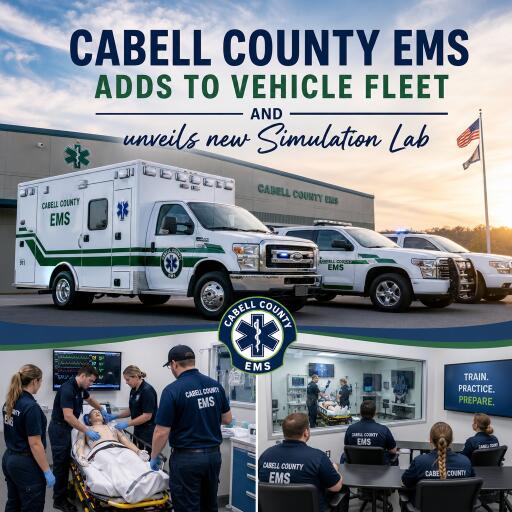
Cabell County EMS adds to vehicle fleet and unveils new Simulation Lab
Huntington, West Virginia — Cabell County EMS has doubled down on readiness, boosting its response capabilities with new vehicles while opening a high-tech Simulation Lab that leans on virtual reality and lifelike mannequins to mirror real emergencies.
Immersive training takes center stage
The newly revealed Simulation Lab is designed to sharpen the skills of EMS students, law enforcement, and other first responders through scenario-based training. Using realistic mannequins alongside VR headsets, trainees can rehearse critical interventions in a controlled environment before encountering them in the field.
According to Marsha Knight, Director of Education for Cabell County EMS, the goal is to elevate comfort, competence, and consistency. By practicing on responsive training dummies—and reviewing mistakes without risk to a real patient—participants can build confidence while aligning with national standards. The result is a safer on-ramp to real-world care, with clear benefits for the broader community.
From a virtual reality perspective, the lab effectively borrows techniques popularized in simulation-heavy gaming: immediate feedback loops, repeatable scenarios, and scalable difficulty. In emergency medicine, those same mechanics translate to faster decision-making, tighter teamwork, and more reliable outcomes under pressure.
Six new vehicles strengthen the fleet
Alongside the training upgrade, Cabell County EMS has expanded its fleet with four new ambulances and two supervisor vehicles, bringing the total to 44 units. EMS Director Veronica Swope emphasized that dependable transportation is fundamental to timely, effective care—both for patients and for the crews who serve them.
The additions include a range of modern features, with a notable upgrade inside the ambulances: a CPR seat arrangement that improves access from both sides of the patient. That layout is designed to streamline critical care, allowing multiple providers to work simultaneously during high-stakes interventions.
Key details at a glance
- Fleet expansion: 4 ambulances + 2 supervisor vehicles (44 total across the system)
- Ambulance investment: Approximately $660,000 for the four units when fully equipped
- Procurement: Funded through the agency’s general budget allocation
- Vehicle mix: Two different EMS vehicle types, tailored for distinct operational roles
- Lifecycle plan: Units are cycled out before reaching 300,000 miles to maintain reliability
- Maintenance: Ongoing, proactive servicing to keep vehicles mission-ready
Cabell County EMS also expects a new critical care transport vehicle to arrive within the next month, adding capacity for complex interfacility transports and advanced patient needs.
Commitment to safety, speed, and staff
Swope underscored that the investments are as much about supporting EMS crews as they are about patient outcomes. New equipment reduces downtime and risk, while updated interiors provide a safer, more efficient workspace. With reliability prioritized—both through replacement schedules and vigilant maintenance—crews can focus on delivering care rather than troubleshooting vehicles.
Why the upgrades matter
In emergency response, seconds count—and so does preparation. The vehicle additions help ensure teams can get where they need to be, while the Simulation Lab builds the muscle memory to perform once they arrive. Combined, the moves put Cabell County EMS on firmer footing for everything from routine transports to high-acuity calls.
For a region that relies on swift, coordinated response, this blend of hands-on practice and fleet modernization represents a practical, future-facing blueprint—one that borrows the best of immersive technology to meet the realities of life-saving work.