
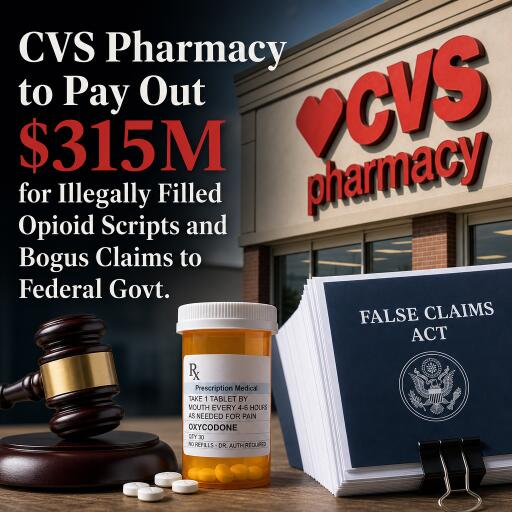
CVS Pharmacy to Pay Out $315M for Illegally Filled Opioid Scripts and Bogus Claims to Federal Govt.
A settlement announced by the Department of Justice commits CVS and related corporate entities to pay $315 million to resolve allegations that, beginning in 2013 and continuing through 2025, CVS pharmacies dispensed opioids and other controlled substances without legitimate medical justification and then sought reimbursement from Medicare and other federal programs for those prescriptions.
The government contends that a substantial portion of these prescriptions lacked proper medical justification, were not valid, or were not issued in the ordinary course of professional practice. The filing described patterns such as distributing large quantities, dispensing refills earlier than appropriate, and providing combinations of drugs that included opioids with sedatives and muscle relaxants. It further asserted that CVS processed prescriptions tied to prescribers labeled as high risk and ignored warning signs about where the prescriptions originated, with many of these claims subsequently billed to federal healthcare programs.
Beyond the dispensing decisions themselves, regulators highlighted internal practices that could have encouraged risky behavior. Issues cited included incentive arrangements linked to performance metrics and staffing shortages that left pharmacies with insufficient pharmacist coverage. Additionally, internal policies were described as constraining staff from flagging questionable prescribers, undermining safeguards designed to ensure safe and appropriate dispensing.
The action was brought under the False Claims Act, with a former CVS employee filing the complaint on behalf of the government in 2024. The case alleges violations of the Controlled Substances Act and the False Claims Act, underscoring concerns about whether certain prescriptions were approved improperly and whether the company sought reimbursement for those charges.
Officials describe the settlement as part of a broader effort to curb illicit opioid distribution within large retail networks. While penalties can deter future misconduct, observers say real progress will require ongoing reforms that improve monitoring of prescribing patterns, strengthen pharmacist staffing, and tighten controls on high-risk prescribers. The opioid crisis remains a nationwide challenge, affecting communities across the country, and the settlement highlights the ongoing push to balance patient access with program integrity and safety.
In the months ahead, policymakers and health systems may pursue enhanced oversight and stronger compliance programs to prevent recurrence and safeguard patient care while ensuring legitimate patients receive appropriate medications.