
LinkedIn Launches 14-Week Business Academy for 30 Employees | TokenPost
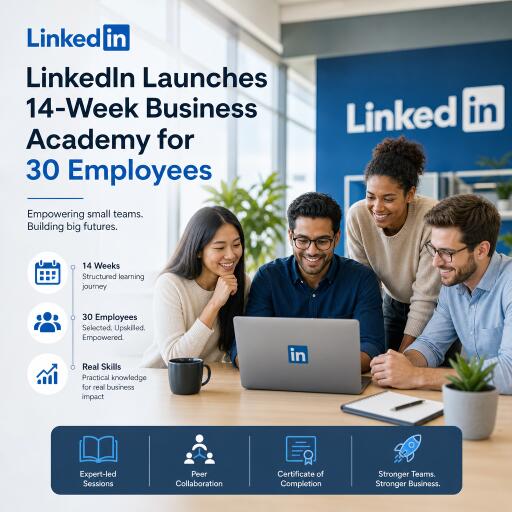
In a bid to equip workers for a rapidly changing job landscape shaped by artificial intelligence, LinkedIn rolled out a 14-week, no-degree training program for a 30-person cohort. The aim is to build practical business skills through immersive simulations and hands-on projects rather than traditional classroom credentials.
The program runs as a free pilot and emphasizes experiential learning. Participants engage in three sessions weekly, tackling realistic scenarios such as managing public-relations crises, making hiring decisions, and pitching ideas to potential investors. A later module guides the team through building an app from scratch, providing a tangible project that demonstrates skill application from concept to prototype.
Admission is intentionally flexible: no formal prerequisites, and the framework is explicitly limited to the initial group, with no announced rules for future cohorts. The overarching intent is to let participants demonstrate capability through work product rather than a certificate.
A LinkedIn executive spoke about the initiative, highlighting a focus on practical outcomes over traditional credentials. The program is pitched as a path to economic resilience rather than a universal push toward entrepreneurship. It is designed to teach people how to build viable businesses or ventures in uncertain times, while acknowledging that not everyone will choose to start a company.
The timing aligns with growing demand for AI-related competencies. Industry data show a significant uptick in postings requiring AI literacy, as well as a surge in AI-enabled roles worldwide over recent years. At the same time, independent work and side ventures are on the rise, reflecting a broader trend toward flexible income streams and asset-building opportunities.
The curriculum draws on the idea that declaring a degree isn’t the only route to meaningful employment. Advocates point to the momentum of nontraditional paths—skills validated by demonstrable work rather than diplomas—as increasingly viable for employers and workers alike. The program’s structure aims to deliver concrete evidence of capability, such as completed projects and problem-solving outcomes, which can be leveraged in job hunts or internal career growth.
Looking back at broader hiring trends, research has suggested that removing degree requirements can open doors for substantial numbers of workers within large hiring pools. While not all such efforts translate into immediate full-time roles, they can broaden access to opportunities and provide stepping stones for career advancement.
As for next steps, there is no public announcement yet about broader enrollment, scale, or pricing beyond this pilot. The current initiative remains focused on the 30 participants and serves as a proof of concept for how structured, credential-free programs can prepare workers for an AI-augmented economy.
If successful, the program could spark conversations about how tech companies design workforce development initiatives that prioritize applied skills, verifiable成果, and independent career pathways over traditional degree requirements. The broader takeaway is a signal that, in a shifting labor market, practical, project-based learning may complement or even substitute for conventional credentials for a growing segment of workers.
In sum, this initiative represents a testbed for rethinking how employers validate capability. By centering real-world projects, rapid iteration, and collaborative problem solving, the academy seeks to empower participants to pursue economic independence—whether that means advancing within an organization, launching a side venture, or pursuing new roles that leverage AI-driven capabilities.
Current status remains focused on the pilot cohort, with details on expansion, enrollment timelines, or pricing yet to be disclosed. The experiment underscores a broader industry exploration: can immersive, non-degree training deliver tangible value in a world where AI and automation are reshaping what workers need to know to succeed?