
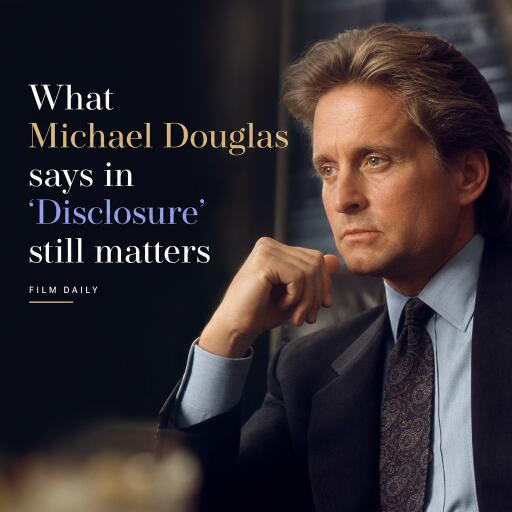
What Michael Douglas says in ‘Disclosure’ still matters – Film Daily
Three decades on, Disclosure remains unsettling not because of its novelty, but because its corporate logic still feels familiar. Michael Douglas’s Tom Sanders is a man trapped in a system that treats credibility like a bargaining chip. In 2026, when policy manuals have thickened and public language has evolved, the film’s core question—who gets believed when power and gender collide—still bites.
The premise that flipped expectations
Based on Michael Crichton’s novel, the story pivots on a gender-reversed harassment allegation at a Seattle tech firm on the cusp of a high-stakes merger. The setup forced audiences to consider whether the rules would be applied evenly if the complainant were male. That tension energized the film in 1994—and keeps it provocative now, as skepticism toward male victims hasn’t vanished so much as changed tone.
Boardrooms, VR, and the optics of power
Director Barry Levinson wrapped the subject in the sleek rhythms of a corporate thriller: glass-walled meetings, hushed legal briefings, and a surprisingly prescient detour into early virtual reality used to explore company data. Those VR sequences—clunky by today’s standards—were less tech flex than mood setter, a way to visualize how control over information can tilt the field. For viewers steeped in modern VR and enterprise software, the scene plays like a time capsule of how the 90s imagined digital truth-finding.
Mergers, risk, and the credibility trap
The allegation lands amid a takeover that endangers Sanders’s job, sharpening every decision into a risk calculation. In this world, scandal isn’t a moral crisis; it’s a line item. Policies and protocols exist, but the merger’s gravitational pull redirects attention from fairness to containment. That’s where the film is most current: institutions reflexively manage exposure before they pursue clarity.
Lines that echo in 2026
Douglas’s blunt retort—“She came on to me”—is the movie’s pressure point. It’s not a speech; it’s a defensive flare, and it exposes how process can swallow people. Short, wary exchanges replace grandstanding as Sanders learns that timelines, emails, and access define reality more than memory does. The film resists a neat verdict, leaving viewers to sift contested facts—again, uncomfortably close to how these cases play out today.
Demi Moore’s counterforce
As Meredith Johnson, Demi Moore is not a caricature; she’s a decisive operator whose authority complicates sympathy lines. By granting her real leverage—command of strategy, command of narrative—the film shifts focus from gender shock to the mechanics of coercion. That choice ages well: we’re not asked to cheer a hero or boo a villain so much as to track how power communicates, conceals, and pressures.
From the 90s to now
Disclosure arrived in the heyday of adult-oriented studio thrillers: big stars, glossy stakes, messy human impulses. Paul Attanasio’s dialogue keeps it procedural and fast, and that restraint lets the social questions seep in through action rather than sermon. It was also a robust commercial success, signaling audience curiosity about a narrative that upended expectations without promising clean answers.
In the streaming era, the film resurfaces beside newer workplace dramas, inviting side-by-side viewing. Against post-2017 discourse, its vocabulary can feel limited, but the institutional instincts it depicts—contain, control, settle—ring out. The contrast doesn’t date the movie so much as map how the conversation expanded while the incentives stayed steady.
Policy rhymes that won’t fade
The HR choreography—interviews, documentation demands, legal rehearsals—remains eerily recognizable. Sanders discovers that every statement is potential discovery material and that the person who steers internal communications steers perception. Many companies now train employees to create contemporaneous records for this reason; the film anticipated that pragmatism before it was codified into slide decks.
This is partly why the movie still plays: its durability isn’t only the gender flip, it’s the procedural realism. Boardrooms still prize quiet resolutions, and reputation management still outruns truth-finding. Policies evolve; incentives persist.
Why Douglas’s performance still lands
Douglas had already etched characters whose lives buckle under sexual tension, but here he channels something more brittle: a man learning that innocence doesn’t equal leverage. The performance is less about romance or danger than about navigating a maze where every exit is gated by someone else’s access. His lines carry the fatigue of a person reduced to a case number.
What keeps the conversation alive
- Credibility as currency: The film shows how institutions negotiate belief rather than adjudicate it.
- Power over narrative: Control of records, briefings, and timing eclipses moral clarity.
- Ambiguity by design: The refusal to render an easy judgment mirrors real disputes that hinge on incomplete proof.
- Tech as terrain: From clunky VR to today’s data trails, tools shape who can prove what—and when.
Still relevant, for better or worse
Disclosure endures because it understands the battlefield. Whether you view it as a thriller with a social sting or a corporate fable in a noir suit, its machinery is intact: doubt, evidence, and risk management grinding people down. New stories will keep circling the same territory, but the 1994 film already mapped the contours. The costumes and headsets have changed; the incentives have not.