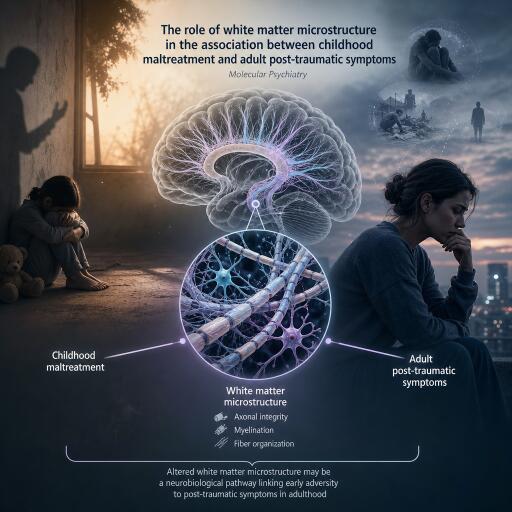
The role of white matter microstructure in the association between childhood maltreatment and adult post-traumatic symptoms – Molecular Psychiatry
This article reexamines how early-life adversity relates to the organization of brain white matter and how this may influence adult trauma-related symptoms. The study pursues three core aims: (1) to determine whether the severity of childhood maltreatment leaves detectable signatures in white matter microstructure in adulthood; (2) to assess whether clinical conditions such as post-traumatic stress symptoms and prior brain injury modify this relationship; and (3) to explore whether patterns of white matter integrity could mediate the link between childhood maltreatment and later trauma-related symptoms.
Participants were drawn from a large, multi-site program focused on trauma, brain injury, and recovery, with data collected at several centers. After applying quality controls to imaging data and clinical assessments, 299 adults aged 18 to 75 were analyzed. Eligible participants did not have conditions that would confound brain imaging results, and informed consent was obtained from all involved individuals.
Childhood maltreatment was quantified using a retrospective questionnaire covering emotional and physical abuse and neglect, along with sexual abuse. Subscale scores and a total maltreatment burden were derived from participant responses. To gauge current trauma-related symptoms, a standardized PTSD symptom checklist was used. Depressive symptoms were screened with a brief mood questionnaire. History of traumatic brain injury was assessed via a structured intake tool, and persistent post-concussive symptoms were measured with a validated symptom inventory.
Imaging and data processing were conducted using diffusion MRI acquired on 3T scanners across sites. To minimize scanner-related differences and ensure comparability, the diffusion data underwent harmonization. A sophisticated fiber-tracking approach mapped major white matter pathways for each participant, enabling tract-specific analyses. Tractography leveraged a model designed to better resolve crossing fibers, and stringent quality checks ensured reliable tract delineation; a single case was excluded for insufficient tract fibers. The resulting metrics—mean diffusivity, axial diffusivity, radial diffusivity, and fractional anisotropy—were computed within each tract, with a correction to reduce confounding from extracellular fluid.
Analytical methods involved parallel regression analyses linking maltreatment burden to each diffusion measure across a curated set of tracts. To account for multiple tests, false discovery rate control was applied within each diffusion metric. Covariates included age and sex; race and alcohol use were considered in sensitivity checks. Because PTSD symptom scores and depressive symptoms were highly correlated, depressive symptoms were not included as a covariate to avoid multicollinearity.
Where meaningful associations emerged between childhood maltreatment and white matter metrics, subsequent analyses explored moderation by PTSD status, history of brain injury, or both. Specifically, moderation was tested using regression frameworks that treated clinical status as a binary moderator. Additional checks examined potential imbalances and comorbidity effects to ensure robustness of the moderation results.
To investigate mediation, models tested whether the observed white matter alterations could explain (mediate) the link between maltreatment severity and adult trauma-related symptoms. A bootstrap-based mediation framework estimated indirect effects, using the diffusion measures that showed associations with maltreatment as potential mediators. Separate models examined whether white matter metrics mediated the relationship with PTSD symptom severity and with post-concussive symptom burden. Supplementary analyses further deconstructed the maltreatment dimensions and tract-specific patterns.
The findings indicate that greater childhood maltreatment burden is associated with altered microstructure in several key white matter pathways. These associations varied by tract and diffusion metric, with stronger signals in tracts implicated in communication between memory, emotion, and executive control regions. In some cases, the presence of PTSD symptoms or a history of brain injury amplified these associations, suggesting that clinical status can intensify the neurobiological imprint of early adversity on the brain’s wiring. Importantly, certain white matter measures partially mediated the relationship between maltreatment and adult symptom severity, pointing to a neurobiological mechanism through which early stress may contribute to later trauma-related outcomes.
The study emphasizes the value of integrating longitudinal histories of childhood adversity with advanced brain imaging to understand individual differences in vulnerability to trauma-related conditions. By identifying white matter signatures linked to early stress and their interaction with clinical factors, this line of work could inform prognosis and guide targeted interventions aimed at mitigating post-traumatic symptoms and facilitating recovery after brain injury.