
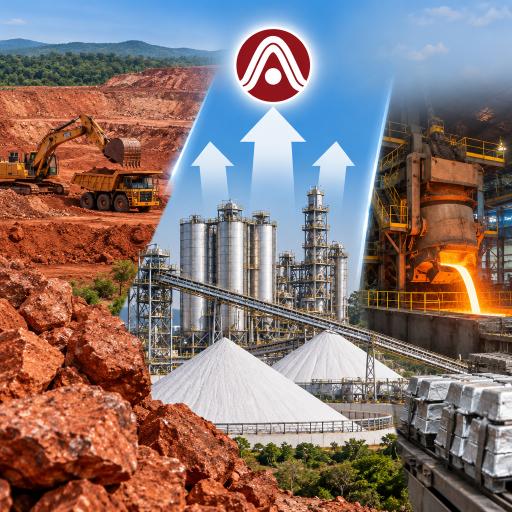

NALCO To Expand Its Alumina Refinery, Bauxite Mines And Smelter: CMD
National Aluminium Company Limited (NALCO), buoyed by its record half-yearly financial performance, is preparing for a major capacity expansion across its alumina refinery, bauxite mining operations and aluminium smelting business.
Speaking in Bhubaneswar, NALCO Chairman-cum-Managing Director Brijendra Pratap Singh said the company is moving ahead with a brownfield expansion of its aluminium smelter at Angul. The project is expected to sharply raise annual smelting capacity and strengthen domestic aluminium supply at a time when demand in India continues to rise.
According to Singh, the proposed Angul expansion is targeted for commissioning by December 2030. Once completed, it is expected to take NALCO’s aluminium smelting capacity from about 0.46 million tonnes per annum to nearly 1 million tonnes per annum. He said expansion is necessary to avoid a future supply gap in the country, while also enabling the company to focus on more value-added aluminium products and specialised grades.
NALCO’s broader growth plan is closely tied to upstream raw material availability. The company expects the Pottangi bauxite mines in Odisha’s Koraput district to become operational within the next few months. Once production begins there, NALCO’s total bauxite output is projected to rise from around 7 million tonnes to more than 10 million tonnes annually.
At the same time, the company is set to commission the fifth stream of its alumina refinery at Damanjodi. This addition will increase alumina production capacity from 2.1 million tonnes per annum to 3.1 million tonnes per annum, giving NALCO more feedstock for its downstream aluminium operations and additional surplus for new business opportunities.
Singh said the detailed project report for the Angul smelter expansion is currently being prepared. If the timeline holds, preliminary groundwork could begin in early 2028, likely in January or February, with construction expected to take between three and three-and-a-half years.
To support the power-intensive smelter expansion, NALCO also plans to develop a 1,080 MW captive thermal power plant through a 50:50 joint venture with NLC India Limited. The power project is intended to ensure energy security for the expanded smelting complex.
Importantly, the CMD dismissed speculation that NALCO might shift its Angul aluminium smelting operations to Andhra Pradesh. He said there is no such proposal and reiterated that the company remains committed to expanding its industrial footprint in Odisha.
Even after scaling up, NALCO may continue to have excess alumina available. Singh said the company is therefore exploring fresh opportunities for alumina utilisation, both within Odisha and in locations outside the state.
Clean Energy, AI and Emissions Reduction
Alongside conventional expansion, NALCO is also pushing on sustainability and digital modernisation. The company has set a goal of meeting 25% to 30% of its total electricity needs through renewable energy by 2030. Its clean energy strategy includes rooftop solar, wind power and procurement of renewable energy from external sources.
NALCO is also introducing artificial intelligence and machine learning tools to improve operational efficiency. These technologies are expected to help the PSU optimise processes across mining, refining and smelting.
On the environmental front, the company is working to cut the carbon intensity of its aluminium production. Singh said NALCO currently emits about 17 tonnes of CO2 for every tonne of aluminium produced, and the target is to bring that down to 12 tonnes.
Bet on Critical Minerals
Beyond aluminium, NALCO is widening its strategic focus to critical minerals, particularly lithium. The company has a 40% stake in Khanij Bidesh India Limited (KABIL), the joint venture created to secure overseas supplies of strategically important minerals.
Through this route, NALCO has secured five lithium exploration blocks in Argentina’s Catamarca province. Exploration work is expected to be completed by the end of 2027. The company is also planning a pilot plant to evaluate lithium grades and develop a process for producing lithium carbonate.
In addition, NALCO is exploring opportunities in Argentina’s Salta province and studying possible equity participation in operating lithium mines in Argentina, Chile and Australia. These efforts align with India’s broader push to build secure supply chains for battery minerals.
Recovering Value From Industrial Waste
NALCO is also trying to unlock value from industrial waste streams. At Damanjodi, the company is developing a pilot facility to recover gallium from red mud in collaboration with the Bhabha Atomic Research Centre and other research institutions.
Research is also underway to extract rare earth elements, scandium, alumina and ferro-titanium from red mud and fly ash. If commercialised, these technologies could improve resource efficiency while creating new revenue streams from by-products traditionally treated as waste.
With expansion plans spanning mining, refining, smelting, power, renewables, digital operations and critical minerals, NALCO is positioning itself not just as a larger aluminium producer, but as a more diversified and future-facing metals company.