
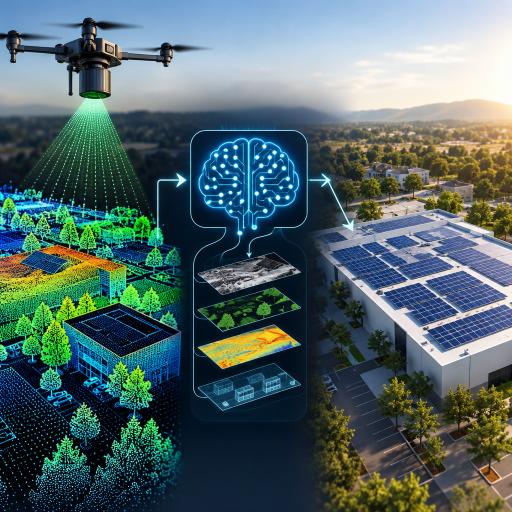

How to combine LiDAR and AI for a more reliable solar design
In solar PV, a proposal is only as strong as the roof data behind it. A layout may look polished on screen, but if key details are wrong before the installer even arrives, the design can quickly fall apart. A chimney may be taller than expected, a dormer may take up more usable area, or nearby trees may cast more shading than the initial model suggested. The result is familiar across the industry: a 12-panel quote turns into a 10-panel installation, with knock-on effects for yield, payback and customer trust.
For UK installers expected to deliver quicker quotes and clearer proposals, the challenge is obvious: how much can be known about a roof before a site visit? Increasingly, the answer lies in combining LiDAR, aerial imagery and AI to build a more dependable remote roof model from the start.
Why remote solar design has been difficult
Traditional remote assessment has often relied heavily on standard aerial or satellite imagery. While useful, images alone have limitations. They can show roof outlines, skylights and some obstructions, but they do not always capture height accurately. That matters because solar design is not just about what sits on the roof, but how high it is, how much space it occupies and what shadows it creates.
Without accurate height data, installers risk overestimating panel capacity or underplaying shading losses. That can lead to redesigns, reduced system size and awkward conversations with customers later in the process.
What LiDAR adds to the picture
LiDAR, or light detection and ranging, fills in that missing dimension. It works by sending laser pulses toward the ground from an airborne platform and measuring how long they take to return. Those measurements, combined with precise location and orientation data, create a three-dimensional point cloud made up of millions of georeferenced points.
In practice, that point cloud provides measurable information about the height and shape of buildings, chimneys, trees and surrounding terrain. Much of this data comes from government mapping programmes or commercial survey providers that collect it for infrastructure, flood modelling and planning applications.
For solar designers, LiDAR is valuable because it turns a flat roof image into a spatial model. A chimney visible in a photograph can be measured for height and position. A dormer can be defined not just by outline, but by how much roof area it removes. Trees can be assessed as shade objects rather than vague visual features.
Why AI matters
LiDAR on its own is not a finished roof model. A point cloud is raw measurement data, not a clean design surface ready for PV layout. This is where AI becomes useful.
AI tools can process aerial imagery, LiDAR and property boundary information together to identify roof planes, distinguish adjoining properties and detect likely obstructions such as chimneys, rooflights and dormers. Instead of asking a designer to trace and interpret every feature manually, AI can generate an initial model much faster.
That speed matters in a market where installers are under pressure to respond quickly to leads. Faster modelling means faster quotation, but the bigger advantage is consistency. AI can help standardise how roof features are recognised and measured, reducing some of the variability that comes from manual interpretation alone.
The importance of combining data sources
The most reliable remote designs do not come from AI, imagery or LiDAR in isolation. They come from combining all three.
Aerial imagery is strong at showing visible features and context. LiDAR contributes height, slope and shape. AI helps convert those inputs into a workable roof model that can support panel placement and early performance estimates. Property boundary data adds another layer of value, particularly in terraces or semi-detached homes where rooflines may appear continuous from above but ownership does not.
This combination gives installers a better chance of producing proposals that survive first contact with the real site. It will not remove the need for survey work altogether, but it can narrow the gap between the initial quote and the final installation plan.
What this means for installers
For installers, the practical benefit is not just efficiency. It is reliability. A better remote model means a better chance of quoting the right system size, identifying likely constraints early and setting more realistic expectations with customers.
That can improve conversion rates as well as project delivery. Customers are more likely to trust a proposal that does not need major last-minute revision. Installers, meanwhile, waste less time redesigning systems after site visits reveal avoidable errors.
There is also a competitive benefit. As quoting timelines shrink, firms that can produce detailed, data-backed designs remotely are in a stronger position than those still relying on rough visual estimates.
The limits of the technology
None of this means remote design is perfect. LiDAR datasets vary in age and resolution. Imagery may not reflect recent roof changes. AI models are only as good as the data they are trained on and the assumptions built into them. Some roof details will still require on-site confirmation, especially where structural condition, electrical integration or hidden obstructions are concerned.
But the goal is not to replace site visits entirely. It is to make the first design stage more robust, so that installers arrive on site with fewer surprises and customers receive proposals that are closer to reality.
A smarter foundation for solar proposals
The future of remote solar design is not about AI doing everything automatically. It is about using AI to extract more value from high-quality spatial data, especially LiDAR, and turning that into a usable starting point for human designers.
When combined well, LiDAR and AI can give installers a clearer understanding of roof geometry, obstructions and shading before anyone climbs a ladder. In a sector where trust, speed and accuracy all matter, that makes solar proposals not just faster to produce, but more reliable from day one.