
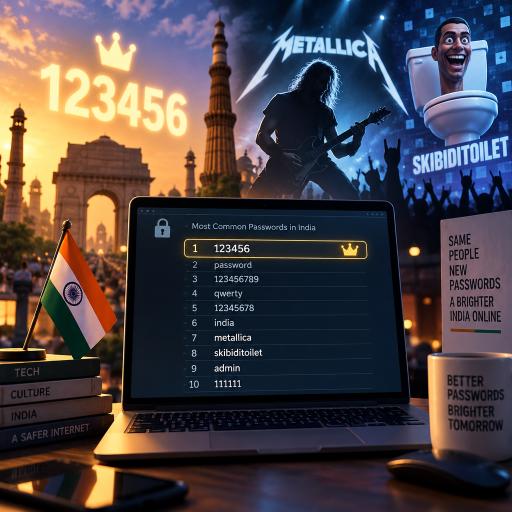

123456 tops India’s most common passwords as metallica and skibiditoilet signal a pop culture shift
India’s password habits remain dominated by predictable number sequences, default administrator credentials and minor variations of familiar words. A large-scale analysis of exposed credentials places “123456” at the top of the country’s rankings, highlighting how convenience continues to outweigh security for many users.
The findings also reveal a broader cultural pattern. Passwords inspired by heavy metal, anime, video games, athletes and viral memes act like digital time capsules, preserving the entertainment trends of different generations.
India’s 20 most common passwords
- 123456
- 12345678
- admin
- 1234
- 12345
- 123456789
- password
- Admin@123
- Welcome@123
- admin@123
- 1234567890
- India@123
- admin123
- smartv
- 1234567
- 123123
- Password
- P@ssw0rd
- 112233
- 654321
Ten entries are straightforward numerical combinations, while several others rely on “admin” or “password.” Capital letters, symbols and familiar suffixes such as “123” may make credentials look more complex, but they provide little protection when the underlying pattern is widely known.
Locally influenced choices also appear. “India@123” adds a national reference, while “Welcome@123” resembles the type of temporary credential commonly assigned to workplace, household or connected-device accounts.
A global problem with familiar credentials
“123456” also holds the leading position worldwide. “admin” ranks second, followed by “12345678.” These repeated appearances show that weak password behavior is not limited to one country or platform.
The use of special characters is increasing, with 39 entries in the global ranking containing symbols, compared with 32 in the previous edition. However, predictable substitutions such as replacing the letter “a” with “@” or the letter “o” with zero do not create meaningful complexity. Automated cracking tools are designed to test these variations immediately.
Default credentials associated with routers and Internet of Things hardware also appeared in the wider dataset. Leaving factory-set passwords unchanged can expose smart TVs, cameras, home networks and other connected equipment to unauthorized access.
From heavy metal to gaming and viral memes
Entertainment has long influenced the words people choose to protect their accounts. Before the 2000s, rock bands and action movies inspired credentials such as “metallica,” “Slayer007,” “corleone13” and “Rambo017.” They were memorable to fans, but also easy to anticipate.
During the 2000s, anime and gaming became increasingly visible. Passwords referencing Naruto, Bleach, Kingdom Hearts and The Legend of Zelda: The Wind Waker appeared alongside music-based combinations such as “eminem2004.”
The 2010s reflected the rapid growth of social platforms, mobile games and sandbox gaming. Examples included “minecraft,” “Templerun303,” “insta123” and “telegram.” Football stars also influenced choices, producing combinations based on names such as Lewandowski and Neymar.
Passwords associated with the 2020s capture online culture at remarkable speed. “skibiditoilet,” “squidgamethebest” and “roblox.com1” mirror viral entertainment and gaming communities, while “Covid@19” and “corona2020” preserve reminders of the pandemic.
These examples do not prove exactly when each password was created. A classic band name could belong to an older fan or to a younger listener discovering past music. The security issue remains the same: personal interests make password choices easier to guess, especially when combined with a birth year or simple number sequence.
How to improve password security
- Use long, random credentials: Aim for at least 14 characters. A generated password or an unrelated multi-word passphrase is safer than a short word decorated with predictable symbols.
- Give every account a unique password: Reuse allows attackers to test credentials stolen from one service against email, gaming, shopping and social accounts.
- Replace weak and outdated passwords: Review accounts regularly and change credentials based on names, fandoms, dates, keyboard patterns or common phrases.
- Use a password manager: It can generate and store unique credentials, removing the need to memorize every login.
- Enable multi-factor authentication: An authentication app, security key or passkey can provide another barrier if a password is exposed.
- Change device defaults: Routers, smart displays, cameras and other connected products should receive new credentials during setup.
How the rankings were compiled
The analysis used statistically aggregated passwords found in public breach material and illicit repositories between September 2025 and September 2026. Researchers examined the frequency of exposed credentials without purchasing personal information.
The results underline a persistent lesson: adding a number or symbol to a famous name does not make it secure. Whether the inspiration is Metallica, Minecraft or Skibidi Toilet, a password based on popular culture may be memorable—but it can also be highly predictable.