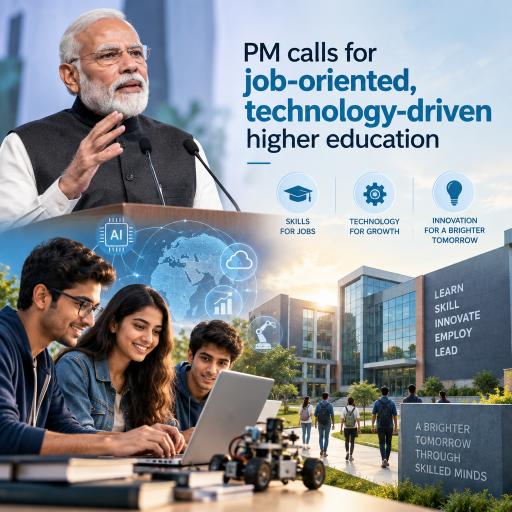

PM calls for job-oriented, technology-driven higher education
Prime Minister Tarique Rahman has urged Bangladesh’s higher education institutions to prioritize practical skills, emerging technologies and career preparation so that graduates can respond effectively to a rapidly changing employment landscape.
Speaking at the National University Principals’ Conference 2026 at the National Stadium in Mirpur, Dhaka, he said increasing the number of degree holders would do little to reduce unemployment unless students could use their knowledge in professional settings.
The prime minister advocated a broader role for internships, apprenticeships, technical instruction, foreign-language education and partnerships between academic institutions and employers. Colleges and universities, he said, must create clear pathways through which classroom learning can be converted into workplace competence.
More than 2,300 principals from National University-affiliated colleges attended the conference.
Rahman described principals as more than institutional administrators, saying they also serve as academic leaders, ethical guides and key decision-makers. Their judgement and long-term vision can have a significant influence on students’ futures, he added.
He noted that the National University, established on October 21, 1992, during former prime minister Khaleda Zia’s government, had helped extend higher education across cities and rural communities. With roughly 2,500 affiliated colleges now operating under the university, he said attention must turn from numerical growth to educational standards.
Preparing students for technological change
Highlighting the impact of the Fourth Industrial Revolution, Rahman said institutions should prepare learners for fields shaped by artificial intelligence, robotics, automation, big data, blockchain, the Internet of Things and cybersecurity. He also identified biotechnology, genetic engineering and advanced wireless connectivity as areas likely to reshape economies and employment.
Technological progress will cause some conventional occupations to decline while generating entirely new professions, he said. Students therefore need adaptable skills, practical experience and a clear sense of purpose before entering the workforce.
To support that transition, the prime minister called for student-focused and research-led teaching in place of methods dominated by one-way classroom instruction. He proposed stronger professional development for educators, including a “train the trainer” model that would help teachers incorporate modern tools and techniques into their lessons.
Rahman said the government had been working to strengthen cooperation between industry and academia. More than 1,500 memorandums of understanding involving universities and industrial organizations had recently been finalized, he stated.
He encouraged institutions to invite experienced professionals as guest lecturers and asked businesses to provide internships, industrial placements and supervised workplace training. Students who acquire relevant expertise before graduation, he said, may be better positioned to launch enterprises and employ others rather than depend solely on existing vacancies.
Languages, humanities and career support
The prime minister emphasized that technical proficiency should be complemented by the humanities and ethical education. Subjects such as literature, philosophy, history, sociology, science and cultural studies can strengthen creativity, critical thinking, leadership and social responsibility, he said.
He also recommended expanding language instruction beyond English. Opportunities to study Arabic, Mandarin, Japanese, Korean, French, German and Italian could improve graduates’ prospects in international labor markets.
National University colleges were urged to establish or expand career counselling, entrepreneurship initiatives, language clubs, internship services and skills-development programs. Rahman identified the shortage of practical and technical knowledge as a major factor behind unemployment among educated young people.
Staffing, sustainability and campus discipline
Addressing teacher shortages, Rahman called for college-level assessments of vacant positions, followed by recruitment and appropriate deployment where needed. He asked the education ministry and relevant education and teacher-registration authorities to coordinate with the National University on staffing and training.
He also encouraged colleges to install rooftop solar systems wherever practical, reflecting the government’s focus on renewable energy. Teachers and students were asked to help keep campuses, homes and surrounding communities clean.
On campus governance, the prime minister said academic institutions should be protected from factional disputes, personal rivalries and conflicts that interfere with education. Political disagreement is normal in a democracy, he said, but it must not undermine student safety, administrative order or regular academic activities.
Rahman additionally called on colleges to safeguard the interests of students from low-income and marginalized communities, as well as learners with special needs.
He said the broader objective was to build a knowledgeable, self-sufficient and humane country capable of competing confidently on the global stage. Concluding his remarks, he expressed support for the National University’s “One Student, One Tree” initiative and acknowledged the contribution of the educators attending the event.