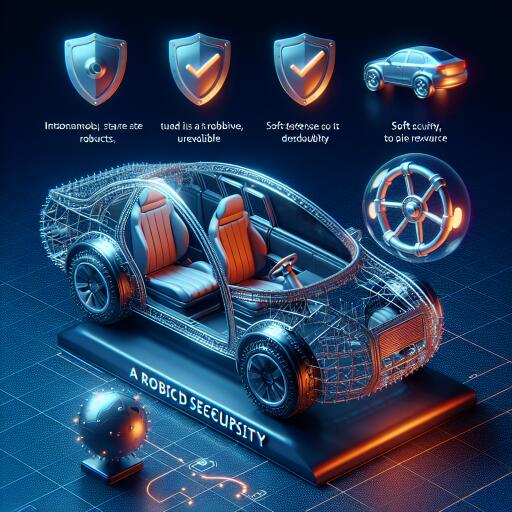

Why autonomous vehicle security needs to be hard and soft
Autonomous vehicles have moved from sci‑fi panels to real city streets. Self-driving cars navigate dense traffic, drones deliver medical supplies, and robots ferry goods across warehouses and ports. The combined land‑air‑sea autonomy market was valued at roughly $62bn in 2022, with steep growth ahead. Yet the same momentum expanding AI-powered mobility is also widening the target zone for cyberattacks—threats that can jeopardize safety, privacy and trust at scale.
The attack surface is bigger than it looks
Autonomous systems are, by design, hyper-connected. They fuse sensors, cameras, GNSS, V2X communications, edge compute and cloud services. That mesh of software and devices creates countless entry points for attackers. A single breach can cascade through fleets and networks, disrupting operations and compromising safety.
We’ve seen the risks in practice. Security researchers have repeatedly demonstrated remote exploits against production vehicles—gaining control over infotainment features, injecting malicious inputs and, in some cases, triggering slow-speed stops. In 2019, researchers at Regulus Cyber spoofed GPS signals to mislead a Tesla Model 3’s navigation, underscoring how over-the-air manipulation can nudge an autonomous system into unsafe decisions. More recently, high-profile incidents involving driverless taxi services have kept autonomy under the microscope, while GM’s Cruise program was paused and restructured after controversial accidents. Whether caused by malicious interference or technical failure, such episodes erode public confidence and highlight a core truth: resilience isn’t optional.
Why software alone won’t cut it
Software will always be a frontline defense—patching vulnerabilities, enforcing access controls, scanning for anomalies. But code is inherently mutable and, too often, one delayed update or misconfigured service is all it takes. In sprawling autonomous deployments, patch cycles, third-party libraries and complex supply chains amplify risk. Malware injection, API mishandling, protocol downgrades, and exploitation of unpatched systems can undermine the algorithms that keep vehicles safe and stable.
Cybersecurity veteran Camellia Chan argues that true resilience demands more than good software hygiene. It requires hard security as well as soft: tamper-resistant, embedded protections that operate even when higher-level defenses falter.
Hardware security: the vault inside the vehicle’s brain
Think of hardware security as a sealed vault co-located with the brain of the vehicle. Unlike software, it’s not easily altered, and its isolation gives it a crucial advantage when everything else is under stress. Done right, it provides:
- Root of trust at boot: Secure boot chains anchored in silicon verify firmware integrity from the first instruction, preventing compromised code from ever running.
- Protected identity and keys: Hardware security modules and secure elements store cryptographic keys out of reach, enabling strong authentication, encrypted comms and signed OTA updates.
- Tamper evidence and response: Embedded sensors can detect probing, voltage glitches or abnormal access patterns and trigger safe modes or key zeroization before attackers pivot.
- Runtime isolation: Memory protections and hardware-enforced enclaves keep critical autonomy functions walled off from less-trusted components and apps.
Pair that with AI-driven telemetry and you get a powerful loop: silicon-level monitors flag anomalies at the source, while machine learning correlates patterns across fleets to detect spoofing, sensor drift, or command manipulation. The result is real-time detection, isolation and response—measured in milliseconds, not maintenance windows.
A layered playbook: hard + soft by design
Security bolted on after the fact won’t survive real-world adversaries. The path forward is security by design, embedding defenses from chip to cloud. Practically, that means:
- Architect for zero trust: Authenticate every device, user and message; limit privileges; partition networks; and assume compromise is possible.
- Anchor in silicon: Use secure boot, hardware key storage, tamper sensing and runtime isolation for the most safety-critical functions.
- Harden the sensor stack: Validate signals from GNSS, lidar, radar and cameras; apply multi-sensor cross-checks to resist spoofing and injection.
- Protect the update path: Enforce signed, staged OTA updates with rollback protection and continuous software bill of materials (SBOM) tracking.
- Monitor continuously: Stream privacy-preserving telemetry to detect anomalies, with fleet-wide intelligence to spot emerging threats fast.
- Secure the data lifecycle: Encrypt data at rest/in transit, minimize retention of sensitive passenger info, and segregate PII from operational logs.
- Test like an attacker: Red-team exercises, fuzzing, and coordinated disclosure programs to find and fix issues before adversaries do.
- Plan for fail-safe: Define graceful degradation and safe-stopping behaviors triggered by integrity violations or sensor uncertainty.
- Comply and document: Align with ISO 21434, UNECE R155/R156 and sector best practices; prove security posture to regulators and partners.
Trust is the real currency
Autonomy will scale only as fast as people trust it. Every breach or high-profile mishap hardens skepticism; every transparent fix, robust safeguard and safe failover earns confidence back. The lesson from recent years is clear: patching software is necessary, but insufficient. By pairing AI-informed software defenses with tamper-resistant hardware foundations, the industry can move from reactive firefighting to proactive resilience.
Chan’s core message is worth repeating: make security a first-class design requirement, not a checklist item. Hard plus soft—silicon plus software—is how autonomous systems protect people, privacy and the promise of autonomy at scale.