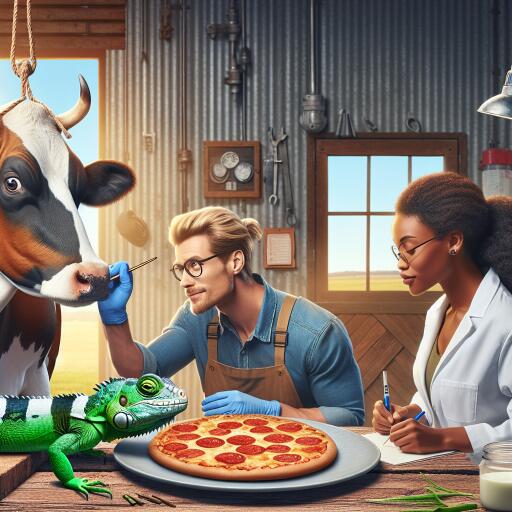

Painting stripes on cows to lizards’ pizza pick: Ig Nobel winners
The Ig Nobel Prizes—the cheeky counterpart to science’s most solemn honors—returned for their 35th edition with a gloriously odd slate of winners. Staged a few weeks ahead of the real Nobels, the Annals of Improbable Research once again celebrated research that first makes you laugh, then makes you think. At a spirited ceremony at Boston University on September 18, ten teams were recognized for studies that span animal behavior, culinary physics, language, and even the intimate logistics of a shoe rack.
Biology: Painting cows like zebras
A Japanese team earned the Biology prize by demonstrating that painting zebra-like stripes on cows reduces fly bites. The field test wasn’t just effectual; it was theatrical. While one researcher accepted the award, colleagues buzzed fly images around him until he revealed a zebra-striped shirt—on-message science communication at its finest.
Nutrition: Rainbow lizards vs. resort pizza
In Togo, pizza-thieving rainbow lizards showed a clear preference: quattro formaggi. Italian researcher Luca Luiselli summed up the Nutrition winner’s insight with a grin: when lizards discover cheese and carbs, “they behave like Italians.” It’s an amusing window into opportunistic feeding behavior—and a reminder that human food can reshape animal taste.
Peace: A sip for smoother foreign speech
A Dutch-German-British collaboration explored the lore of liquid courage and found that a small dose of alcohol—less than a pint of beer—can help non-native speakers pronounce a foreign language more clearly. Confidence seems to play a role, but the team cautions against treating alcohol as a learning tool. The idea reportedly sparked over conference drinks, where “drunken Germans usually pronounce Dutch better than sober Germans.”
Physics: De-clumping cacio e pepe
European researchers took on the Physics of pasta sauce, dissecting how to prevent clumping in the minimalist Italian classic cacio e pepe. Beyond culinary memes and an onstage fake moustache, the work reveals how emulsions and starch dynamics can make or break a dish—yes, even dinner can be a testbed for fluid mechanics.
Aviation: Tipsy bats and impaired echolocation
What happens when bats consume alcohol from fermented fruit? Aviation prize winners showed that ethanol hampers both flight control and echolocation. The experiment required giving bats alcohol—no easy brief. “The problem is that the bats, they like it,” a researcher confessed, underscoring how natural behavior can complicate controlled tests.
Literature: A 35-year fingernail log
The late William B. Bean received the Literature prize for persistently tracking his fingernail growth over 35 years. It’s a minimalist study—filing a mark, waiting, recording—but a testament to longitudinal data. As his son Bennett recounted, the power of measurement can rest in simple, relentless observation.
Psychology: Telling narcissists they’re smart
A Polish-Canadian-Australian team probed what happens when you inform narcissists of their intelligence. The result earned the Psychology prize and a rousing singalong of “If you’re special and you know it, clap your hands.” It’s playful framing for a serious question about self-perception, feedback, and behavior.
Pediatrics: Garlic-flavored milk
Conventional wisdom often urged nursing mothers to avoid strong flavors. The Pediatrics prize went to researchers who tested that claim by examining the effects of maternal garlic consumption on nursing infants. Verdict, per prize-winner Julie Mennella: babies can “savor” garlic—expanding how we think about early flavor learning.
Chemistry: The Teflon satiety test
A US-Israel team explored whether ingesting Teflon—the non-stick coating—might make people feel fuller without added calories. The Chemistry prize recognizes the audacity of the question more than a dietary recommendation. It’s a sharp reminder: even curious hypotheses belong under the microscope, especially when materials intersect with metabolism.
Engineering: When sensors fail, use noses
The Engineering prize went to two Indian researchers who investigated how foul-smelling shoes affect the user experience of a shoe rack. In a classic lab-to-life pivot, odor sensors proved unreliable, so they recruited human noses to rate the stench. Sometimes the most robust instrument is, quite literally, right under your nose.
Why this matters
Tech and science thrive on curiosity. The Ig Nobels reward studies that might seem trivial but often reveal subtle mechanisms: pattern-driven pest deterrence, confidence effects in speech, emulsion physics in cooking, sensory limits in navigation, and the resilience of human-centered measurement when sensors come up short. Taken together, this year’s winners are a showcase of method, imagination, and the power of asking “what if?”—then building the experiment to find out.
As always, the ceremony—chaotic, joyous, and surprisingly rigorous—makes one point crystal clear: science isn’t just about solemn breakthroughs. It’s also about playful questions pursued with serious tools, yielding insights that can ripple from barnyards and bat caves to kitchens and cribs.