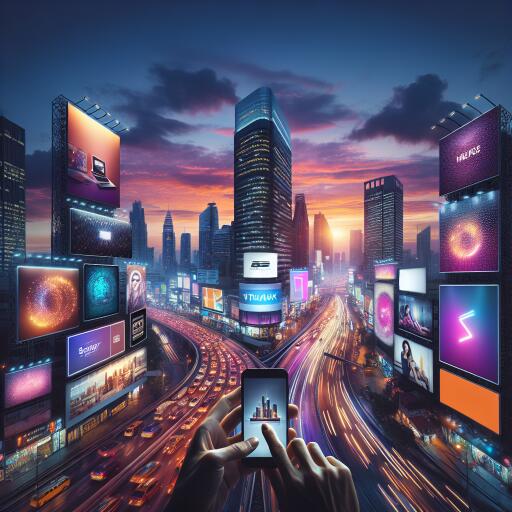

Billboards Still Mean Business In A Noisy Digital World
Scroll fatigue is real, ad blockers are everywhere, and feeds get noisier by the minute. Yet the simplest canvas — a message planted in the physical world — keeps cutting through. Out-of-Home (OOH) advertising is proving its staying power by doing what digital often can’t: commanding attention in shared spaces and building trust through real-world presence.
India’s streets tell the story
Even as digital budgets balloon, India’s OOH market has accelerated. Estimates peg the segment at roughly INR 4,140 crore in FY24, up about 13% year-on-year. Projections point to steady expansion toward INR 5,961 crore by FY28, implying near 7.5% annual growth. In other words, brands still rely on streetscapes and transit hubs for reach, recall, and credibility.
DOOH steps on the gas
The standout surge comes from Digital Out-of-Home (DOOH): screens that adapt to time, weather, audience flow, or context. DOOH currently contributes around 20–25% of OOH revenues in India and is expected to climb to roughly 30–40% by FY28. By value, the country’s DOOH market was near USD 2.2 billion in FY24 and is forecast to grow at a 12–14% CAGR over the next decade. That trajectory mirrors how brands want to buy media today — flexible, data-informed, and measurable — while still benefiting from the authority of physical placement.
Why physical ads feel more “real”
- Tangible presence: Oversized billboards, building wraps, station takeovers, and bus shelters create unavoidable sightlines that can’t be scrolled past, muted, or skipped.
- Shared moments: OOH exists in the same spaces people commute, gather, and play — turning brand messages into part of the city’s texture.
- Trust and safety: A public-facing placement signals investment and stability, which boosts perceived credibility compared to fleeting online impressions.
- Efficiency: Studies consistently show OOH delivers strong response per rupee spent relative to TV, print, or radio — and it multiplies digital performance when used together.
When the street fuels the screen
OOH increasingly acts as the spark that ignites digital behavior. A smart headline or visual triggers a search. A QR code closes the loop. Geofenced retargeting continues the conversation on mobile once someone has passed a location. Hashtags on a skyline screen can catalyze social chatter. Many consumers now interact with a brand online only after a compelling real-world encounter.
Gen Z gets the memo
Despite being native to feeds and stories, younger audiences still read physical visibility as a mark of authenticity. A large-format placement signals that a brand is confident and accountable — and that kind of permanence stands out in a swipe-first culture. It’s no surprise Gen Z is often more likely to click, follow, or search after first seeing a message outdoors.
Where OOH meets gaming and XR
Here’s where it gets exciting for interactive media. DOOH is evolving from static storytelling to responsive experiences:
- AR layers: Viewers can unlock augmented scenes on their phones by pointing at a poster or screen — turning a 2D placement into a mini-game or product demo.
- Real-time triggers: Weather, traffic, or event data can switch creative on the fly, making messages feel timely and alive.
- Virtual crossovers: Campaigns that appear on street screens can echo inside virtual worlds, with in-game billboards or skins mirroring what’s on the highway IRL, creating a loop between the city and the screen.
- Eco-forward builds: Solar-powered panels, recyclable materials, and low-energy LEDs are reshaping how installations are produced and maintained.
How to make OOH work harder
- Design for distance: Bold typography, uncluttered visuals, and immediate propositions win. If it can’t be decoded in a heartbeat, it’s not ready for the street.
- Plan for the path: Match creative to context — locations near campuses, business districts, stadiums, or transit corridors each influence message and timing.
- Close the loop: Use QR codes, unique vanity URLs, or promo codes to attribute lift. Pair OOH flighting with search and social bursts in the same zip codes.
- Measure modern: Lean on mobile panel data, heatmaps, and modeled impressions to assess reach and frequency; track brand search and site visits for incremental impact.
- Iterate with DOOH: Test multiple cuts of creative by time of day or audience flow. Treat screens like a high-impact, location-tuned canvas for rapid learning.
The big picture
People encounter thousands of online messages daily, but only a few break through. That’s why a towering billboard, a clever transit wrap, or a dynamic digital screen can feel refreshingly definitive. OOH thrives because it’s unmistakably there — shaping the skyline, punctuating commutes, and bridging offline discovery with online action. In a world of noise, the biggest, boldest screens still speak the clearest.