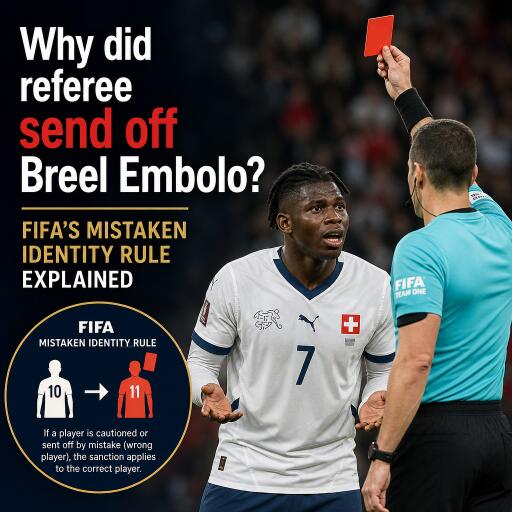

Why did referee send off Breel Embolo? FIFA’s mistaken identity rule explained
The 2026 World Cup delivered a rare rules quirk in Argentina’s quarterfinal against Switzerland: Breel Embolo was dismissed in the 72nd minute because of a “mistaken identity” situation that the laws of the game didn’t allow the officials to correct once play had already restarted. The incident instantly became the talking point of the night—and flipped the match’s momentum.
How the chaos unfolded
Here’s the sequence that led to Embolo walking off early:
- Midway through the second half, a foul sparked disciplinary action. The referee, João Pedro Silva Pinheiro, produced a yellow card at the time.
- Play resumed. Moments later, the VAR invited the referee to conduct an on-field review of the prior incident.
- After watching the replays, the referee decided to alter the initial judgment. In the confusion that followed, the caution was shown to Breel Embolo—who was not the intended recipient.
- Because Embolo had already been booked earlier in the game, that caution automatically became his second yellow, which equals a red card under standard discipline rules.
The crucial wrinkle: by the time the VAR review happened, the ball had already been back in play after the original decision. That timing locked the referee into a narrow set of options by rule.
The law that made the red card stick
Under Law 5 of the Laws of the Game, once play has restarted, the referee cannot change the identity of a player who has been cautioned or sent off. In short: you can correct who the offender is before the restart; you cannot swap the booking to the “right” player after the game resumes. Even if everyone recognizes a mistaken identity has occurred, the law prevents retroactively moving the card.
That’s exactly why Embolo’s dismissal stood. The officials could not legally transfer the second yellow to the actual offender once the ball had already been put back into play earlier in the sequence.
What “mistaken identity” means in practice
- Mistaken identity occurs when a referee cautions or sends off the wrong player for an incident.
- VAR is permitted to help the referee correct mistaken identity—if the correction happens before play restarts.
- After the restart, the identity of the player disciplined is locked in, even if the decision was shown to the wrong teammate.
It’s one of the more unforgiving parts of the laws, designed to prevent endless rewrites of earlier phases of play. The trade-off is that, in rare cases like this, a team can lose a player because of an unfixable administrative error once the game has moved on.
Match impact
At the time of Embolo’s dismissal, the score was 1-1 and the contest was finely balanced. Reduced to ten, Switzerland were forced into a deep defensive posture. Argentina capitalized in stoppage time, striking twice to close out a 3-1 victory and book a place in the semifinals.
The win set up a meeting with England on Thursday, July 16, in Atlanta—a heavyweight showdown shaped, in part, by one of the tournament’s most debated officiating moments.
Why it felt so baffling
To viewers, it seemed obvious that if the wrong player was shown a card, the officials could just correct it. But the timing was everything. Because the initial decision had been made and play had restarted before the deeper VAR check and card re-issue, the law prevented swapping the identity afterward. The result is counterintuitive: the system is built to protect match flow and prevent backtracking through multiple restarts, even if that occasionally cements an error.
Takeaways
- The referee can revisit disciplinary decisions with VAR support—but not change who was booked once play restarts.
- Embolo’s red derived from a second yellow shown to the wrong player, which could no longer be reassigned.
- The incident is rare but not unprecedented in the modern VAR era, and it highlights how vital restart timing is to what can and can’t be corrected.
It’s a tough break for Switzerland and a stark reminder that, like any complex ruleset, football’s officiating framework can produce edge cases. On a night of high stakes, this one decisively tilted the field.