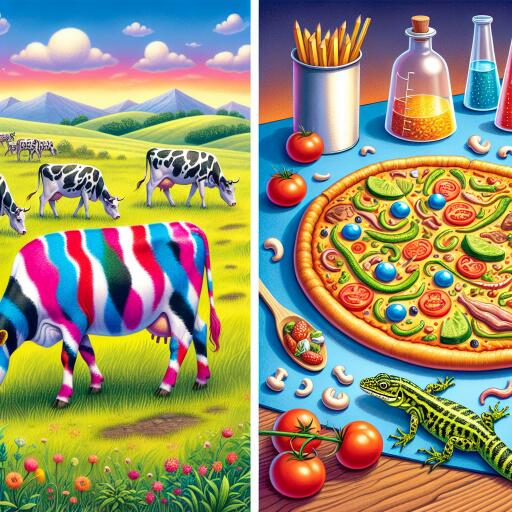

‘Painting stripes on cows to lizards’ pizza pick: Ig Nobel winners
The Ig Nobels—science’s favorite celebration of the curious, the comedic, and the surprisingly consequential—returned with a lineup that ranges from tipsy linguistics to pasta dynamics, sonar-challenged bats, and the user experience of stinky shoe racks. Here’s a tech-minded rundown of studies that made audiences laugh, then think.
A drink that smooths your Dutch (but don’t try this as a lesson plan)
Inspired at a bar during an international conference, researchers noticed something odd: Germans with a small buzz seemed to pronounce Dutch better than their sober counterparts. In controlled tests, a modest dose—less than a pint of beer—nudged pronunciation and confidence upward. The important caveat: the effect shows up only in moderation, and the team explicitly discouraged alcohol as a language-learning tool.
Pasta physics: the cacio e pepe that doesn’t clump
A European group earned the physics nod for unpacking the flow and mixing behavior behind a notoriously finicky dish: cacio e pepe. The researchers examined how cheese, pepper, starch, and water emulsify—and, crucially, how to prevent those gluey, unappetizing clusters. In a wink to culinary stereotypes, one team member leaned into the theatrics on stage with costume flair, while the science itself deconstructed sauce rheology with precision.
Drunk bats, bad GPS
The aviation prize highlighted a natural hazard for fruit bats: ethanol from fermented fruit. When bats consumed small amounts of alcohol, their flight control degraded and echolocation—nature’s sonar—got noisier and less reliable. The researchers joked that the experimental challenge wasn’t dosing but restraint: the bats seemed all too willing to sample the ethanol.
Watching fingernails grow for 35 years
The literature award honored the late William B. Bean for a marathon of meticulous self-tracking. Over three and a half decades, he marked his fingernails and measured growth with a persistence any quantified-self enthusiast would applaud. The long series produced a rare longitudinal dataset on a trivial-seeming but biologically telling phenomenon.
Narcissists, praise, and feedback loops
What happens when you tell a narcissist they’re clever? A Polish-Canadian-Australian team captured the psychology prize for examining how self-regard interacts with affirming feedback. Their ceremony moment turned into a playful call-and-response about being “special,” but the underlying work probed how praise can reinforce preexisting self-beliefs and shape behavior.
Garlic goes straight to baby—through breast milk
The pediatrics prize revisited long-standing advice that nursing mothers should stick to bland diets. A US duo tested flavor transfer via breast milk and found that infants actually appeared to enjoy garlic notes. Rather than deterring feeding, garlicky profiles were savored—evidence that babies are more adaptable tasters than conventional wisdom assumes.
Is satiety a slippery subject? Eating Teflon tested
The chemistry award recognized a US-Israel collaboration that asked a provocative question: could ingesting Teflon—the nonstick coating better known from cookware—alter fullness without adding calories? The team’s aim was to explore satiety mechanisms in a tightly controlled way. However, the idea sits firmly in the realm of experimental inquiry, not dietary advice.
Engineering the least awful shoe rack (with human noses)
Two Indian researchers took on a genuinely practical UX challenge: how foul-smelling shoes affect the experience of using a shoe rack. Electronic sniffers didn’t deliver reliable signals, so they recruited trained human noses to rate odor levels, then mapped those impressions to design considerations. It’s sensory science pressed into everyday ergonomics.
Why this oddball science matters
Behind the zany headlines are rigorous methods and surprising insights. A barroom observation becomes a controlled study on performance under low-dose alcohol; a classic Roman pasta becomes a testbed for emulsions and flow; echolocation falters under ethanol, hinting at broader implications for navigation in animals; self-tracking nails remind us that patient, long-term data can reveal subtle biology; and even smelly shoes demonstrate why human perception remains a gold standard when sensors fail. That’s the Ig Nobel promise: illuminate the world by first making us look twice.