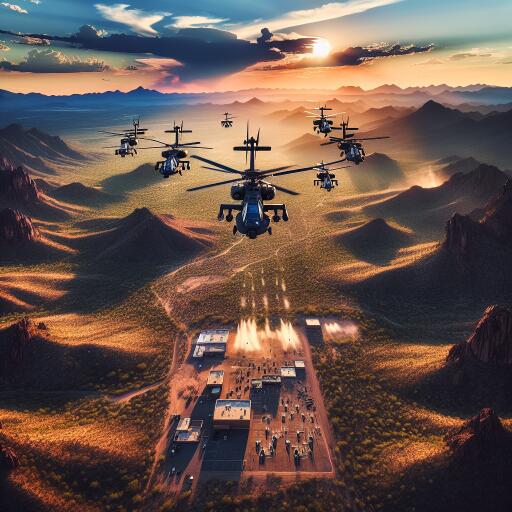

Arizona Army National Guard Aviation Strengthens Combat Readiness Through Aerial Gunnery Training
GILA BEND, Ariz. — Under the desert sun and across the ridgelines west of Phoenix, crews from A Company, 2nd Assault Helicopter Battalion, 285th Aviation Regiment, Arizona Army National Guard, sharpened their edge with a comprehensive aerial gunnery exercise on May 3, 2026. The live-fire training at Gila Bend Air Force Auxiliary Field showcased the unit’s ability to synchronize pilots and crew chiefs in fast-moving scenarios that mirror real-world missions.
Aerial gunnery is one of the most demanding skill sets in rotary-wing aviation. It requires precise communication, calm under pressure, and mastery of the UH-60 Black Hawk’s flight envelope. While pilots maneuver the aircraft to create optimal firing geometry, crew chiefs maintain continuous security, scan for threats, and engage targets—all while coordinating with the cockpit to manage altitude, speed, and angles of attack.
The mission starts long before the rotors turn. Crews begin with detailed planning and aircraft preparation—balancing fuel and payload, tracking winds and density altitude, and reviewing terrain and approach routes. Parallel to flight ops, door gunners progress through layered training to build proficiency and safety from the ground up. That path is increasingly tech-driven, with virtual environments playing a greater role in accelerating skills that used to be gained only in the air.
Soldiers described a structured pipeline that blends classroom learning, static-fire practice with aircraft-mounted weapons, and virtual reality-based scenarios before culminating in the live aerial qualification. The simulation phase mirrors the fidelity and responsiveness familiar to VR gamers, allowing gunners to rehearse communication flows, target recognition, and corrective actions without burning a drop of fuel. By the time crews roll into live fire, muscle memory and team rhythms are already forming.
Once airborne over the Sonoran landscape, the chatter on the intercom rarely stops. The pilot flying calls the maneuver; the non-flying pilot manages systems and navigation; the crew chiefs scan, confirm bearings, and call out targets. Firing runs require a balance of precision and tempo—enough time on the sight picture to ensure accurate rounds, but not so long that the aircraft lingers in a predictable path.
Live-fire iterations covered a diverse set of profiles intended to mimic the demands of combat aviation. Among them:
- Hover fire to practice stabilization and accurate engagement from a stationary position.
- Banked firing passes that challenge gunners to track targets while the aircraft transitions through turns and varying airspeeds.
- Multi-axis engagements to simulate complex terrain and dynamic threat angles.
- Protective-mask firing to build confidence operating under chemical, biological, radiological, and nuclear (CBRN) conditions.
- Night operations to reflect the reality that many aviation missions unfold after dark.
Throughout each phase, crew coordination remains the constant. From target acquisition to weapons employment, every call and confirmation reinforces the teamwork that defines Army aviation. Instructors emphasized that the purpose of the gunnery event goes beyond punching holes in targets; it is about building a shared language and intuition across the crew so that, when stakes rise, each member anticipates the others’ needs.
The training also accounted for contingencies. Crews rehearsed emergency procedures, communications handoffs, and transitions between flight profiles, ensuring pilots and gunners can adapt quickly if conditions change. The combination of VR rehearsal, ground-based validation, and airborne execution compresses the learning cycle and strengthens confidence under stress.
While the live-fire scenes are dramatic, the broader goal is practical readiness. For a National Guard aviation unit, that means being prepared for a spectrum of missions—deployed operations overseas, support to joint-force exercises, or rapid response during domestic emergencies. Aerial gunnery builds the precision, discipline, and communication habits that carry over to any mission set.
The Gila Bend range complex, with its open terrain and controlled airspace, offered an ideal venue to run complex lanes safely and repeatedly. Crews cycled through day and night iterations to capture the full spectrum of conditions they’re likely to encounter, ensuring proficiency isn’t limited to a single window of the day.
By the end of the event, the unit had reinforced the basics and pushed into more advanced scenarios, validating the effectiveness of a modern training pipeline that blends traditional flight instruction with immersive simulation. It’s a model that aligns with the broader shift across defense and training industries—leveraging VR to increase reps, reduce risk, and compress timelines, then validating those skills where it matters most: in the aircraft.
The takeaway was clear: when pilots, crew chiefs, and instructors align around communication and repetition, accuracy follows. The result is an aviation team better prepared to fly, fight, and support—whenever and wherever the mission requires.